


Choose a threat intelligence platform by the decision your team needs to make and the work it can sustain. An enterprise intelligence team may need to curate research across many sources. An MSSP needs reliable client separation and permission to redistribute intelligence. A small business may get more value from the intelligence already available in its security service. Begin with those needs, then compare products against a repeatable workflow.
This guide provides evaluation shortlists rather than a universal ranking. It covers intelligence management, sharing, enrichment, and adjacent security services so that buyers can identify which category belongs in their procurement. The objective is a usable result: relevant information reaches a responsible person or control, and the team can explain what happened next.
How this comparison was researched
Research was checked on October 20, 2026. We reviewed official guidance, public vendor documentation, documented integration constraints, deployment responsibilities, and licensing caveats. No platform, connector, paid intelligence feed, customer tenant, support channel, or contract was tested. No private quotes, vendor demonstrations, or customer interviews informed the shortlists. Technical review is pending.
Inclusion means there is a documented capability worth evaluating for a stated job. It does not establish that a product is the fastest, most accurate, cheapest, or suitable for every organization. Vendor documentation supports the descriptions below; it does not independently prove effectiveness. This article contains no affiliate links, and no vendor paid for placement in this comparison. Recheck the exact edition, entitlement, contract, and documentation before purchase.
Start with the intelligence job
A threat feed supplies information. A platform helps people organize, assess, enrich, and distribute it. Detection and response tools apply information to activity in an environment. A provider may combine several of these functions, but buying the combined product should be a deliberate choice.
NIST SP 800-150 recommends defining information-sharing goals, selecting sources, and establishing rules for publication and distribution. It is foundational guidance from 2016, not a current product endorsement. A practical buying brief can apply those principles to a specific decision: “Help our analyst determine whether this domain is relevant to an investigation,” or “Share approved indicators with these clients without exposing their case details.”
Write down the input, decision owner, expected output, and destination. Name the gap in the present workflow. If analysts cannot act on existing alerts because ownership is unclear, adding another feed may increase the backlog. If a team already produces useful analysis but spends hours maintaining several exports, intelligence management may be the actual need.
Documented capabilities and evaluation candidates
The table compares roles and evidence, not equivalent feature bundles. Each “verify” column identifies something the buyer still needs to establish. A connector listing, organization field, or successful import should never substitute for that check.
| Candidate | Documented role | Consider when | Verify before selecting |
|---|---|---|---|
| OpenCTI | Structured intelligence knowledge with import, enrichment, stream, and export connectors. | Your team needs to connect reports, entities, observables, and operational destinations. | Deployment ownership, feed licenses, connector maintenance, edition requirements, and access behavior. |
| MISP | Collection, correlation, sightings, distribution controls, sharing groups, synchronization, and exports. | Your central job is exchanging and qualifying intelligence within a defined community. | Community access, sharing rules, operational staffing, and the behavior of the exact downstream export. |
| ThreatConnect | Intelligence APIs, Organization/Community/Source ownership, and documented STIX 2.1 ingestion through TAXII. | You need to evaluate structured intelligence operations with defined ownership and integrations. | Current deployment offer, API entitlement, workflow configuration, and client-access boundaries. |
| Anomali ThreatStream | Intelligence aggregation through documented TAXII paths and an Enterprise REST API. | You need to curate intelligence and connect it to an existing security stack. | Exact edition, supported objects, import/export direction, limits, and integration maintenance. |
| Recorded Future | Programmatic threat, vulnerability, and adversary intelligence with module-dependent entitlements. | The main gap is external intelligence and enrichment inside an existing workflow. | Licensed data, endpoints, usage limits, redistribution rights, and relevance to your requirements. |
| Existing SIEM or security service | Potentially supplies intelligence import, curation, enrichment, or operational application already. | You have a small team or a narrow use case that may fit the current stack. | Actual tenant capabilities, incremental charges, coverage, and who investigates the resulting alerts. |
OpenCTI’s connector documentation describes distinct ingestion, enrichment, and distribution paths. Its deployment guide also exposes the operational work behind a deployment: application dependencies, workers, connectors, upgrades, and supporting infrastructure. Treat that work as part of the decision, even when software is available under an open-source license.
MISP’s documented capabilities emphasize intelligence structure, correlation, collaboration, and controlled sharing. Start with the community you intend to participate in and the information it allows you to use. A technically working installation has limited value if the relevant partners, permissions, and operating process are missing.
ThreatConnect documents API access in public-cloud, dedicated-cloud, and on-premises contexts. Its owner model distinguishes Organizations, Communities, and Sources. These are useful evaluation details; confirm the current commercial offer and how the configured permissions affect your workflow.
ThreatStream’s TAXII client documentation gives a concrete interoperability caveat: the client can receive supported STIX entities, while its push path sends only indicators. Separately, the Enterprise REST API supports other operations. Ask which path the proposed integration actually uses.
Recorded Future’s API overview states that data and endpoint entitlements depend on licensed modules. Evaluate the information your team needs alongside the interface that delivers it. A product-level integration claim does not establish that your proposed subscription includes every endpoint or permitted use.
Enterprise shortlist: match the tool to the missing capability
For an enterprise with dedicated intelligence analysts, OpenCTI, ThreatConnect, and ThreatStream are reasonable management-platform candidates to investigate. Evaluate MISP where community sharing and indicator collaboration are central. Evaluate Recorded Future when the unmet requirement is external intelligence or enrichment. These are starting points based on documented scope, not findings that each candidate satisfies every enterprise requirement.
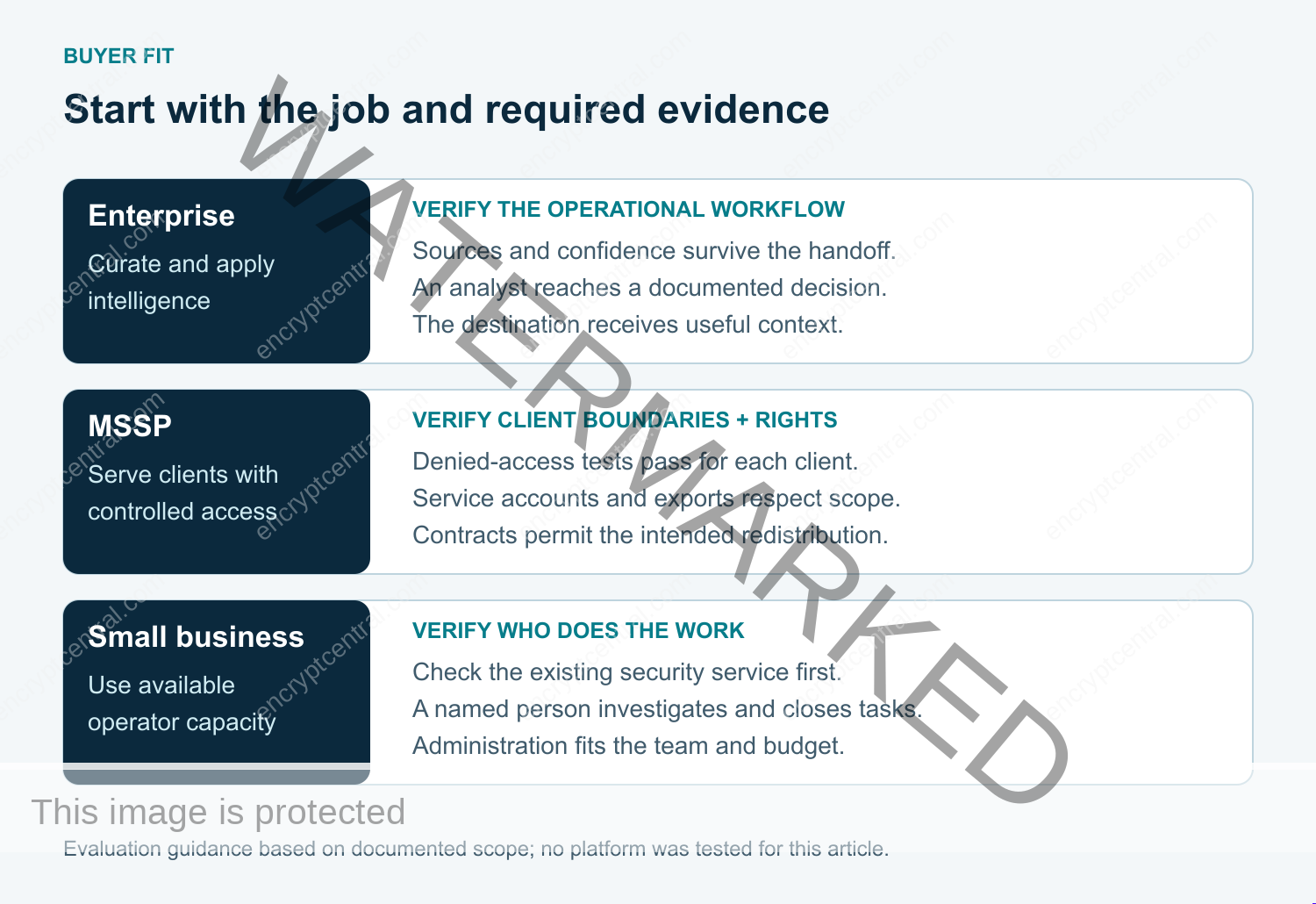
Use two or three real requirements to narrow the field. One might be a threat assessment for a business unit; another, enrichment of suspicious infrastructure; a third, distributing approved detection inputs to a security tool. Require the analyst to preserve source attribution, distinguish observation from assessment, and explain confidence. Check whether the destination retains enough context for the person who receives it.
Give deployment and governance equal attention. Establish where data, backups, logs, and support access reside; how privileged access is reviewed; and how a disabled feed or expired license affects retained intelligence. Request evidence for the proposed configuration. A broad claim about “data residency” cannot answer every storage, processing, and support question.
MSSP shortlist: prove client boundaries and usage rights
An MSSP should apply an access-and-licensing gate before scoring convenience. Can analysts work across clients while each customer sees only authorized information? Can a report, search result, API token, export, or integration reveal another customer’s details? Does the intelligence license permit the service you plan to deliver? Put those questions into the demonstration and the contract.
ThreatConnect’s owner model and OpenCTI’s organization controls are candidates for this evaluation, but their terminology cannot prove client isolation. OpenCTI explicitly describes organization segregation as an Enterprise Edition feature on a shared knowledge graph, distinct from independent multi-tenancy. A shared object’s changes can affect the version visible to other authorized organizations. That behavior needs to fit your service design.
Use synthetic Client A and Client B data. Test customer users, ordinary analysts, service accounts, and administrators. Attempt searches, dashboards, relationships, notifications, and exports from each role. Record the expected result before testing. Include an intentional negative test: information that Client B must not receive. Review whether privileged staff can bypass restrictions and how their access is monitored.
MISP sharing groups can be relevant when the service centers on a trusted exchange community. That still requires careful distribution design. Evaluate separate instances when client contracts or risk requirements call for stronger separation, and price the extra maintenance. Obtain written permission for feed redistribution and derived reports; technical ability to export data is not a license to resell it.
SMB shortlist: check the service already doing the work
For a small organization without an intelligence analyst, first inspect the capability in its existing SIEM, endpoint platform, or managed security service. Ask who investigates a relevant match, what the service returns, and which action remains your responsibility. The useful comparison may be between completing that workflow and operating an additional system.
For example, Microsoft Sentinel documents intelligence import and management through supported connectors and an upload API. The same documentation says the legacy TIP connector is being deprecated. A buyer using Sentinel should verify the supported integration path in its tenant and proposal, rather than accepting an old connector name as sufficient evidence.
Consider MISP when sharing with relevant partners is a specific requirement and someone can operate it. Consider OpenCTI when a structured knowledge workflow justifies its administration. Neither should be chosen solely because a license is open source. For a team seeking a managed outcome, ask providers to demonstrate the handoff from intelligence to investigation using the tools and responsibilities in your contract.
A sensible SMB pilot might cover one business risk, one source, and one destination. Define what the owner will receive and who closes the task. If the pilot produces more items than the team can investigate, reduce the scope before extending the subscription.
Where Cortex, GreyMatter, ZeroFox, and IntSights fit now
Earlier comparisons often mixed intelligence management with broader operations and external-risk services. Current scope matters more than keeping an old product list intact.
Cortex XSIAM describes a broad security-operations platform with analytics, incident management, threat intelligence, and automation. ReliaQuest GreyMatter is also positioned around security operations. Evaluate either against the operating model and coverage you intend to buy, including any wider consolidation decision.
ZeroFox emphasizes external threat monitoring, validation, and disruption. Rapid7 Threat Command describes digital risk protection and related investigation and remediation workflows. Those scopes can matter for impersonation, exposed information, or external threats, but require different success criteria from maintaining an internal intelligence knowledge base.
Rapid7 acquired IntSights in 2021. Buyers encountering the older name should request the current product, SKU, support position, and migration details from Rapid7. Do not use a historical acquisition announcement as proof that every old capability remains available under a current contract.
Run a 30-day evaluation with observable outcomes
The following is a proposed evaluation schedule, not a vendor benchmark or prescribed NIST program. Adjust it to your procurement and engineering process. Use authorized data, approved destinations, and a reversible configuration. Keep automated production blocking outside the initial evaluation unless separately approved and tested.
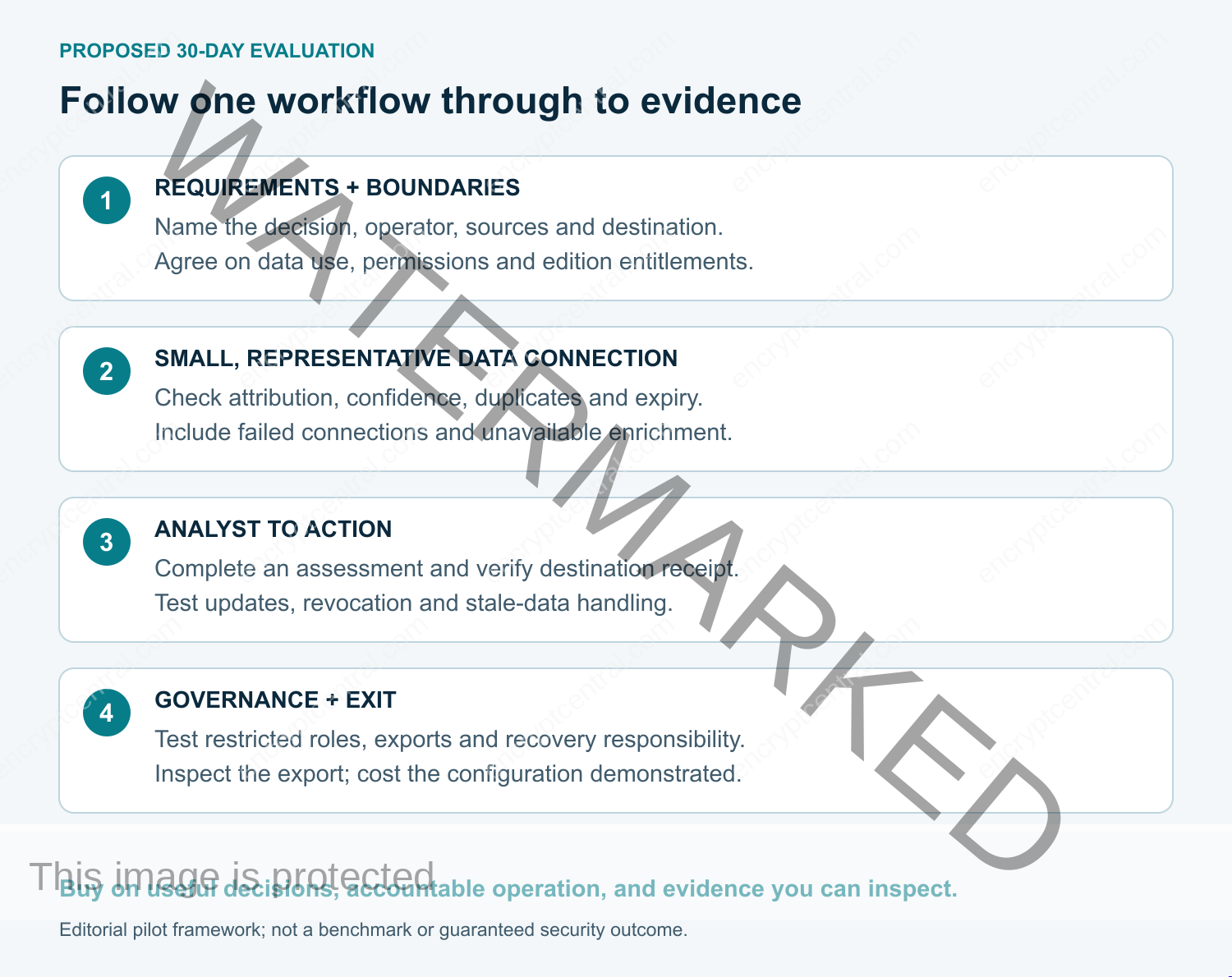
- Week 1: agree on requirements and boundaries. Select two or three decisions, record the current workflow, name an operator, and identify the necessary sources and destinations. Establish permitted data use, retention, sharing, and access. Record which capabilities the proposed edition includes.
- Week 2: connect a small representative dataset. Include useful, duplicate, expired, and irrelevant items. Check timestamps, attribution, confidence, relationships, and handling restrictions. Observe authentication failures, limits, queues, and unavailable enrichments. Verify that an import failure is visible to its owner.
- Week 3: complete the analyst-to-action workflow. Have a regular operator investigate a sample, make a documented assessment, and deliver the agreed output. Confirm receipt in the actual destination. Test an update and a revocation or expiry, so stale intelligence does not remain active unnoticed.
- Week 4: test governance and exit. Exercise restricted roles, exports, backup recovery responsibilities, and removal of access. Export representative intelligence and inspect what survives. Estimate recurring administration and review the commercial proposal against the demonstrated configuration.
Track active analyst effort, unusable items, lost context, failed deliveries, and time spent maintaining the connection. Define “useful” before counting it: for example, an item changed an investigation decision with a recorded reason. Compare the sample with the prior process. A short pilot can reveal workflow friction; it cannot establish universal detection accuracy or guarantee prevention.
Compare total cost and recognize failure signals
Request a line-item quote for the configuration you tested. Include software or subscription, intelligence modules, API access, feed licenses, hosting, storage, backups, support, deployment, connectors, and analyst time. For an MSSP, add client growth and redistribution rights. For any deployment, identify charges or work associated with export and termination.
This guide does not assign current prices or label vendors “cheap” or “expensive.” Public capability pages and an entry-level subscription are insufficient for a comparable total. Use EncryptCentral’s TIP RFP and pricing checklist to request equivalent proposals, and its OpenCTI versus MISP guide for a more focused workflow comparison.
Watch for a demonstration that ends at “data imported,” a connector nobody maintains, a feed whose permitted use is unclear, or an export that loses essential context. Other warning signs include an MSSP evaluation without a denied-access test, a queue without an accountable reviewer, and a proposal that omits the module used in the demo. Resolve these before treating a pilot as a buying recommendation.
If intelligence reaches a detection tool but nobody can verify the alert path, inspect the wider process using the logging and alerting failures guide. More intelligence cannot compensate for an unobserved delivery failure.
Choose the smallest shortlist that answers your requirements
Write one page describing the intelligence decision, available operator time, sources, destinations, and access boundaries. Use it to select two or three candidates from the relevant category. Ask each to complete the same workflow, expose the same limitations, and quote the configuration that was demonstrated.
Select the option your team can operate, govern, and verify. The strongest buying evidence is an understandable path from a relevant source to a recorded decision, with clear ownership and a workable exit. That is a firmer basis for procurement than the number of feeds, the length of a feature list, or an unsupported claim that one platform is best for everyone.
Related posts:
 Battle of Threat Intelligence Platforms: Cisco, ManageEngine, CrowdStrike, IBM, Security X-Force
 Comparing Top Cybersecurity Platforms: CloudSEK, Brandefense, Group-IB, Threat Intel Platform
 CrowdStrike Falcon® Intelligence: Automated Threat Intelligence Review
 Cisco Talos Intelligence Group – Comprehensive Threat Intelligence Review
 ZeroFox Threat Intelligence Services Review
 ReliaQuest GreyMatter Threat Intelligence Review


