


A mid-size business incident response plan needs to connect the people who see a problem with the people who can authorize action. That usually means coordinating internal IT, business service owners and outside providers across more than one shift. The useful output is an agreed operating plan: who declares an incident, who decides disruptive trade-offs, who accepts each handoff and what evidence permits recovery.
This guide addresses that coordination problem. “Mid-size” describes the operating situation here, not a legal employee-count classification: your organization has several teams and suppliers, but cannot assume a dedicated responder is available for every task. If one small team can manage the whole response, begin with our small-business plan template and drills. For definitions, use the incident-response overview.
Define the operating boundary around business services
Start with a service people depend on, such as customer ordering, payroll or case management. Identify its business owner, technical administrators, important data and suppliers. Add dependencies that sit outside the application team: identity, network access, hosting, payment processing or a managed integration. The plan must cover the decisions between these owners, not merely list their systems.
Write down the boundary of your authority. A managed service provider may administer your endpoints while a separate vendor controls the ordering application. Neither automatically owns the decision to interrupt trading. Conversely, a business owner may approve a service interruption without having the technical access to execute it. Record both decision ownership and execution ownership.
Keep continuity and recovery interfaces explicit. The incident lead coordinates the security event; another owner may activate manual order processing or a recovery procedure. Our continuity, disaster recovery and incident response comparison explains those boundaries. Reference the maintained plans rather than copying several conflicting versions into your incident document.
Build a response team people can actually staff
A practical core is an incident coordinator, an internal technical lead, the affected service owner and a business decision sponsor. Add communications, legal, privacy, HR and specialist responders when the incident calls for them. These are responsibilities to cover, not a requirement to hire a department for every role.
The NCSC guidance on creating a response team discusses virtual teams, deputies, coverage and supplier support. Its organizational advice is useful beyond the UK; its jurisdiction-specific reporting references are not being adopted here. Decide how named people can leave ordinary work to respond, and who covers their usual duties.
For each critical role, record a deputy, two agreed contact methods and the access needed to work. Check extended-hours coverage with the people and providers involved. An office-hours help desk, a monitoring service and an incident-response retainer are different arrangements. Use the actual agreement to establish what help is available and how it is activated.
Plan for a response that extends into another working day. Name someone who can take over coordination, not just technical investigation. Arrange secure workspace access, communication equipment and management support for the rotation. An impressive contact list is of limited use when every name depends on the same unavailable person.
Turn the role chart into a decision-authority worksheet
NIST SP 800-61 Revision 3, finalized in April 2025, integrates incident response with CSF 2.0 risk management. Its planning guidance includes documenting responsibilities and the authority needed to carry them out. Apply that principle to actual decisions rather than assuming a job title answers every question.
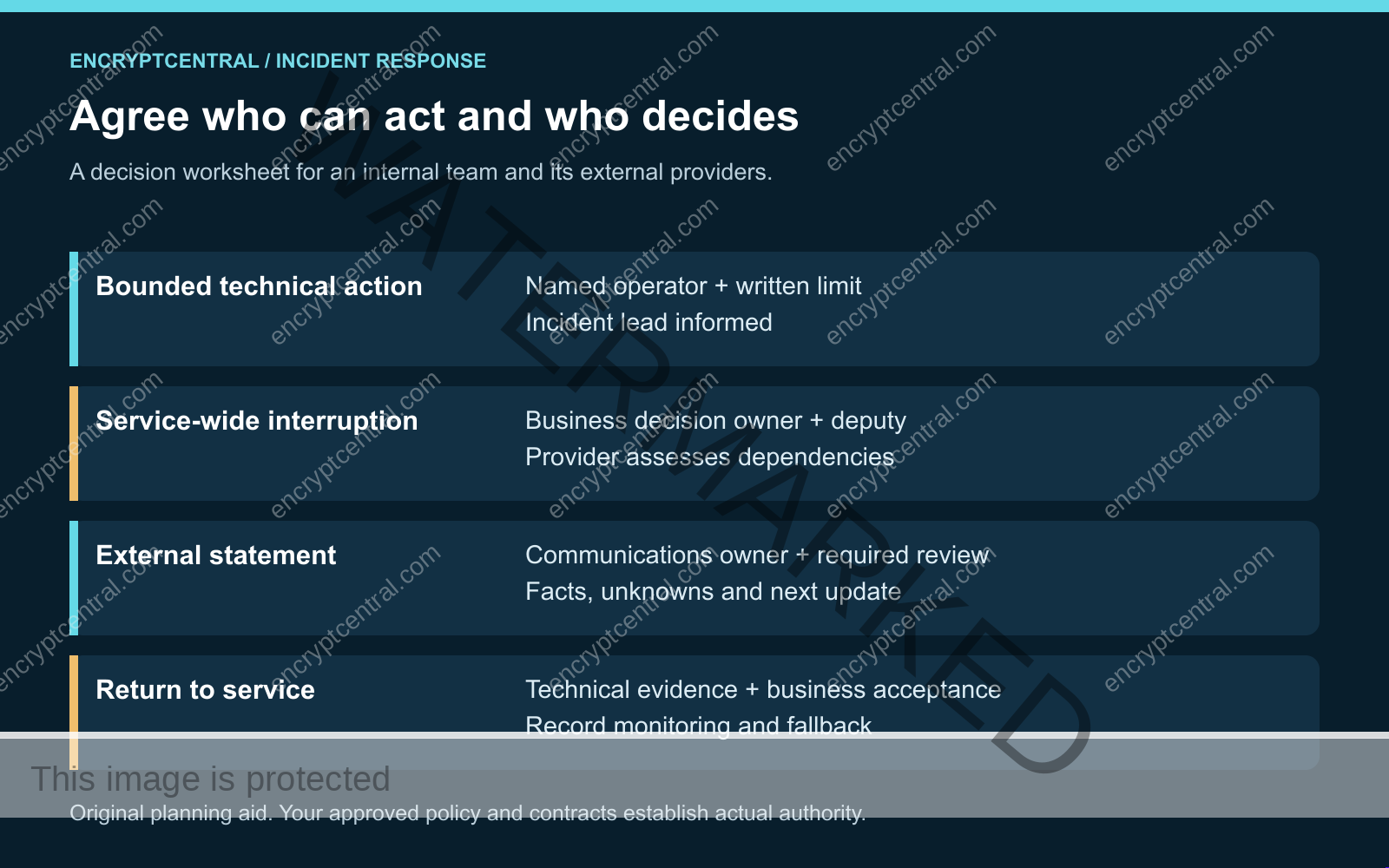
Create one worksheet row per important action. Use these fields: action and affected service; person allowed to execute; person allowed to approve; deputy; limit of delegated authority; required consultation; evidence of the decision; escalation route. Keep the wording specific enough that the provider and internal team would interpret it the same way.
- Bounded technical containment: identify the approved procedure, systems it covers and limits that require escalation. The article grants no authority to isolate or change a real system.
- Wider service interruption: name the business decision maker and the technical owner who explains dependencies and expected consequences.
- Emergency specialist engagement: specify who approves the work, who checks contractual requirements and who gives the specialist authorized access.
- External statements and service return: assign their separate reviewers and approvers; technical progress alone does not answer either decision.
For a fictional distributor, its endpoint provider might be permitted to take a narrowly defined action under an approved procedure, while interrupting warehouse ordering requires the operations sponsor or deputy. If the sponsor is unavailable, the plan should identify the fallback decision route. “Keep calling until somebody answers” is an unresolved authority gap.
Define activation and escalation as different decisions
Give staff and suppliers a reporting route that reaches someone responsible for assessment. Record what was observed, the affected service, the source of the report and the known operational effect. A report may justify urgent investigation without establishing every fact about the incident.
Define who declares the incident and when the wider team joins. Use triggers tailored to your services: credible unauthorized activity involving important access, unexplained changes to business data, or disruption with evidence suggesting a security cause. Have the qualified technical lead validate and reassess the report. Avoid making “complete proof of the entire attack” a prerequisite for raising concern.
Then distinguish requesting more response resources from raising a business decision to senior management. You may need specialist investigation without a company-wide crisis call; you may also need immediate business leadership because a proposed containment action affects a critical service. The NCSC planning guidance treats severity, escalation and critical decision authority as connected planning tasks.
Document when a case must be reassessed: new evidence, expansion to another service, an approaching business commitment or insufficient response capacity. Agree internal review targets appropriate to the business, but label them as your targets. A time printed in a template is neither a provider commitment nor a legal notification deadline.
Write a provider activation card before an emergency
Make one card for each provider that could be needed. Include the service and contract reference, urgent contact route, authentication process for an authorized caller, covered hours, scope of assistance and route when the first contact cannot help. Identify the internal owner who resolves cost or access questions.
Ask the provider to walk through a hypothetical activation. Who receives the case? What incident reference comes back? Who acknowledges ownership? How are additional suppliers brought in? Where can evidence be exchanged under agreed restrictions? Record the answers and any limits. Do not convert an informal sales statement into an emergency service guarantee.
Separate routine support from specialist work. A provider may restore availability while a forensic responder investigates the cause and scope. Assign an internal coordinator so neither team assumes the other is preserving records or assessing an information exposure. If the service agreement excludes an important capability, identify the gap and the approved fallback.
Make the acceptance point observable. “Ticket submitted” proves a request was sent; an acknowledged case with a named responder and agreed next action shows who has taken responsibility. Keep both records when they matter. An automated receipt alone may not mean a specialist has begun work.
Use an accepted handoff record across teams and shifts
Maintain one incident reference across the internal case, provider cases and management updates. The shared record can link to protected evidence rather than containing every sensitive attachment. Set access and retention through your organization’s approved process, with qualified help for evidence handling.
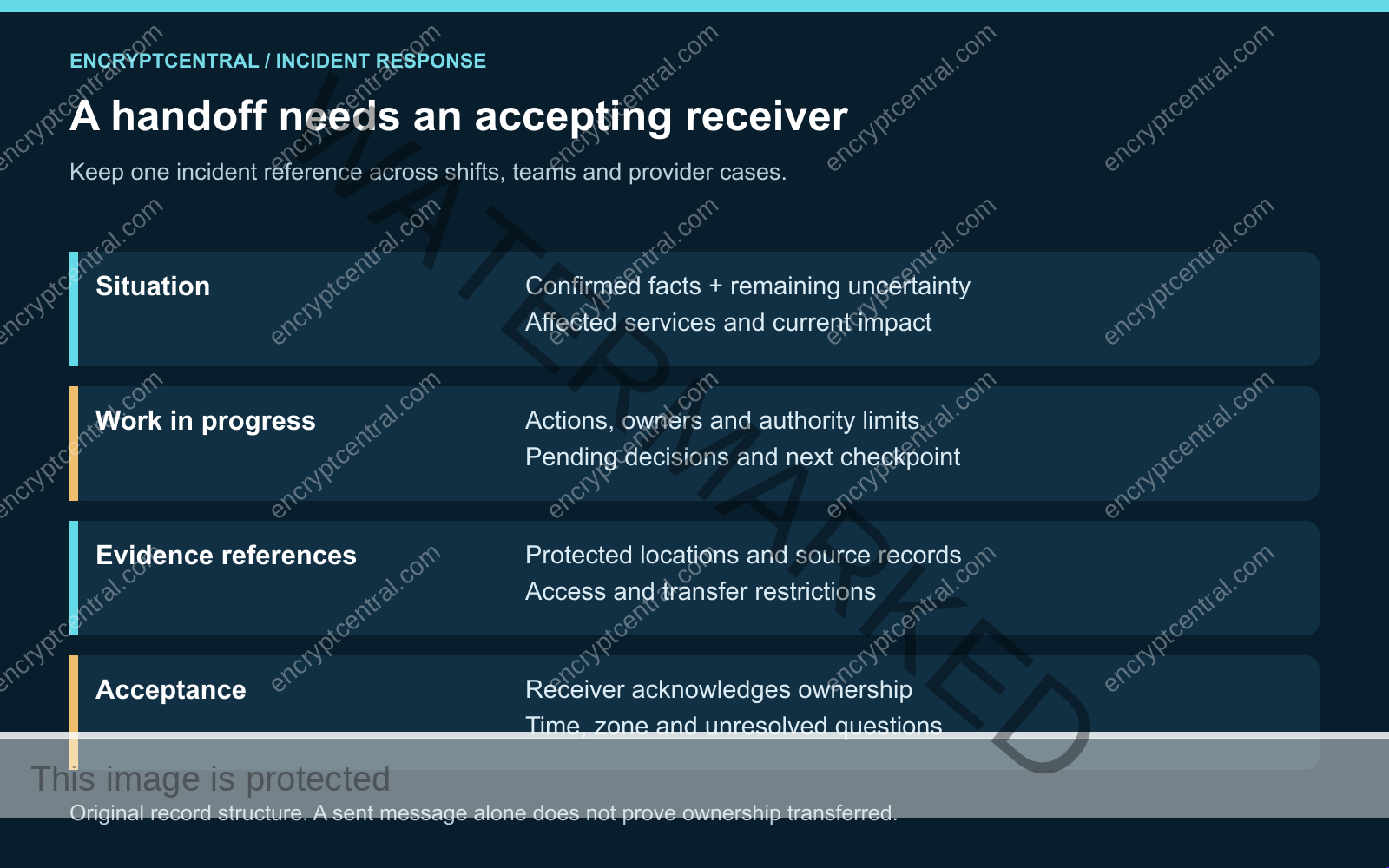
A workable handoff contains six things:
- Current situation: confirmed observations, their sources, affected services and the operational impact.
- Open uncertainty: hypotheses, unexamined systems and questions that could change the response.
- Active actions: owner, scope, approval, current state and expected next checkpoint.
- Pending decisions: the decision maker, options and consequences of waiting.
- Evidence references: controlled locations, access restrictions and collection or transfer ownership.
- Receiver acceptance: who takes over, when, in which time zone and what still needs clarification.
Before leaving the response, have the incoming coordinator explain the current priorities back to the outgoing coordinator. Resolve differences in interpretation and record the transfer. Keep a fallback if the incoming person cannot obtain access or reach a supplier. A calendar entry announcing a shift change is not the handoff itself.
Keep coordination separate from speculation
Choose a trusted coordination route that remains usable if the ordinary company channel is unavailable or suspected to be affected. Establish how responders verify participants, who may invite outside specialists and where restricted records belong. Keep emergency-access secrets out of broadly distributed contact lists.
Use a short situation update: incident reference; current business effect; confirmed facts; major unknowns; actions in progress; decisions needed; next update. Assign a person to reconcile technical findings before the update is issued. Conflicting tickets should remain visible until someone resolves them, rather than being silently combined into a confident statement.
The FTC’s breach-response guidance recommends specialist and legal involvement, evidence preservation and accurate communications. Have qualified counsel assess obligations for the actual data, entities, locations and contracts. Assign the review early; this guide does not establish a universal notification clock.
Preservation and urgent containment can compete. The operating plan should identify who makes that trade-off with qualified technical advice. It should not tell every employee to reboot, wipe or power down a device as a universal response. Keep environment-specific procedures under the relevant technical owner.
Walk through a fictional after-hours incident
Consider a fictional 450-person distributor with three locations, an internal IT team, an endpoint provider and a separate ordering-system vendor. At 18:10 local time, the endpoint provider reports suspicious activity involving an important account. Ordering remains available. These details and times are an exercise example, not a case study or response target.
The designated coordinator records the report as provisional, contacts the internal technical lead and uses the agreed activation criteria. The technical lead requests supporting information and assesses the affected access. The business service owner identifies which ordering functions could be disrupted by proposed containment. The team records who may authorize those changes.
Next, the ordering vendor says its support team cannot perform forensic investigation. The provider card makes that limit visible. The internal owner follows the approved specialist-engagement route, while the coordinator keeps the vendor’s service work and the investigation under the same incident reference. Nobody marks the exposure resolved because the application still works.
At shift change, the incoming coordinator receives the findings, unknown scope, approved actions, specialist case reference and pending decision about service interruption. They acknowledge ownership and agree the next checkpoint. The exercise succeeds when participants demonstrate these decisions and records, not when somebody guesses a technically clever fix.
Require technical evidence and business acceptance for recovery
Before restoration, agree the service-specific checks and who can accept them. NIST’s recovery guidance in Revision 3 addresses restoration-asset integrity, restored systems and essential business functions. Apply those outcomes to the actual service and incident; a completed restore job alone does not establish readiness.
Build an acceptance record with the recovery source, checks performed, results, remaining concerns, technical owner and business approver. Include necessary dependencies and monitoring. For an ordering service, a business check might follow an authorized test order through the relevant workflow, while technical owners assess the agreed security and platform conditions. That is a planning example, not a universal test script.
If a provider reports a repair, ask for evidence appropriate to the affected function and verify the result. Record any residual risk and who accepts it. Define a fallback if the restored service fails its checks or behaves unexpectedly. Use our backup and ransomware recovery preparation guide for the narrower recovery-testing job.
Keep investigation, notifications and longer-term corrective actions open where required after service resumes. Give each unfinished action an owner and review point. Operational availability and completion of every incident obligation are separate states to track.
Exercise the seams and verify technical capabilities separately
Run a discussion exercise with internal IT, a business owner, a decision sponsor and the relevant providers. Suggested injects include an unavailable sponsor, an untrusted email channel, a supplier that disputes scope and an incoming responder who lacks access. Use fictional data and keep live system changes outside the discussion.
Ask the participants to produce the provider acknowledgement, decision record, handoff and recovery acceptance criteria. These artifacts reveal where the plan depends on an assumption. Record whether each step was demonstrated, discussed only or blocked. Do not turn attendance into a readiness score.
The NCSC capability-maintenance guidance distinguishes exercises from checks of technical capabilities. Separately authorize practical checks appropriate to your environment, such as retrieving a permitted log sample or validating a selected recovery workflow. Record the tested scope and result without treating one successful check as universal proof.
Prioritize the gaps with the biggest effect on a real handoff. For each, name an owner, an agreed completion point and the evidence needed to close it. Review contact, coverage and authority records when people, suppliers or services change. Retest important repairs with the receiving team involved.
Method, limits and the first useful deliverable
This document-based guide was researched on October 27, 2026 using selected NIST, FTC and NCSC sources. The worksheets, record format and distributor scenario are original editorial adaptations. No company, provider contract, incident engagement, exercise or technical recovery was tested. Independent technical review remains pending; legal obligations and operational procedures require appropriate local review.
Begin with one critical service and its next difficult handoff. Produce a service boundary, an agreed authority row, a provider activation card and an accepted handoff record. Rehearse them with the people named in the plan. Expand only after the first service has a clear owner on both sides of every important decision.
Related posts:
 Small Business Incident Response Plan: Template and Drills
 What Is Incident Response, And How Do I Prepare For It?
 Lessons Learned from the CrowdStrike Outage: Building Resilience through Incident Response Planning and Disaster Recovery
 Business Continuity vs Disaster Recovery vs Incident Response
 Ransomware Recovery Plan: Test Backups Before an Attack
 NIST CSF 2.0 for Small Businesses: A 90-Day Roadmap


