


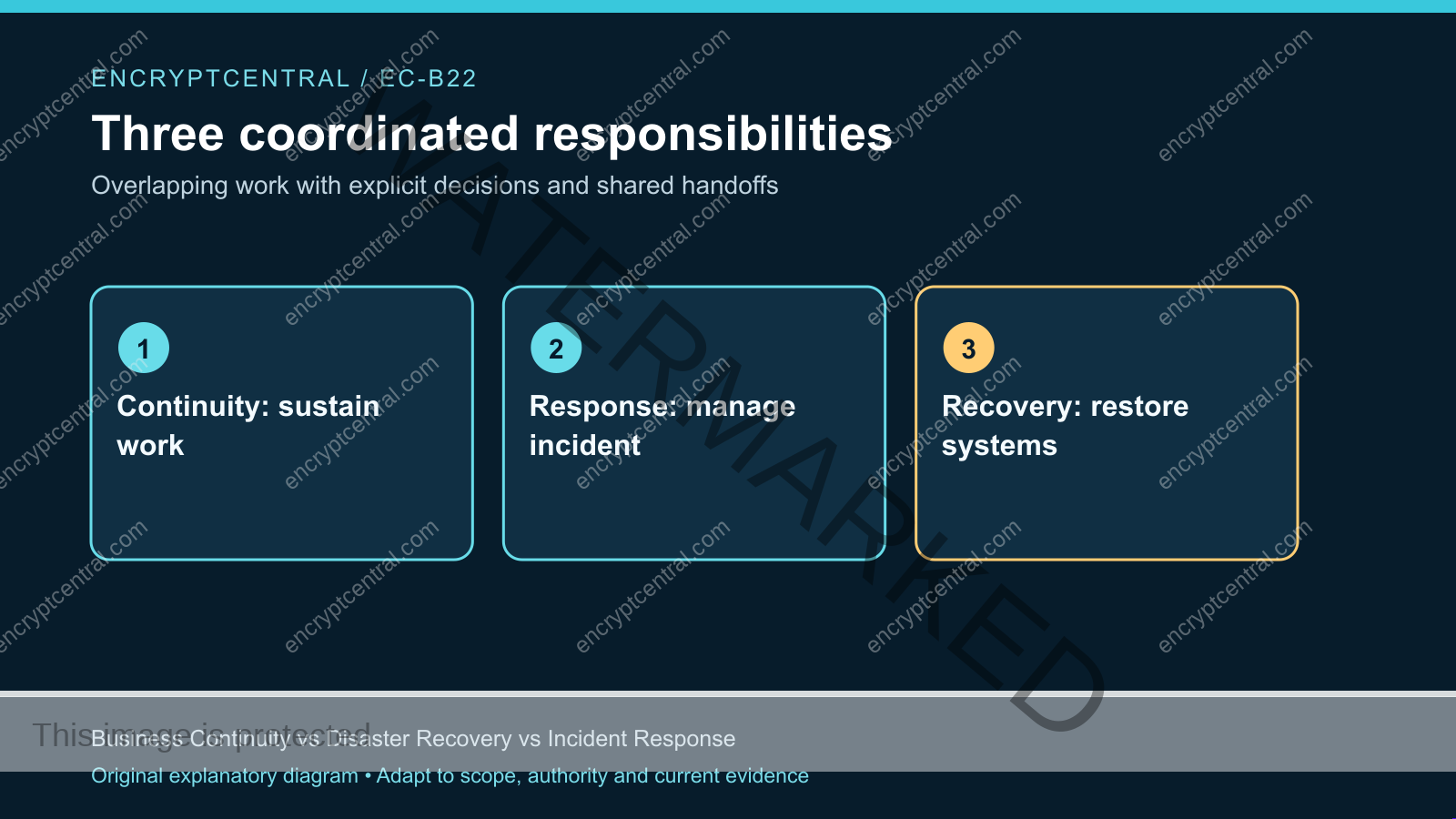
Business continuity keeps essential work moving during disruption. Disaster recovery restores the technology and data that work depends on. Incident response manages the security event, including investigation and containment. The plans overlap because one disruption can require all three, but their decisions and owners should be explicit.
A small company does not need three disconnected binders. It needs a service map, clear decision authority, and tested handoffs between the people sustaining operations, managing the incident, and restoring systems. This guide proposes that practical structure using official guidance reviewed on October 19, 2026. No company exercise or recovery test was performed for this article; technical review is pending.
Compare the work each plan owns
Imagine that your order-management service becomes unavailable while the security team investigates suspicious administrator activity. Sales needs a way to record urgent orders. IT needs to restore a trustworthy service. The incident lead needs to decide what can reconnect, what evidence must be preserved, and whether the suspicious activity is still active.
Those are related questions, but one answer cannot stand in for all the others. A manual order form can support continuity without restoring the application. A restored database can support technical recovery without establishing that the attacker has lost access. A completed investigation can clarify the event without resolving a backlog of orders.
| Discipline | Primary question | Typical decision |
|---|---|---|
| Business continuity | How do we sustain the essential service? | Activate a controlled workaround and set service priorities. |
| Disaster recovery | How do we restore the required technology and data? | Select and verify a recovery sequence. |
| Incident response | How do we manage this security event and its consequences? | Contain exposure, preserve evidence, and coordinate response. |
NIST SP 800-34 Revision 1 discusses relationships among contingency plans and the importance of evaluating operational priorities. It is a foundational planning reference published in 2010, not a current cloud configuration manual. Use its planning context while checking current implementation details for your actual services.
Start with one business service
Choose a service people can describe in terms of work completed: accepting orders, paying employees, dispatching technicians, or responding to customer requests. “The cloud” is too broad. A single application may also be too narrow if the business service depends on identity, messaging, payments, and a third-party integration.
Ask the business owner what stops when the service fails, who is affected, and what becomes more difficult as disruption continues. Include deadlines, contractual commitments, safety considerations where relevant, and the practical capacity of alternative processes. Avoid turning every system into the same highest priority; that leaves recovery teams without a usable sequence.
Then list dependencies. An application may be restored while its identity provider remains unavailable. A manual workaround may depend on the same email service that failed. A telephone escalation list may be stored only inside the locked-out tenant. These shared dependencies belong on the service map before anyone declares a fallback ready.
Define recovery targets as business decisions
Recovery time and acceptable data loss are often discussed as technical numbers. Treat them first as business requirements to be tested. Ask how long the service can operate in a degraded state and what information must be reconstructed if the latest usable recovery point is older than expected.
Write the assumptions behind each target. A four-hour objective may depend on a vendor response, a specific administrator, and access to clean credentials. If those assumptions are untested, record the target as an objective rather than a demonstrated capability. Do not convert a contractual service commitment into proof that your complete business workflow will recover within the same period.
The backup recovery testing guide addresses technical restore evidence in more depth. Here, use that evidence to inform the service-level decision. A successful file restore is useful, but the business owner still needs to know whether the restored service can process valid work.
Assign decisions before assigning tasks
Name an incident lead, business service owner, recovery lead, and communications owner. One person may hold multiple roles in a small organization, but write down which authority they are exercising. A backup operator should not accidentally become the person accepting business risk simply because they know how to click Restore.
For each important decision, identify who proposes it, who authorizes it, who executes it, and who receives the result. Examples include activating a manual process, isolating an application, restoring into a separate environment, reconnecting recovered systems, and returning from the workaround to normal operations.
NIST SP 800-61 Revision 3, finalized in April 2025, places incident response within cybersecurity risk management. That supports planning beyond the moment an alert fires. The role register and exercise below are proposed ways to make those relationships concrete, rather than a claim that NIST mandates this exact organizational chart.
Build a shared handoff register
Use a short register instead of copying whole procedures into three plans. Each row should identify a trigger, the decision required, the responsible authority, the evidence needed, and the next owner. Link to the detailed technical or business procedure where it already exists.
For the order-management example, the business owner might authorize a controlled manual intake process when the application is unavailable. The incident lead might require recovered systems to remain isolated until specified checks are complete. The recovery lead might provide evidence that the selected data and application version passed validation. The business owner then accepts a defined level of service, with the incident lead confirming the security conditions for reconnection.
Keep disagreement visible. If the business wants immediate reconnection and the incident team sees unresolved exposure, record the decision, evidence, constraints, and accountable risk owner. Do not hide that tradeoff inside an ambiguous “IT approved” field.
Design continuity workarounds with their own controls
A workaround changes how work is done and can introduce new errors. Decide which transactions it may handle, who can authorize them, where temporary records are stored, and how duplicates will be detected when normal service returns. Restrict access to the people who need it.
For example, a temporary order sheet should have a unique transaction identifier, a named recorder, a review step, and a reconciliation owner. Avoid an uncontrolled shared document containing more customer information than the workaround requires. Agree on how long the temporary process may continue before capacity or quality becomes unacceptable.
Also test the tools the workaround uses. A paper procedure may be more independent than a cloud form during a tenant outage, but it creates storage and reconciliation responsibilities. A second software service may be convenient but share the same identity or network dependency. Independence is a property to inspect, not a label to assume.
Rehearse one disruption across all three teams
Begin with a tabletop that follows a single service through an uncertain security incident. Provide a starting condition, then introduce developments: normal administrators cannot sign in, the latest backup is not yet validated, a key supplier is unreachable, or customers need an update. These are hypothetical exercise inputs, not claims about your current environment.
Ask each role to state its next decision and the evidence it needs. Record missing contacts, circular dependencies, unclear authority, and assumptions about vendor support. A good exercise can reveal that a plan is incomplete without putting production systems at risk.
Follow with authorized technical checks for the most important assumptions. Verify that the recovery credentials are reachable, a selected restore works in the agreed environment, the communication route reaches its owner, and the continuity records can be reconciled. A tabletop establishes understanding; these checks establish whether the underlying mechanisms operate as expected.
Define return-to-service criteria
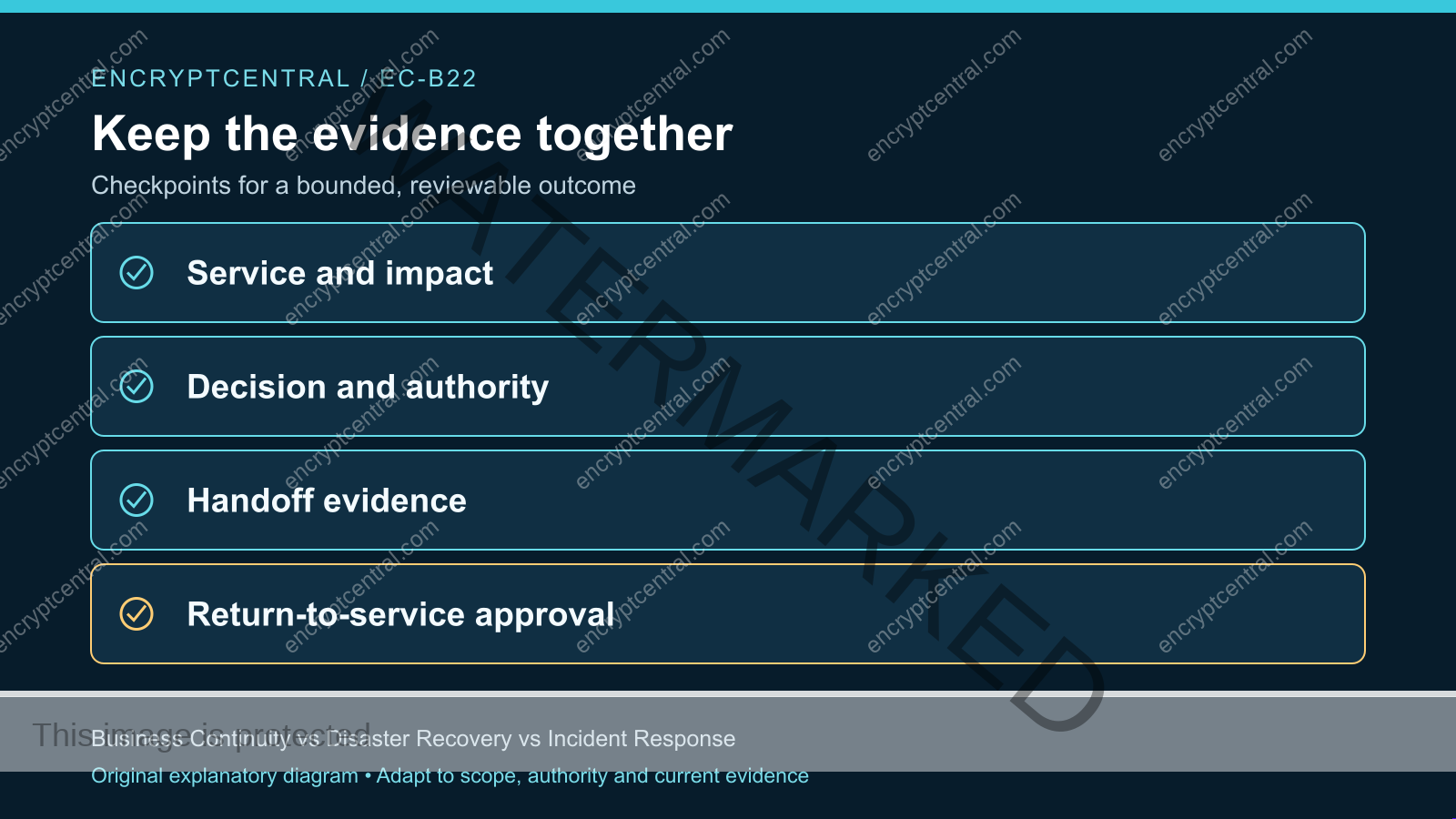
Return to service is a joint decision. The recovery lead should report what was restored and how it was tested. The incident lead should identify remaining security concerns and the conditions for reconnection. The business owner should validate the workflow and accept any temporary limits.
Write the criteria before a crisis where possible. They might include successful authentication for approved roles, valid transaction processing, restored monitoring, reconciled data, approved supplier connectivity, and a documented rollback route. Select criteria relevant to the service instead of copying a universal checklist.
Remember the work accumulated during disruption. Reconcile manual transactions, notify affected teams about changed processes, and close temporary access when it is no longer needed. A server can be healthy while the business remains behind or while a temporary emergency exception stays open.
Failure modes to remove from the plans
Three plans name three incident commanders. Resolve overall coordination and the boundaries of specialist authority. Multiple leads can work together, but conflicting authority during containment and recovery must have an escalation path.
The recovery plan starts by using the failed identity service. Identify independent administrative access, credential custody, and the people authorized to use it. Verify the access path in a controlled drill.
The continuity plan assumes unlimited manual capacity. Estimate the workload the workaround can handle and identify the point where the business must prioritize, pause, or communicate reduced service.
Completion means the application responds to a health check. Add a business transaction and its downstream result. Technical availability and useful service are related but different observations.
Practical questions for a small organization
Can the plans live in one document?
Yes. A combined document can work well when the service map, decision authorities, and specialist procedures remain easy to find. Organize it around the reader’s next decision rather than three large sections that repeat contacts and conflict when one changes.
Does every disruption need incident response?
Not every outage is a cybersecurity incident. Establish a triage path for deciding when security involvement is needed, including uncertainty about the cause. Continuity and technical recovery may begin while the incident status is being assessed, subject to agreed evidence and safety constraints.
How often should we rehearse?
Choose a cadence that reflects service criticality and change. Repeat relevant checks after major application, supplier, identity, or staffing changes. An old annual calendar entry should not be the only reason a materially changed recovery path is considered current.
Give one service a complete decision path
Keep an offline or independently reachable copy of the essential decision register and contact routes, according to your organization’s information handling rules. Test that an authorized alternate can find it without relying on the disrupted application. Record who maintains the copy and how changes are synchronized so independence does not produce an outdated emergency plan.
After an exercise or real disruption, review the decisions that were delayed or reversed. A useful finding describes the missing dependency or unclear authority, its effect on the service, and a proposed correction. Assign the correction to a person and verify it in the next targeted check. Counting completed exercises without following those repairs leaves the same operational obstacle in place.
Choose one service, map its dependencies, and assign the decisions that connect continuity, response, and recovery. Rehearse those handoffs and convert the findings into specific repairs with owners. Keep unverified recovery objectives clearly distinguished from demonstrated results.
Use the incident response introduction for foundational context and the CrowdStrike outage lessons as a separate case discussion. Your plan becomes useful when a person can find the next decision, reach its owner, and show the evidence needed to proceed.
Related posts:
 Lessons Learned from the CrowdStrike Outage: Building Resilience through Incident Response Planning and Disaster Recovery
 What Is Incident Response, And How Do I Prepare For It?
 Ransomware Recovery Plan: Test Backups Before an Attack
 What Is Cyber Insurance, And Should My Business Have It?
 How do we align our cybersecurity strategy with our business objectives?
 Smishing, Vishing, and Mobile Phishing Response Guide


