


An enterprise incident response plan must establish how local teams act, how the organization coordinates a wider incident and who decides trade-offs that affect several business units. Its core is a set of decision rights and working interfaces across regions, legal entities, suppliers and shared services. A larger contact list cannot resolve competing shutdown requests or determine whether a recovered component is safe for another unit to use.
This guide focuses on that enterprise operating model. It assumes multiple response teams or business units with meaningful local responsibilities; “enterprise” is not a legal size classification here. For a single small team, use our small-business response plan and exercises. Our incident-response overview covers the foundational concepts.
Choose a command model that respects real boundaries
Begin with the organization you actually operate. List business units, regions, subsidiaries, major technology services and external operators. Identify who owns local response, who coordinates enterprise risk and which decisions remain reserved to particular business or legal authorities. Include acquired businesses whose systems and permissions may not match the parent organization’s assumptions.
NIST SP 800-61 Revision 3 is the April 2025 guidance that connects incident response with CSF 2.0 risk management. Its discussion of multiple response teams describes coordination through a common entity or federation. Use that principle to establish consistent information and decision interfaces while defining the authority retained by each team.
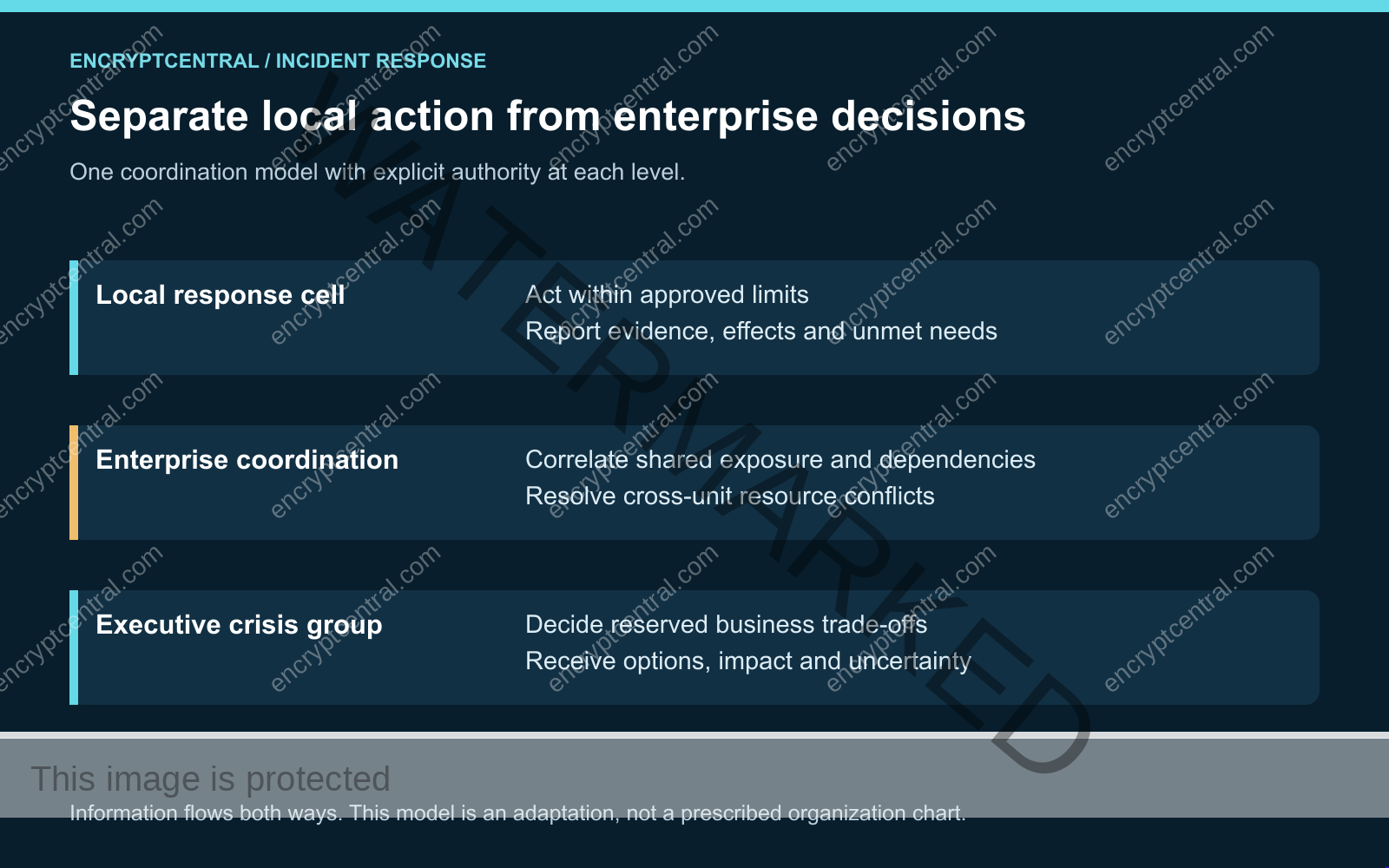
A practical model has local response cells, an enterprise coordination function and an executive crisis interface. These are functions, not prescribed department names. A local cell assesses and handles its assigned environment. Enterprise coordination reconciles shared exposure, dependencies and resource conflicts. The executive interface resolves business trade-offs reserved to senior authority.
Define how the functions connect before an incident. State what a local team reports, when another team joins and who can change the coordination arrangement. Include a fallback when central communications or normal identity services are unavailable. Central coordination should have a documented purpose beyond inviting more people onto a call.
Write decision rights before drawing the escalation chart
For every consequential decision, distinguish the person recommending an option, the person authorizing it and the person executing it. Add affected service owners and required specialist review. A person accountable for an outcome may lack the authority to make changes in another subsidiary’s environment; the plan needs an agreed interface for that case.
Use three decision lanes as an original planning aid:
- Local decisions within approved boundaries: actions the local team may take under its own authorized procedures, with specified reporting and escalation conditions.
- Cross-unit coordination decisions: priorities, sequencing and resource allocations that require agreement among affected teams or the enterprise coordinator.
- Reserved business decisions: wider operational interruption, exceptional expenditure, external commitments and risk acceptance requiring the designated business authority.
For each lane, record the boundary, trigger, primary authority, deputy, required inputs, execution owner and decision record. Define emergency fallback authority explicitly. Do not let “urgent” become an undocumented exception that grants a central team control over every environment.
For example, the right to act on one endpoint should not silently imply authority to interrupt a shared identity service. An enterprise plan should make that distinction visible to local responders, service owners and outside providers. The example identifies a decision boundary; it does not authorize a technical action.
Create one situation picture without flattening uncertainty
Give the enterprise incident one reference, with linked local and supplier case references. Agree a minimum reporting format across units: observed event, source, time and zone, affected service, current impact, confidence, action owner and next checkpoint. Retain the origin of each report so another team can evaluate it.
Separate observed facts, working interpretations and unknown scope. A local team’s “no evidence found” statement should include what was checked and what was unavailable. It should not be compressed into “the region is clear.” Likewise, a vendor incident notice is an input to assessment, not proof that all your business units are compromised.
The NCSC incident-process guidance describes central coordination and the tracking of findings, tasks and decisions. Build a concise enterprise situation report from those records, rather than asking every team to create a different slide presentation under pressure.
Choose severity criteria tied to business effects and exposure. Local labels may differ, so translate them into common decision needs: additional resources, another unit’s involvement or a senior business decision. Reassess when scope, dependencies or impact changes. Document who can challenge a classification and how disagreement is resolved.
Plan for the shared-service decision nobody owns alone
Identify the services that cross organizational boundaries: identity, network transit, cloud platforms, shared data services, customer support or a common transaction system. For each, maintain a short dependency record with consuming units, technical owner, business owners, support contacts and important limitations.
Then ask which incident decisions could affect those consumers. Who assesses the consequences of a proposed interruption? Which units must supply input? Who decides when priorities conflict? What can a local team do safely within its own boundary while a wider decision is pending? Resolve those questions with the service owners during preparation.
Consider a fictional retailer operating in three regions with a shared identity service. One region reports suspicious privileged activity while another is processing a time-sensitive trading batch. The local report does not establish the full incident scope. Enterprise coordination needs the technical assessment, affected access, service dependencies and business consequences of the available options.
In this exercise, the identity owner presents options and their limits; regional owners explain operational effects; qualified responders advise on the security risk; the designated authority records the decision. Local teams continue authorized work within their boundaries. The purpose is to demonstrate a defensible decision process, not to prescribe a global shutdown.
Keep continuity and recovery leaders connected to that decision. They may propose alternative operating arrangements or restoration paths, but should not receive conflicting instructions from separate response bridges. Use the continuity, recovery and incident-response comparison to establish the plan interfaces without merging every responsibility into incident command.
Control evidence access across regions and entities
Determine in advance where incident records and evidence are held, who may collect them and who may receive them. Involve legal, privacy, security and relevant local owners in approving the process. Do not assume that a central investigation request settles every access, contractual or jurisdictional question.
NIST’s Revision 3 profile addresses the integrity, provenance and protection of response records and incident evidence. An enterprise can implement that outcome through a common evidence-reference format while keeping restricted material in an approved location. A situation report can identify a finding and its owner without attaching the underlying sensitive dataset.
For a proposed transfer, identify the purpose, sender, recipient, data involved, access controls, applicable review and approved destination. Have the responsible specialists resolve restrictions for the actual case. This is a governance worksheet, not a determination of cross-border law or a claim that a particular transfer is permitted.
Preserve corrections and the history of important findings. If a local team later revises the affected account list, update the enterprise assessment with the reason and source. Avoid overwriting the original interpretation without a trace. Different time zones and inconsistent event clocks also belong in the investigation record, not in an unexplained reconstructed timeline.
Give suppliers a defined place in the command structure
Map which suppliers detect activity, operate infrastructure, perform specialist investigation or assist with communications. Document who activates each service, the contracted scope, covered hours, authorized access and internal owner. Verify terms rather than assuming a global enterprise agreement provides every local entity with identical support.
A supplier may coordinate its own response without controlling your business decisions. Specify the information and acknowledgements expected at the interface: provider case reference, assigned responder, requested action, authority limits, evidence-exchange route and next update. Distinguish a service provider’s internal recovery decision from your acceptance of the service for your own use.
The NCSC team guidance discusses distributed staffing, deputies, coverage and supplier arrangements. Choose coverage deliberately. “Follow the sun” is a staffing arrangement to establish and rehearse, not a promise created by having offices in several time zones.
For extended incidents, plan relief for coordinators, investigators and decision makers. Check that incoming people can reach the relevant records, facilities and specialists. Identify who reallocates scarce responder capacity when two business units need help at once, and who resolves a supplier request beyond the contracted scope.
Make command handover an explicit transfer of responsibility
A regional or shift handover should explain the current objective, known exposure, ongoing actions, unresolved decisions, stakeholder commitments and upcoming checkpoints. Include the coordination boundary: which teams remain locally led and which actions require enterprise agreement.
Require the incoming lead to acknowledge the transfer and restate the highest-priority decisions. Record the effective time and zone, outgoing and incoming leads, affected workstreams and unresolved access problems. Keep the outgoing lead available under an agreed transition arrangement where feasible; avoid leaving ownership implied by a meeting invitation.
Use a separate decision queue for items requiring senior authority. Each entry should state the question, options, expected business effects, uncertainty, recommended course, decision owner and review point. This helps a new leader understand why an action is pending without repeating the whole investigation.
Establish a trusted alternative coordination route if the primary channel is affected. Define participant verification, permission to invite suppliers and the boundary between general updates and restricted investigation material. Test those arrangements through authorized preparation rather than circulating emergency-access secrets in a command briefing.
Accept recovery by business service and dependency
Design recovery acceptance around the complete service people need. Identify prerequisite systems, the checks required at each boundary and the owners who accept the result. A rebuilt regional application may still depend on identity, integrations or data whose status is unresolved.
Use an original service-acceptance record with these fields:
- Scope: service, region, users and functions covered by this acceptance.
- Prerequisites: dependencies and recovery sources reviewed, with their evidence references and owners.
- Validation: authorized technical and business checks, actual results, exclusions and outstanding concerns.
- Decision: technical recommendation, business acceptance, any approved exception and the reason.
- Continued operation: monitoring owner, fallback conditions and the next review point.
Sequence acceptance using the real architecture and current incident assessment. The illustrative diagram below is not a universal restoration order. If identity is a prerequisite in your service path, establish its relevant status before interpreting a successful application login as proof that the whole service is ready.
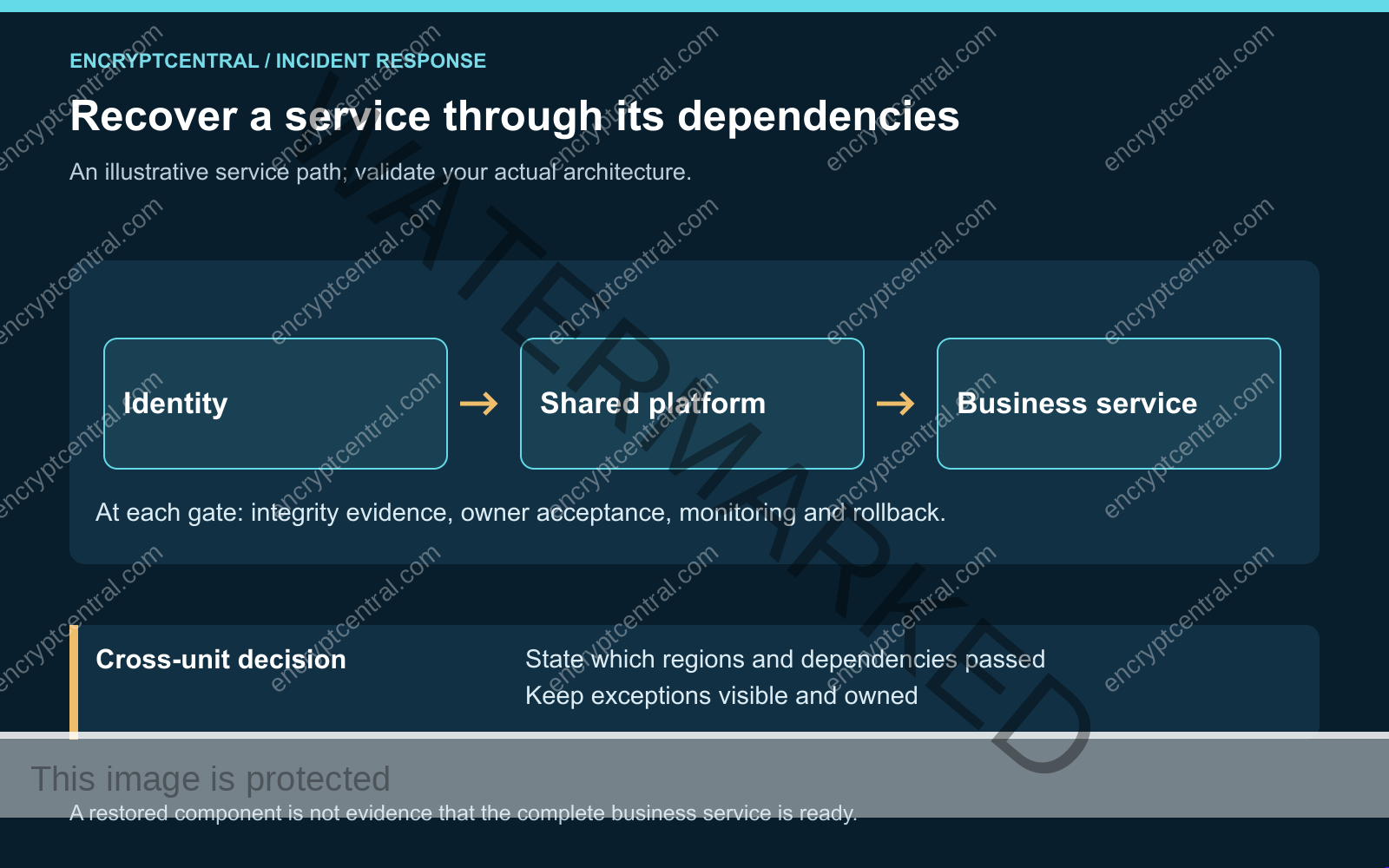
Track acceptance separately for affected regions or functions. A limited return to service should state its limits, rather than produce one enterprise-wide green status. Keep residual investigation, legal review and remediation visible after availability returns. Refer technical teams to the backup and ransomware recovery preparation guide for that narrower testing scope.
Keep executive decisions and external communications connected
Give executives the decision they need to make, the business consequences and the uncertainty that matters. A list of technical alerts rarely supplies those inputs. Conversely, ensure that an executive decision reaches the technical owners who must implement it, with its scope and conditions intact.
Keep incident coordination, public statements and formal notifications as related but distinct workstreams. The FTC breach-response guide advises businesses to involve appropriate specialists and legal counsel and avoid misleading communications. Have designated reviewers assess applicable obligations for the affected entities and information.
Create an obligations register with the responsible reviewer, affected audience, decision trigger, factual inputs, applicable requirement and status. Qualified counsel must determine the actual rule and deadline. A single template timer cannot establish obligations across an enterprise’s sectors, contracts and jurisdictions.
Use consistent facts across local and central messages while preserving necessary audience differences. Record what was approved, by whom and when. Do not describe a restoration milestone as a completed investigation or make a “no data affected” statement merely because the business can operate again.
Exercise local, enterprise and executive interfaces together
Use a fictional shared-service incident to exercise three levels of decision making. Have a local team report uncertain privileged activity, ask enterprise coordination to assess dependencies, and present a consequential business choice to the designated executive authority. Include suppliers where their agreements and participation make that useful.
Introduce one constraint at a time: an unavailable regional lead, a supplier with limited scope, a request for restricted evidence, a second affected service or a recovery check that passes in only one region. Ask participants to produce the actual decision record and acceptance criteria instead of agreeing that they would “coordinate.”
The NCSC maintenance guidance discusses exercising leadership and suppliers as well as checking technical capabilities. Keep a discussion exercise separate from authorized technical validation. A confident explanation of log collection does not establish that the required records can actually be retrieved.
Evaluate observable outcomes: an authority conflict resolved, a restricted request routed to review, an incoming lead accepting command, or a service return held pending evidence. Record what was demonstrated, what was only discussed and what remained unavailable. Give each repair an owner and a verification step.
Find failures in the command model before adding more process
Look for a central coordinator with responsibilities but no agreed authority; local teams that cannot explain their permitted boundary; suppliers whose acknowledgements do not name an owner; or executive decisions that never reach the service operator. These are specific defects to repair, not reasons to add another general policy document.
Also inspect the recovery record. If every component is marked restored but nobody has accepted the end-to-end business function, the acceptance model is incomplete. If one region’s result has been generalized to the whole company, recover the missing scope detail. If a common picture hides uncertainty, return to the source records.
After an exercise or incident, revise the relevant interfaces and retest the failures. Preserve useful local differences while standardizing the information required to coordinate. Expansion, acquisitions, supplier changes and redesigned shared services are reasons to revisit the model rather than assume the old command chart still applies.
Method, limits and the next enterprise planning decision
This is a document-based guide researched on October 27, 2026 against selected NIST, FTC and NCSC material. The command model, decision lanes, retailer scenario and acceptance worksheet are original editorial adaptations. No enterprise exercise, incident engagement, provider arrangement or technical recovery was tested. Independent technical review remains pending. Sector obligations, evidence handling and operational safety need qualified review for the actual organization.
Start with one shared service that affects several business units. Agree its local action boundaries, central coordination trigger, reserved business decisions and recovery acceptance owners. Rehearse a difficult choice with those people present. That produces an enterprise plan your teams can use when a decision crosses the boundary between them.
Related posts:
 What Is Incident Response, And How Do I Prepare For It?
 Small Business Incident Response Plan: Template and Drills
 Incident Response Plan for Mid-Size Businesses
 Lessons Learned from the CrowdStrike Outage: Building Resilience through Incident Response Planning and Disaster Recovery
 Business Continuity vs Disaster Recovery vs Incident Response
 Enterprise AI Governance: Building Comprehensive Risk Management Frameworks


