


Direct answer: Detect security misconfiguration by comparing a versioned, approved baseline with what is defined, deployed, exposed, and operating in each environment. Remediate the root setting under change control, deploy through the normal path, read back the saved and runtime state, and preserve a regression check. A scanner alert, clean deployment, or header grade alone is not proof that the configuration is secure.
What to do first
- Inventory the application and every configurable layer that can change its security behavior.
- Record exact desired values, component versions, owners, exceptions, and verification methods.
- Compare source, deployment artifacts, runtime state, external behavior, and telemetry.
- Prioritize drift by reachable consequence, privilege, data, blast radius, and evidence confidence.
- Fix through the controlled delivery path, verify independently, and turn the check into regression evidence.
This is a planning and verification guide, not a report about a tested target. No application, cloud account, server, container, repository, pipeline, policy engine, scanner, or production control was inspected for this article. Test only systems you own or are authorized to assess. Use a controlled nonproduction environment when a check could change data, availability, access, cost, or trust relationships.
What security misconfiguration means
OWASP A02:2025 Security Misconfiguration covers systems, applications, and cloud services whose security-relevant settings create exposure. Examples include unnecessary features, default accounts, excessive privileges, permissive cloud storage, verbose errors, disabled security features, weak framework or database settings, and missing or unsafe client directives. The category moved to A02 in the 2025 list, but its rank is not a remediation order for your environment.
The important distinction is between a known desired state and an observed operating state. A team cannot reliably detect drift if it does not know which component and version it is evaluating, which value was approved, why it was selected, who owns it, and how the value will be verified after deployment.
A security setting can also be wrong without being globally “insecure.” A public API may intentionally allow cross-origin requests from any origin; a private administration interface should not. A cache policy suitable for public documentation may expose protected account data. A benchmark recommendation may reduce attack surface but break a required workload. Security comes from matching a tested baseline to the system’s actual trust boundaries and business job.
EncryptCentral’s OWASP Top 10:2025 fix-first guide explains how to prioritize category-level work. This checklist goes deeper on the A02 operating process: inventory, baseline, drift detection, controlled repair, and evidence.
1. Inventory the whole configuration boundary
Start with one application or service and one deployment path. List the environments, public and private hosts, APIs, administrative surfaces, workers, scheduled jobs, data stores, queues, caches, secret stores, cloud resources, network controls, images, packages, infrastructure modules, and delivery tools that influence it. Record the exact version or immutable artifact identifier where possible.
Then assign an owner to each layer. “Platform team” is not enough if nobody is accountable for a database parameter, object-storage policy, container capability, feature flag, identity role, or gateway rule. Include the people who can approve a change and the people who can verify the operating result.
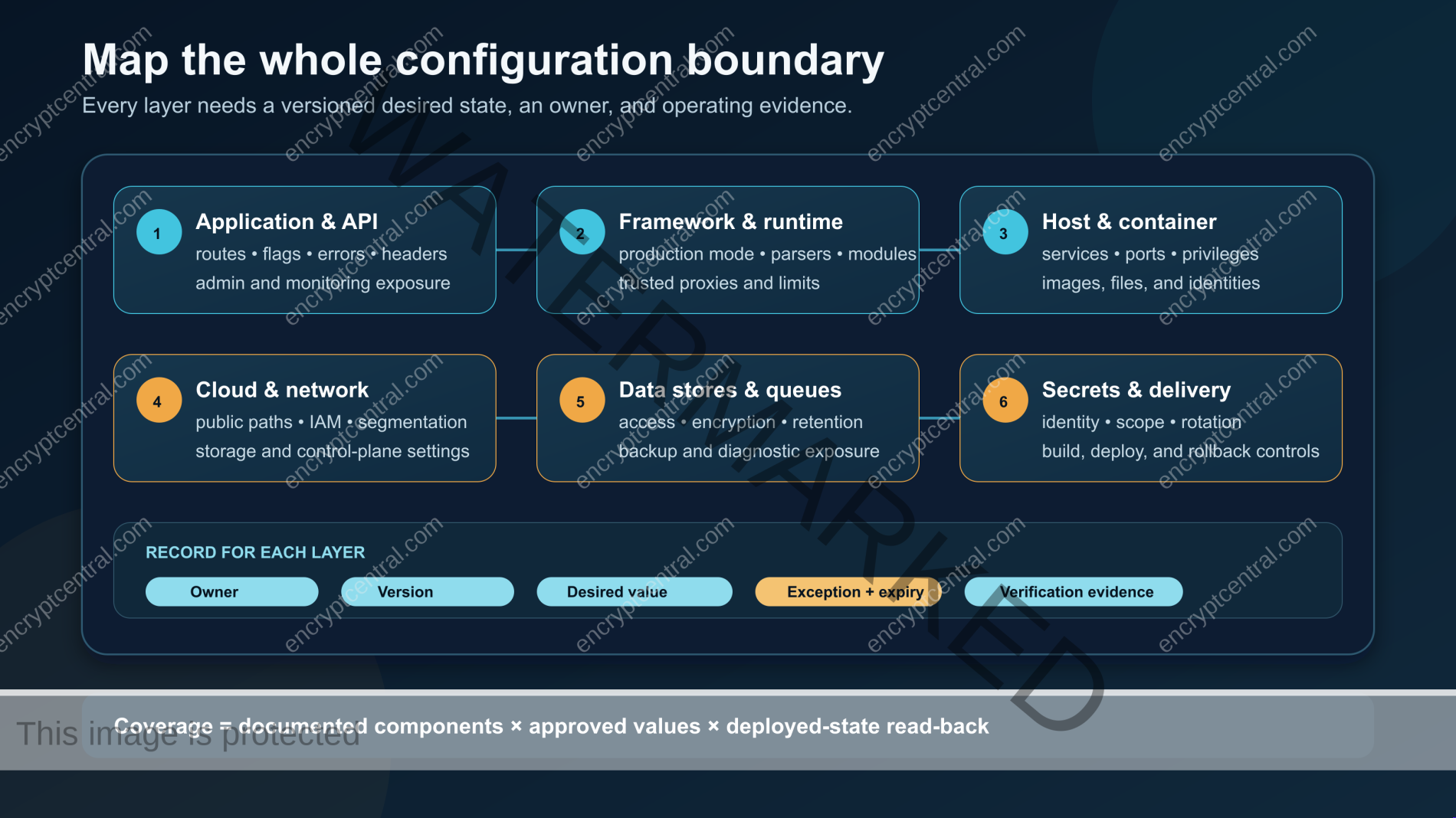
The inventory must include alternate paths. A hardened primary hostname does not cover a legacy hostname, direct load-balancer address, staging host, regional endpoint, mobile API, file origin, monitoring interface, or backup bucket. Include non-HTTP surfaces as well as the application’s web routes.
2. Write a versioned desired-state baseline
For every material setting, record the component and version, exact desired value, security purpose, source of guidance, supported exceptions, owner, enforcement point, verification method, and last verified date. If the setting is inherited, record where inheritance originates and how the effective value will be read back.
NIST SP 800-218, the Secure Software Development Framework, calls for software to have secure settings by default and for teams to test that settings work as expected without causing security weaknesses or operational problems. NIST SP 800-128 adds the configuration-management process: establish baselines, control changes, monitor state, and retain required business functionality.
Use product- and version-specific guidance when the platform offers it. CIS Benchmarks provide prescriptive recommendations across operating systems, cloud platforms, containers, databases, network devices, and other product families. Record the exact benchmark, version, and profile. Test recommendations in a representative environment and document tailoring; do not label an untested mass application of settings as hardening.
Exceptions belong inside the baseline, not in chat messages or someone’s memory. For each exception, record the business need, affected assets, compensating controls, approver, evidence, review date, and expiry. An exception without an owner and expiry is a second baseline competing with the first.
3. Detect drift from five evidence views
No single evidence view is sufficient. Compare all five:
- Declared source: configuration files, infrastructure as code, policy definitions, templates, feature-flag rules, image recipes, and secret references.
- Delivery artifact: the built image, deployment manifest, release bundle, generated plan, and approved change record.
- Saved platform state: the configuration the framework, cloud control plane, database, gateway, or identity system reports after the write.
- External behavior: exposed ports and hosts, response headers, error behavior, public files, administrative routes, cross-origin behavior, access decisions, and transport properties.
- Operating evidence: startup logs, policy evaluation, configuration-drift alerts, denied actions, health data, and the absence or presence of expected security events.
A declared value can be overridden later. A successful pipeline can deploy to the wrong account. A control plane can accept a value that a running process never reloads. An external scan can see a symptom without identifying the source. Reconciliation across these views turns a suspicion into a reproducible finding.
The OWASP Web Security Testing Guide lists version 4.2 as stable while 5.0 remains in development. Its stable test catalog separates configuration and deployment checks from authentication, authorization, error handling, cryptography, client-side behavior, business logic, and APIs. Record the WSTG version when you use a test identifier; do not silently mix a development page with a stable acceptance baseline.
4. Run the security misconfiguration checklist
Application and API
- Confirm production mode is active and development routes, consoles, sample applications, diagnostic pages, source maps, test fixtures, and interactive documentation are absent unless explicitly intended.
- Review feature flags, administrative actions, file handling, parsers, serialization, cross-origin policy, upload limits, request limits, and trusted-proxy behavior.
- Verify error responses do not reveal stack traces, connection strings, internal paths, secrets, queries, object contents, or component versions. Confirm useful detail still reaches protected logs.
- Check directory listing, backup files, temporary files, old deployments, default content, unsupported methods, and unreferenced endpoints.
Configuration and authorization can fail together. Use the broken access control testing checklist when a route, feature, role, object, tenant, or administrative function also requires a subject-specific policy decision.
Framework and runtime
- Inventory enabled modules, middleware, extensions, interpreters, management functions, and compatibility modes. Remove what the workload does not need.
- Verify framework security features remain enabled after upgrades and migrations. Compare effective runtime values with the version-specific baseline.
- Confirm timeouts, connection pools, body limits, recursion limits, and failure behavior match the availability and abuse model.
- Check that internal documentation and monitoring endpoints are not exposed unless the exposure is deliberate and controlled. OWASP ASVS 5.0 V13 provides a useful configuration requirement set for this layer.
Host, container, and orchestration
- Remove unnecessary packages, services, listeners, tools, capabilities, writable paths, host mounts, and privileged execution.
- Use immutable versioned images or reproducible builds. Verify the deployed image digest rather than trusting a mutable tag.
- Confirm service identities, file permissions, process users, resource limits, health probes, admission controls, and isolation boundaries.
- Check that administrative sockets, orchestrator dashboards, metrics endpoints, and node services are not unintentionally reachable.
Cloud, network, and storage
- Review public exposure, routing, firewall or security-group rules, load balancers, private endpoints, peering, egress, DNS, and administrative access.
- Inspect effective identity policies and resource policies. Test both the intended allow and a controlled deny rather than relying on a policy document alone.
- Verify object storage, snapshots, backups, logs, queues, and managed databases have the intended access, encryption, retention, and deletion settings.
- Check every account, subscription, project, region, and environment. A secure production account does not compensate for an exposed backup or forgotten test project.
Secrets and delivery
- Remove default, shared, embedded, and long-lived credentials where supported. CISA’s secure-by-design alert on default passwords places responsibility on manufacturers to eliminate unsafe defaults rather than transferring the entire burden to customers.
- Verify identities, scopes, audiences, rotation, revocation, secret-store policy, and build-log redaction. Do not expose secret values merely to prove they exist.
- Protect deployment approvals, environment selection, artifact promotion, rollback, and configuration changes from unauthorized modification.
- Confirm development, test, and production derive from the same hardening logic but use separate credentials, data, trust relationships, and exposure.
Browser-facing directives
Use the current OWASP HTTP Security Response Headers Cheat Sheet as a starting point, then define directives for the actual response context. Check success and error responses, redirects, authenticated pages, downloads, alternate hosts, and APIs. A header present on the homepage may be absent elsewhere.
Do not copy a universal string without impact testing. Content Security Policy can block required scripts and frames; HSTS affects future browser connections and subdomains; cross-origin policies can disrupt integrations; cache controls differ for public and sensitive responses. Record the exact rule, coverage, rollout method, report-only evidence where applicable, and rollback plan.
5. Triage by consequence, not by count
A scanner may report dozens of missing headers while overlooking one public storage policy or privileged diagnostic endpoint. For each candidate finding, answer:
| Decision | Question | Evidence |
|---|---|---|
| Reachability | Who or what can reach the setting or affected function? | Routes, network paths, identity conditions, and tested preconditions |
| Consequence | What data, privilege, integrity, availability, or tenant boundary can be affected? | Controlled reproduction and saved-state or side-effect read-back |
| Blast radius | Is the weakness limited to one request, one tenant, one environment, or every deployment? | Inventory, shared-component map, and deployment lineage |
| Control strength | Which preventive and detective controls actually operate? | Policy evaluation, runtime behavior, logs, alert route, and owner response |
| Confidence | Is this confirmed drift, an approved exception, a tool heuristic, or an untested assumption? | Versioned baseline, exact observation, date, and limitations |
Prioritize a reachable high-privilege or cross-tenant path over cosmetic disclosure. Still record lower-risk drift because it can reveal a broken delivery process or combine with another weakness. Avoid claiming a harmless version banner is equivalent to an exposed management interface.
6. Remediate through the delivery path
Fix the earliest authoritative source that should control the setting: application defaults, framework configuration, infrastructure module, policy definition, image recipe, deployment manifest, or managed-platform rule. A manual console edit may stop immediate exposure, but it can be overwritten by the next deployment and leave source state inaccurate. If emergency containment requires a manual change, reconcile it back into the controlled source and record the sequence.
When the root cause is in application behavior rather than deployment state, connect the change to a repeatable development control. EncryptCentral’s secure coding overview provides broader context for reviews, tests, dependency handling, and maintainable defaults.
- Reproduce the drift safely and preserve the observation without collecting unnecessary sensitive data.
- Identify the authoritative owner and root configuration source.
- Define the intended value and an explicit acceptance test.
- Assess availability, integration, data, cost, and rollback effects in a representative environment.
- Approve and deploy the smallest controlled change.
- Read back the saved configuration and verify external and runtime behavior.
- Run health, allow-path, deny-path, and rollback checks; then automate the regression where practical.
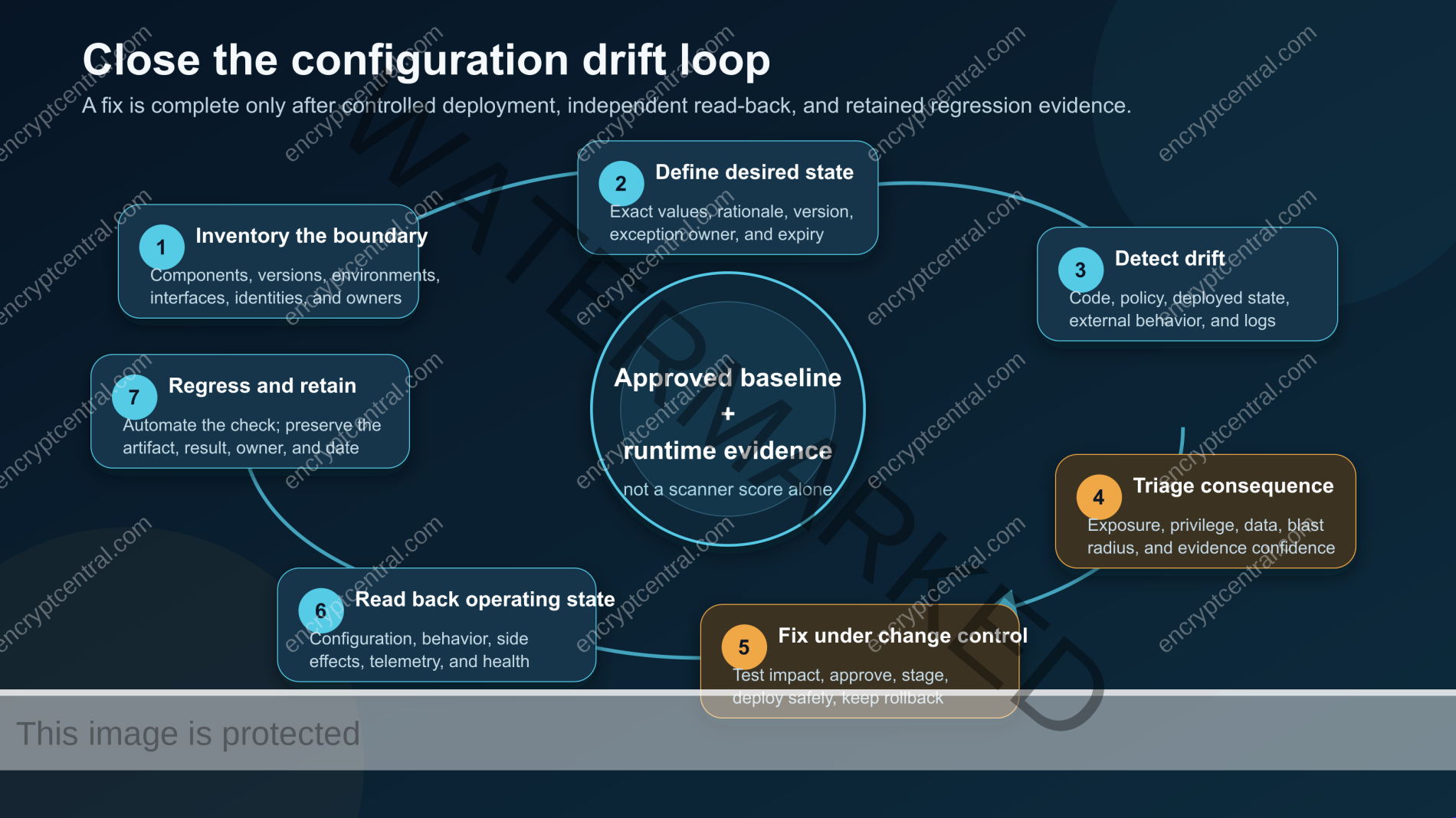
Patch management and configuration management must meet. A new component version can add a secure feature, change a default, deprecate a directive, or introduce a new administrative surface. Review release notes and baseline changes together, and do not assume that an upgrade preserves the previous effective state.
7. Keep an evidence-producing record
One concise record per material drift makes retesting and audit possible:
| Field | What to retain |
|---|---|
| Identity | Finding ID, application, environment, component, version, owner, and date |
| Baseline | Desired value, rationale, source, benchmark or requirement version, and exception state |
| Observation | Sanitized declared, deployed, saved, external, and runtime evidence |
| Consequence | Reachability, affected action or data, privilege, blast radius, and confidence |
| Change | Root source, approved fix, artifact or change ID, reviewer, deployment, and rollback plan |
| Verification | Saved-state read-back, external test, runtime behavior, health result, and telemetry |
| Follow-through | Regression check, residual risk, exception owner and expiry, next review date |
Store hashes or immutable identifiers for evidence artifacts where the workflow supports them. Protect secrets, tokens, personal data, internal addresses, and exploit details according to the evidence-handling policy. A finding record should let an authorized reviewer reproduce the decision without becoming a new source of exposure.
Common failure modes
Scanning without a baseline
The tool finds known patterns but cannot decide whether every value is intended, inherited, overridden, or business-critical. Build the component and desired-state inventory first.
Fixing only the visible symptom
A manual cloud-console change, one response header, or hidden menu item may leave the configuration source and alternate paths unchanged. Repair the authoritative source and redeploy.
Trusting the pipeline receipt
A successful plan or deployment proves that a job ran. It does not prove the right account, region, artifact, effective value, process reload, external behavior, or alert path. Read back the destination.
Applying a benchmark blindly
Benchmark settings are valuable, but versions, profiles, workload needs, and operational impacts matter. Test, tailor, document exceptions, and verify the result.
Counting headers as complete hardening
Headers affect browser behavior. They do not prove secure identities, cloud permissions, secrets, containers, data stores, delivery controls, or administrative exposure. Keep them in the correct layer.
Sharing production secrets for consistency
Environments should use the same hardening logic, not the same credentials or customer data. Separate identities and trust boundaries prevent a lower environment from becoming a path into production.
Decision
A useful security misconfiguration program begins with one owned system and a small number of high-consequence settings. Inventory every layer, define exact versioned values, and compare source, delivery, saved platform state, external behavior, and operating evidence. When drift appears, prioritize the reachable consequence, fix the authoritative source through change control, and independently read back the result.
The immediate deliverable is not a perfect benchmark score. It is a versioned baseline and evidence record for the application’s most important boundaries, plus a regression check that detects when those boundaries move. Expand coverage as components and deployment paths change, and treat any setting without an owner or verification method as unresolved work.
Primary references
- OWASP A02:2025 Security Misconfiguration
- OWASP ASVS 5.0 V13 Configuration
- OWASP Web Security Testing Guide
- OWASP HTTP Security Response Headers Cheat Sheet
- NIST SP 800-218 Secure Software Development Framework
- NIST SP 800-128 Security-Focused Configuration Management
- CIS Benchmarks
- CISA secure-by-design alert on default passwords
Related posts:
 CISA KEV Patch Playbook: Alert to Verified Remediation
 Broken Access Control Testing Checklist
 Third-Party Cyber Risk Checklist for Small Businesses
 What Is Ethical Hacking, And How Can It Improve Security?
 Software Supply Chain Security and SBOM Buyer Guide
 Beagle Security: OWASP Security Testing review


