


For each important domain, identify who can change its registration, delegation, DNS records and recovery details. Then verify the protection for each operation. Domain registrar security requires more than a “locked” label: a transfer restriction, an administrator’s MFA setting and a DNS-zone permission protect different paths.
Start with one domain that supports a service your organization cannot easily lose. Connect its business owner to the registrar account, the relevant registry and the authoritative DNS operator. Record the approved administrators, recovery route, change procedure and evidence needed to establish that the controls work as intended.
This guide provides a proposed control record and review sequence, not results from an account audit. Official sources were checked on October 31, 2026. No registrar access, domain changes, unlocks, transfers or recovery attempts were performed. Confirm provider-specific procedures before implementing changes; qualified technical review remains pending.
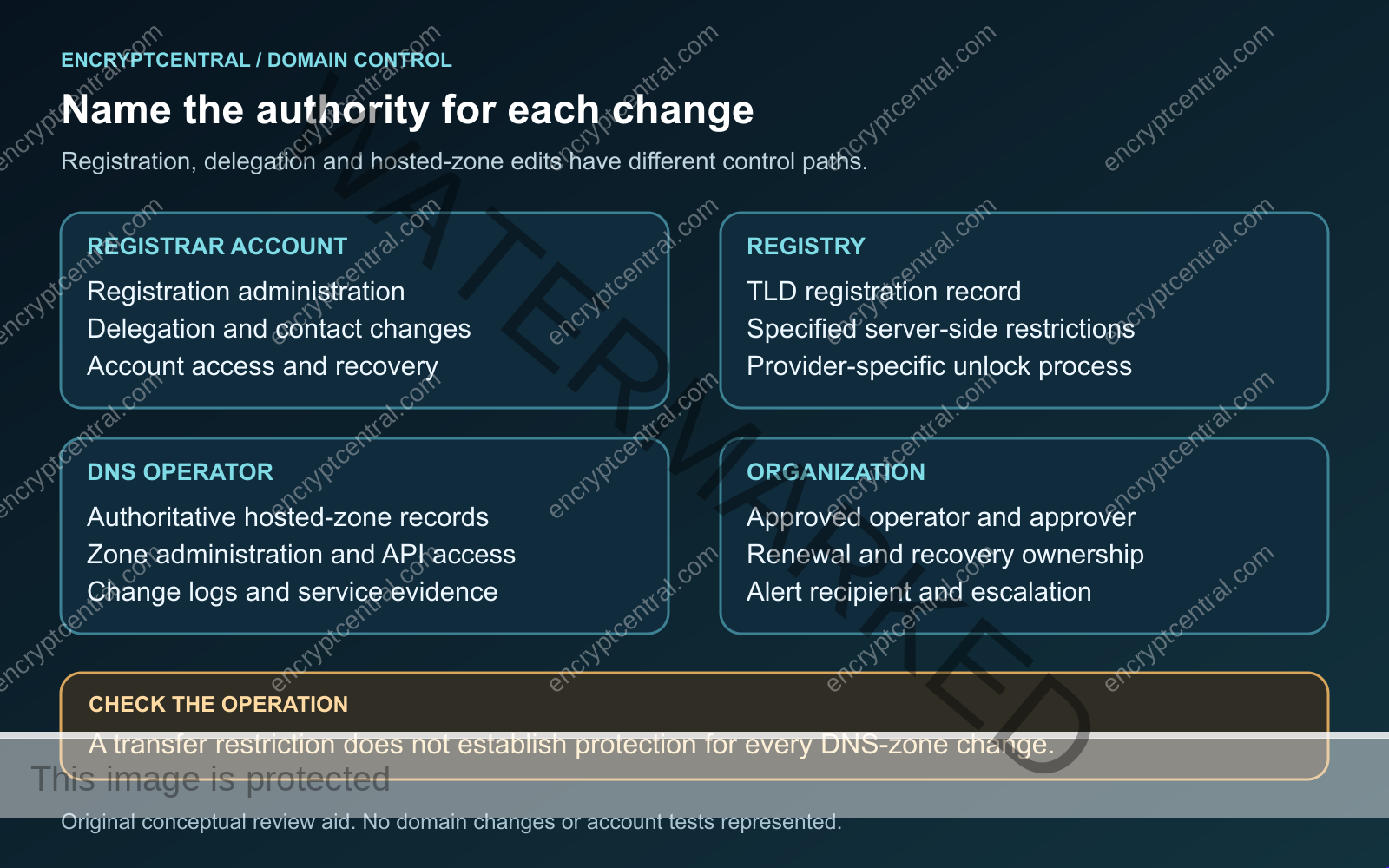
Map authority before evaluating settings
A domain can depend on several organizations even when you receive one invoice. The registrar manages the registration relationship and works with the registry responsible for the relevant namespace. The operator hosting the authoritative DNS zone can be a different provider.
The UK NCSC’s public-domain management guidance distinguishes these roles, including DNS hosted by a registrar, a cloud provider or the organization itself. Use that distinction to ask who can perform each administrative action.
Build a small authority map:
- Registration: identify the registrar, account reference, organizational registration contact and renewal owner.
- Delegation: identify the approved route for changing the domain’s authoritative name servers and any associated parent-side configuration.
- Zone administration: identify the authoritative DNS service, its administrators and any automation authorized to edit records.
- Recovery: identify the people, contact routes and provider procedures that can restore administrative access.
Record what is known and what still needs confirmation. A web developer who can edit a hosting dashboard may have extensive DNS privileges, or none. An agency contact may manage day-to-day changes while a former employee remains the registrar’s recovery contact. These are questions to resolve, not assumptions to copy into an inventory.
Keep the review focused on administration authority. Hosting selection is a separate decision covered in the secure web hosting guide.
Secure the everyday administration paths
Review the registrar and DNS operator separately, even if the same company supplies both. Identify the current human administrators and the work each needs to perform. Include contractors, agency access and service identities in the review where those access paths exist.
Use supported MFA for administrative access, maintain strong unique credentials and restrict DNS administration to people with an operational need. The Australian Signals Directorate’s domain-owner guidance also recommends reviewing account access logs and maintaining current registration contacts so unexpected change alerts can reach the organization.
Ask the account owner to show the available role boundaries and logging. Record the evidence reference and review time; do not write “least privilege enabled” merely because a product offers multiple roles. Determine which assigned role can change delegation, edit a zone, manage other administrators or alter recovery details.
For automation, record its owner, intended scope and approved credential-management location. Keep live passwords, API tokens and recovery codes out of the domain worksheet. An evidence reference can point an authorized reviewer to the appropriate protected system without exposing its contents.
Include domain and DNS access in personnel changes. When an administrator leaves or changes duties, have the responsible owner reconcile their access and any automation dependency. Preserve a business-approved operating path instead of discovering during an incident that only one departed person knew how the account worked.
Make recovery reachable and accountable
Login protection and account recovery belong in the same review. A strong everyday sign-in process does not explain how a provider handles a lost factor, an unavailable mailbox or an ownership-verification request.
ICANN SSAC’s SAC044 account-protection guide discusses authorized contacts, audited recovery and questions to ask about registrar reset procedures. It dates from November 2010. Use those organizational principles while obtaining the registrar’s current process; do not treat its older implementation examples as current authentication requirements.
Prepare a recovery record that answers:
- Who may request recovery, and who approves it internally?
- Which current provider procedure applies to this account?
- Where is the required registration or organizational documentation securely retained?
- Which organization-controlled contact route remains reachable if the primary domain’s email is unavailable?
- Who receives recovery notifications, and where is the request audited?
The independent contact route is a dependency-planning recommendation, not a claim that every registrar accepts a particular mailbox or method. Confirm what the provider supports. Keep it under organizational control rather than moving the dependency to a personal account.
Walk through the written process with the named owners. Mark it as a document review unless an authorized exercise actually tests the route. Avoid initiating a live reset or unlocking a production domain merely to fill a worksheet field.
Read a lock status by the operation it restricts
Ask what the lock restricts, who enforces it and how it can be removed. A dashboard icon can hide several different mechanisms.
ICANN’s EPP status-code reference distinguishes client codes set by registrars from server codes set by registries. Examples include:
clientTransferProhibited: the registry rejects a transfer to another registrar.clientUpdateProhibited: the registry rejects updates to the domain registration object.serverTransferProhibited: a registry-set restriction prevents an inter-registrar transfer.serverUpdateProhibited: a registry-set restriction prevents domain updates.
These are operation-specific registration statuses. Do not interpret a transfer restriction as proof that nobody can edit an A, MX or TXT record at the separate DNS host. Equally, do not assume a registry-domain update restriction describes every setting in the registrar’s customer account.
Use current registration information as one evidence source. ICANN identifies RDAP as the definitive gTLD registration-information source from January 28, 2025 and recommends its Lookup service. Some data is nonpublic, and country-code domains can have different registry arrangements. A public lookup is not a complete account or permission audit.
Compare observed status with the registrar’s explanation and the approved control record. Record uncertainty instead of assuming an unfamiliar status means the intended security service is active.
Confirm the exact scope of registry locking
Registry locking can add controls beyond a registrar’s ordinary account workflow. The ASD guidance describes registry-side restrictions and identity verification before unlocking, normally arranged through the registrar. It also notes implementation differences and the limits of policy controls if a provider is compromised or acts improperly.
For each high-impact domain, obtain a provider-specific answer to these questions:
- Does the relevant registry and registrar support the proposed service for this domain?
- Which operations are restricted: transfer, update, deletion or a defined combination?
- Who can request removal, and what additional verification occurs?
- How are planned changes, urgent requests and restoration of the restriction handled?
- What evidence confirms enrollment and the effective status?
Do not infer enrollment in an optional Registry Lock service from a server status alone. ICANN describes other reasons for server restrictions, including disputes and lifecycle conditions. Reconcile the status with the actual service record.
Plan legitimate change lead time with the provider before an emergency. Record its stated process and any account-specific commitments, with their evidence date. This article does not establish a universal unlock time, feature entitlement or price. Escalate an unsupported requirement to the business owner instead of relabeling a different control as equivalent.
Create a domain control record people can use
The following is a proposed operational record. It connects the domain, the authority to change it and the evidence supporting a decision. It is not a standardized ICANN form or a determination of legal ownership.
| Record area | Capture | Resolve |
|---|---|---|
| Domain and responsibility | Domain, relevant namespace, business service, business owner and operational owner | Who accepts the consequences of disruption or loss of control? |
| Administrative authority | Registrar account reference, registry, DNS operator, approved administrators and automation owner | Who can change registration, delegation, zone data and recovery? |
| Restrictions | Exact operation, enforcing party, observed status, provider procedure and evidence date | What does the control cover, and what remains outside it? |
| Recovery and continuity | Authorized requester, protected documentation reference, reachable contact route and renewal owner | Can the organization coordinate recovery without relying on one unavailable person or mailbox? |
| Change and verification | Approved change, previous state, expected result, actual observation, alert recipient and evidence location | Was the authorized change applied correctly and recognized? |
| Open issues | Unverified assumption, responsible owner, approved exception if any, expiry and next action | What still prevents closure? |
Keep account references and evidence locations useful without embedding live secrets or sensitive identity documents. Store those materials in the organization’s approved protected systems with appropriate access.
Use separate fields for expected and observed values. “Provider says this is supported,” “configured in the account” and “observed during an authorized check” describe different evidence. Retain the distinction when a summary is passed to a manager or another administrator.

Give an approved change a clear verification path
Before a legitimate administrative change, identify its exact scope. A record edit at the DNS operator and a delegation change through the registrar have different control paths. An account-contact change also needs its own authorization and evidence.
Use this sequence within the organization’s established change process:
- Describe the request. Identify the domain, service dependency, intended operation, provider and business reason.
- Approve the route. Name the authorized operator and approver. Resolve any provider verification or registry restriction that affects the planned operation.
- Preserve the relevant baseline. Retain the necessary current registration, delegation or zone information securely, with a time and evidence reference.
- Define acceptance and recovery. Specify expected observations, service checks, accountable alert recipients and an authorized restoration plan.
- Reconcile the result. Compare actual observations with the request, retain available change logs and confirm the intended restrictions remain in place afterward.
Do not approve a broad unlock when the request describes only a narrow edit without first resolving why it is needed. If a change crosses providers or affects DNSSEC configuration, have the relevant owners coordinate the implementation and restoration plan. This sequence is a review framework, not deployment instructions for an unfamiliar environment.
Check alerts and renewal as operating controls
The NCSC recommends monitoring critical DNS records for unexpected changes and securely retaining available logs. Select the records and events that matter to the services in the authority map, including relevant delegation changes.
Then follow the notification path to a person or operating team. Who reviews a change alert? Where is it recorded? What happens outside normal hours? When an authorized exercise is appropriate, retain evidence of receipt and response. Until then, describe alert delivery as unverified rather than equating a configured address with a completed control.
Domain-registration renewal also needs an accountable owner and an actively maintained organizational payment method. Record the next review point and who investigates failed payment or renewal notices. A renewal setting is not a substitute for reviewing its dependencies.
Keep adjacent jobs connected without merging them. Use the TLS certificate inventory and renewal runbook for certificate deployment and expiry checks. Use the DMARC, DKIM and SPF guide for mail authentication. Neither review replaces registrar and DNS administration control.
Recognize failures a green lock cannot explain
Consider a fictional organization reviewing example.org. Its public registration status shows a transfer restriction, but an agency still holds broad DNS-zone administration and a former employee’s mailbox remains involved in recovery. This is an illustrative scenario, not an observed account audit.
The transfer restriction does not resolve either authority question. The proposed next actions are to identify the approved agency scope, reconcile the actual assignment with that need and confirm the registrar’s current recovery contacts through an authorized process. Record those as open tasks until evidence supports closure.
Other misleading signals include a successful portal login with no verified recovery route, a monitoring subscription with no accountable alert recipient, and a registry status whose purpose nobody can explain. Each needs investigation at its own control layer.
DNSSEC is another distinct layer. NIST SP800-81r3 describes source authentication and integrity protection for DNS data, without confidentiality, as part of wider DNS security. That function does not establish who may recover a registrar account or approve an administrative change.
Close the review with evidence and a named next action
A useful review ends with an explainable state for one domain. The record should identify the responsible organizations and people, the relevant operation-specific restrictions, the recovery dependencies and the evidence supporting each observation.
Assign unresolved items instead of converting them into a blanket “secure” verdict. If the business accepts a temporary gap, use its existing exception process and retain the exact scope, approving owner, reason, expiry and recheck trigger.
Revisit the record when administrators, providers, recovery contacts or important services change. The next administrator should be able to understand who can act, through which provider process, and what still needs verification before approving the next domain change.
Related posts:
 DMARC, DKIM, and SPF Setup to Stop Domain Impersonation
 Microsoft Entra Emergency Access Account Checklist
 Kubernetes RBAC Review: Check Service-Account Permissions
 OWASP Top 10: 2025 Changes and What to Fix First
 Vendor Bank-Detail Changes: A Verification Checklist
 What Are The Security Considerations For Remote Work?


