


A useful threat intelligence platform RFP describes the decisions your team must make, the evidence vendors must provide, and the full scope of the quotation. Give every bidder the same task, data assumptions, sharing requirements, and exit questions. Compare accepted work and operating obligations before comparing headline prices.
This guide supplies a proposed procurement framework grounded in official sources reviewed on October 19, 2026. It contains no vendor ranking, market-price estimate, or hands-on platform result. No quotations or sales demonstrations were obtained. Technical review is pending; there are no affiliate links or sponsored recommendations.
State the intelligence outcome before listing features
Begin with the people who will use the output. A SOC analyst, detection engineer, incident responder, and executive reader may need different forms of intelligence. Ask each person which decision is currently delayed, which information is missing, and what a useful delivered result would look like.
Turn one answer into a requirement. For example: “An analyst must trace an externally supplied indicator to its source, review its relevance to our environment, and pass an approved output to the detection workflow.” That is more testable than asking whether a product has artificial intelligence, automation, or a threat graph.
NIST SP 800-150 discusses establishing information-sharing goals, identifying sources, and controlling distribution. Use those goals to frame the RFP. Your procurement document should explain which intelligence relationships the platform supports and what your organization is authorized to do with the information.
Define a common scope sheet
Write down the expected users, organizations or tenants, data sources, retention needs, integrations, deployment model, and service hours. Label estimates clearly. If a quantity is unknown, ask vendors to state the assumption they used and describe how cost or architecture changes when it increases.
Separate platform functionality from content subscriptions and managed analysis. A quotation may include software access while excluding a feed, a connector, integration services, or the people needed to interpret results. Those are not automatically problems, but they must be visible before proposals can be compared.
Connect the RFP to EncryptCentral’s platform landscape for category context. Keep the requirement set independent of that article’s vendor list. A shortlist should follow the job and evidence, rather than inherit a ranking from a general review.
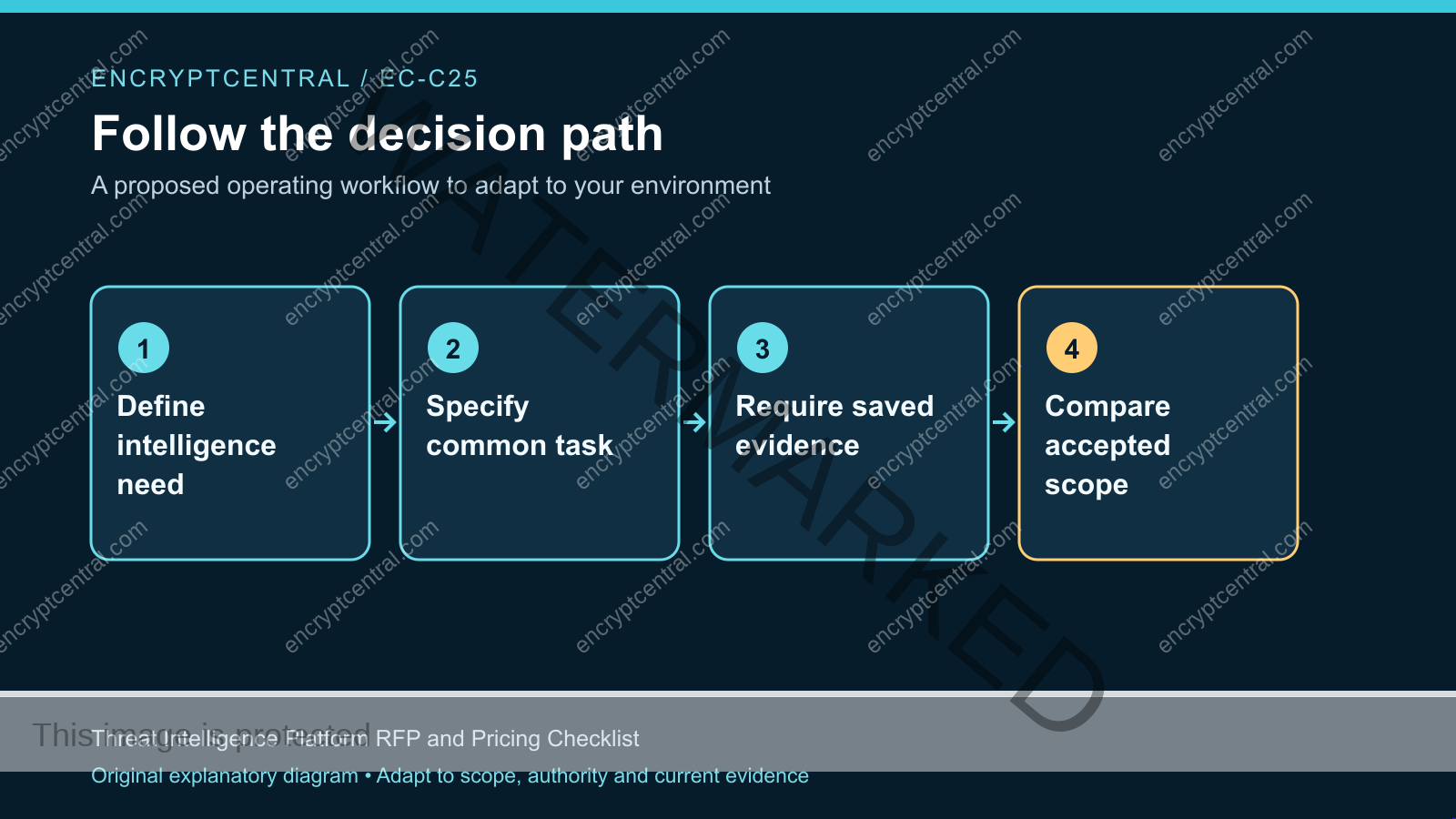
Request workflow evidence in a repeatable format
Give vendors a short, harmless task and ask them to identify the exact steps, roles, configuration, and output required. The task might include importing a report, associating indicators with context, correcting an observation, restricting distribution, and exporting a selected result.
Ask each bidder to distinguish native functionality, optional modules, custom integration, third-party dependency, and planned functionality. Require written identification of any capability that is not available in the quoted configuration. A roadmap statement should remain a roadmap statement in the evaluation record.
For each demonstration, retain the question, expected result, observed result, configuration, and limitation. Ask whether your staff can repeat the task under their intended roles. A polished demonstration can be informative, but it is a different evidence type from an independently repeated customer pilot.
Make data and exchange requirements precise
Do not accept “supports STIX/TAXII” as a complete interoperability requirement. OASIS STIX 2.1 defines structured threat intelligence content, while TAXII 2.1 addresses exchange. State which information, versions, directions, and consumer workflows matter to your organization.
Provide a representative sample and ask for a round-trip result. Inspect whether source references, relationships, markings, timestamps, corrections, and unsupported fields survive in the way your consumer needs. A standards label alone does not demonstrate compatibility between two specific configurations.
Request the handling process for malformed or incomplete data. Does the integration reject it, quarantine it, modify it, or import a partial record? Require the vendor to show how an operator finds the error and understands what did not arrive. Silent transformation can be more difficult to diagnose than an explicit failure.
Ask who may see and redistribute the information
Describe your internal teams, external clients, partners, and any separate business entities. Ask how the quoted configuration represents those boundaries and which roles can change them. Include API access, exports, scheduled reports, and downstream integrations in the discussion.
Request a test showing that an unauthorized recipient cannot receive a harmless restricted item through the route you intend to use. Then ask how corrections and changes to distribution restrictions are communicated. Do not assume a source marking or a visible permission field is enforced everywhere the data travels.
Keep contractual data rights alongside technical permissions. A platform may make export possible while a source agreement restricts the information’s redistribution. Have the appropriate legal or procurement reviewer interpret actual terms. The RFP can require disclosure and review without offering a universal legal conclusion.
Normalize the commercial response
Give bidders a common quotation schedule. Ask for initial implementation, recurring platform access, included usage, content rights, optional services, support, training, and exit assistance. Specify the evaluation period and the workload assumptions so a first-year discount does not conceal a different renewal scope.
| Quote field | What to request | Why it matters |
|---|---|---|
| Base configuration | Named edition, included capabilities, deployment and users | Establishes what the price actually buys. |
| Usage assumptions | Measured units, limits, overage rules and exclusions | Exposes sensitivity to workload growth. |
| Data and integrations | Included feeds, rights, connectors and maintenance | Separates platform access from usable workflow. |
| Services | Implementation, analysis, support and training scope | Identifies work your staff must still perform. |
| Renewal and exit | Term assumptions, export and transition assistance | Makes lifecycle obligations visible. |
Use actual numbers only from written quotations or your organization’s cost model. Preserve the date, currency, tax assumptions, term, and exclusions. If vendors price with different units, compare a common scenario rather than pretending the units are interchangeable.
Budget the work the contract does not perform
List internal responsibilities: source review, indicator quality, identity integration, access review, connector changes, detection handoff, monitoring, and recovery. Assign an owner and an estimated effort for each. Label the estimate as your planning assumption until a pilot supplies better evidence.
Include the cost of maintaining existing tools during transition. An organization may need overlapping subscriptions or additional integration effort while it validates the new workflow. Ask who will maintain the interface when either side changes, and whether that maintenance is included in the proposal.
For self-hosted options, include infrastructure, backup, patching, recovery testing, and on-call support. For hosted options, inspect the remaining customer responsibilities rather than assuming hosting removes them. The selected arrangement should leave a clear owner for each operational task.
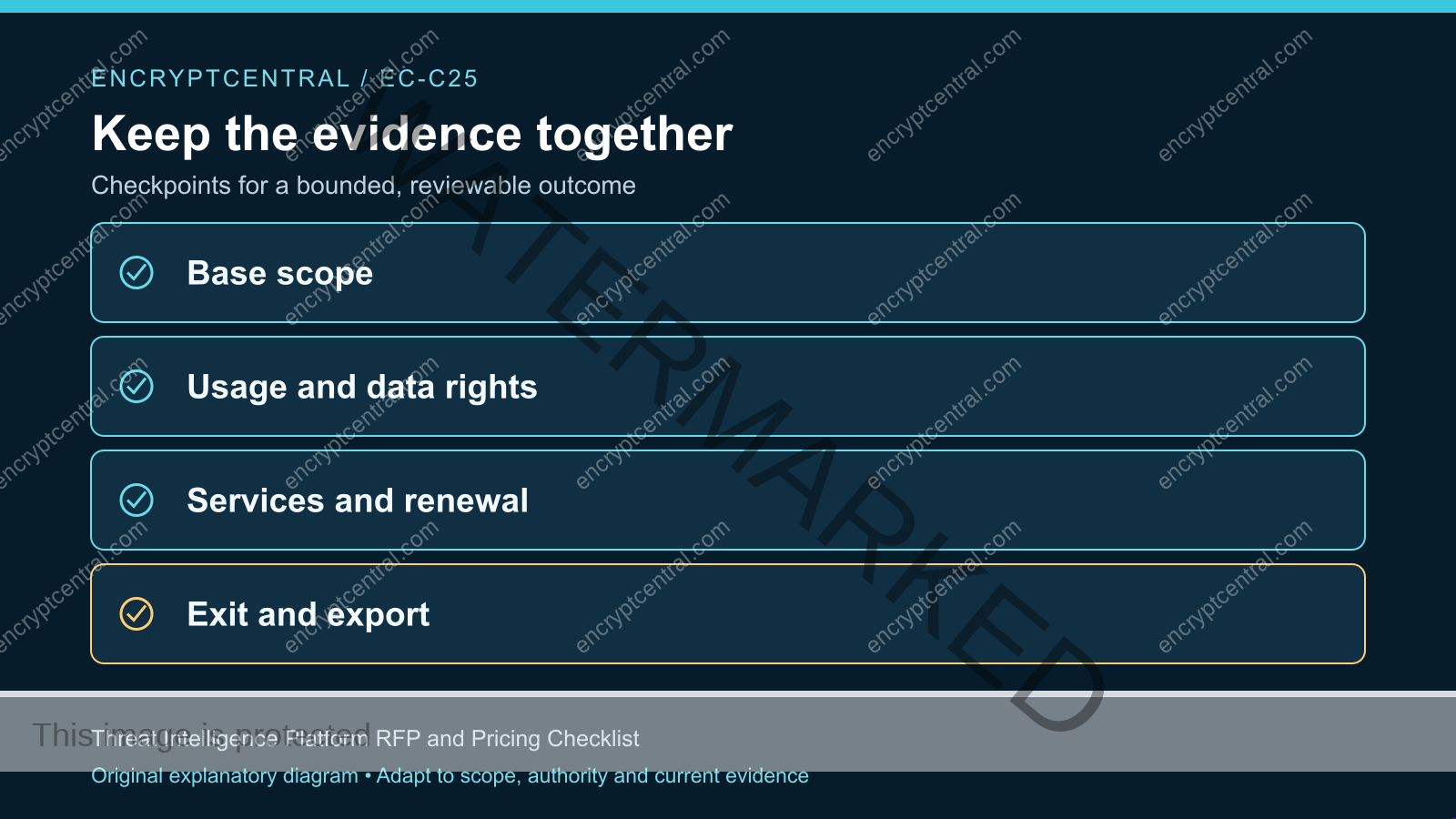
Define pilot acceptance and an exit test
Choose a small set of mandatory outcomes, with an expected result and evidence owner for each. Examples include a reproducible source trail, correct handling of a restricted record, successful delivery to the intended consumer, visible integration failure, and an export your organization can use independently.
Keep preferences separate from mandatory requirements. A convenient visual interface may improve analyst work, but it should not compensate for a failed distribution boundary. Decide the scoring approach before the final demonstrations, and record the reason for each decision.
Test exit while the relationship is cooperative. Ask for an export of the selected sample, documentation of its structure, treatment of attachments and relationships, and the steps required to end integrations. Confirm which data can be retained under source agreements. A downloadable file is useful only if the organization can interpret and lawfully use it.
Run a clarification round without changing the scoring secretly
After the first responses, create a clarification log with one row per unresolved requirement. Include the original wording, bidder’s assumption, question, response, evidence reference, and resulting scope change. Send materially changed common requirements to every affected bidder so the comparison still describes the same purchase.
For example, one supplier may quote a connector as included while another includes only access to an API. Ask each to identify who builds the actual interface, who monitors failures, which side maintains it after changes, and whether that work is priced. Neither answer should be scored as a completed integration until the same operational outcome is defined.
Ask procurement to keep commercial commitments separate from an analyst’s interpretation of a demonstration. A salesperson’s explanation, a product manual, an observed pilot, and a signed scope can support different parts of the decision. Identify which evidence is required for each mandatory requirement and which commitment must appear in the final agreement.
Close the round with a versioned scope and a list of unresolved assumptions. If a required outcome remains uncertain, retain an explicit decision for the accountable owner rather than averaging the uncertainty into a numerical score. That preserves the reason for the selection and prevents a later implementation dispute about what the evaluation supposedly established.
Before approval, give the implementation owner the final comparison and ask them to identify their first unresolved dependency. Resolve that dependency in the scope or retain it as an explicit implementation risk with funding and ownership.
Procurement failure modes to watch
Every vendor answers a different scenario. A bidder may assume fewer users, less data, or a simpler integration. Require a response against the same scope sheet and preserve every deviation as a separate commercial or technical decision.
Feature presence becomes proof of operational fit. A documented API does not establish that the required connector is implemented, supported, and monitored in your configuration. Ask for the complete workflow and ownership.
A high score hides a mandatory failure. Keep pass/fail requirements visible outside the weighted score. A convenient system that cannot meet an essential handling rule should not pass because it has enough unrelated features.
Pricing precision exceeds the evidence. Do not publish or budget an assumed market range as if it were a quote. Ask for the missing information, record the uncertainty, and compare scenarios using disclosed assumptions.
Questions to resolve before issuing the RFP
How many requirements should we include?
Include enough to describe the required job, boundaries, operating responsibilities, and acceptance evidence. A shorter set of testable requirements is often easier to evaluate than a large questionnaire whose answers cannot be checked. Keep optional future ambitions distinct from the first deployment.
Should the cheapest bid win?
First establish which bids meet mandatory scope and handling requirements. Then compare lifecycle cost, operational effort, and relevant preferences. A lower headline price can be a valid choice, but only when its exclusions and remaining customer work are understood.
What if a vendor will not demonstrate a requirement?
Record the evidence as unavailable, not failed or passed by inference. Decide whether another acceptable evidence route exists. If the requirement is mandatory and remains unverified, keep the selection decision open or choose a proposal with adequate evidence.
Issue an RFP that produces comparable decisions
Complete the scope sheet, choose the common task, and attach the quotation schedule and acceptance criteria. Have the analyst owner, security owner, and procurement reviewer examine the same document before it goes to bidders.
Use the broader platform comparison and existing intelligence-provider coverage for background. The RFP’s value is the evidence it asks every supplier to provide for your actual work, with the assumptions and remaining obligations visible.
Related posts:
 IntSights Threat Intelligence Platform (TIP) Review
 CrowdStrike Falcon® Intelligence: Automated Threat Intelligence Review
 Cisco Talos Intelligence Group – Comprehensive Threat Intelligence Review
 Cyber Threat Intelligence Showdown: SOCRadar® vs. OpenCTI
 ZeroFox Threat Intelligence Services Review
 ReliaQuest GreyMatter Threat Intelligence Review


