


A threat report can be useful and still be inappropriate for the channel where someone is about to paste it. Traffic Light Protocol markings help a source express distribution boundaries. The practical work is translating that marking into a specific recipient decision, preserving the context through exports, and knowing when to ask the source for permission.
This TLP 2.0 sharing checklist is a proposed operational workflow, researched on October 19, 2026. It follows FIRST’s published definitions but does not claim that a label encrypts information, grants a license, or resolves privacy and contractual obligations. We have not tested your sharing platform. Validate its actual behavior before relying on automated controls.
What TLP 2.0 tells a recipient
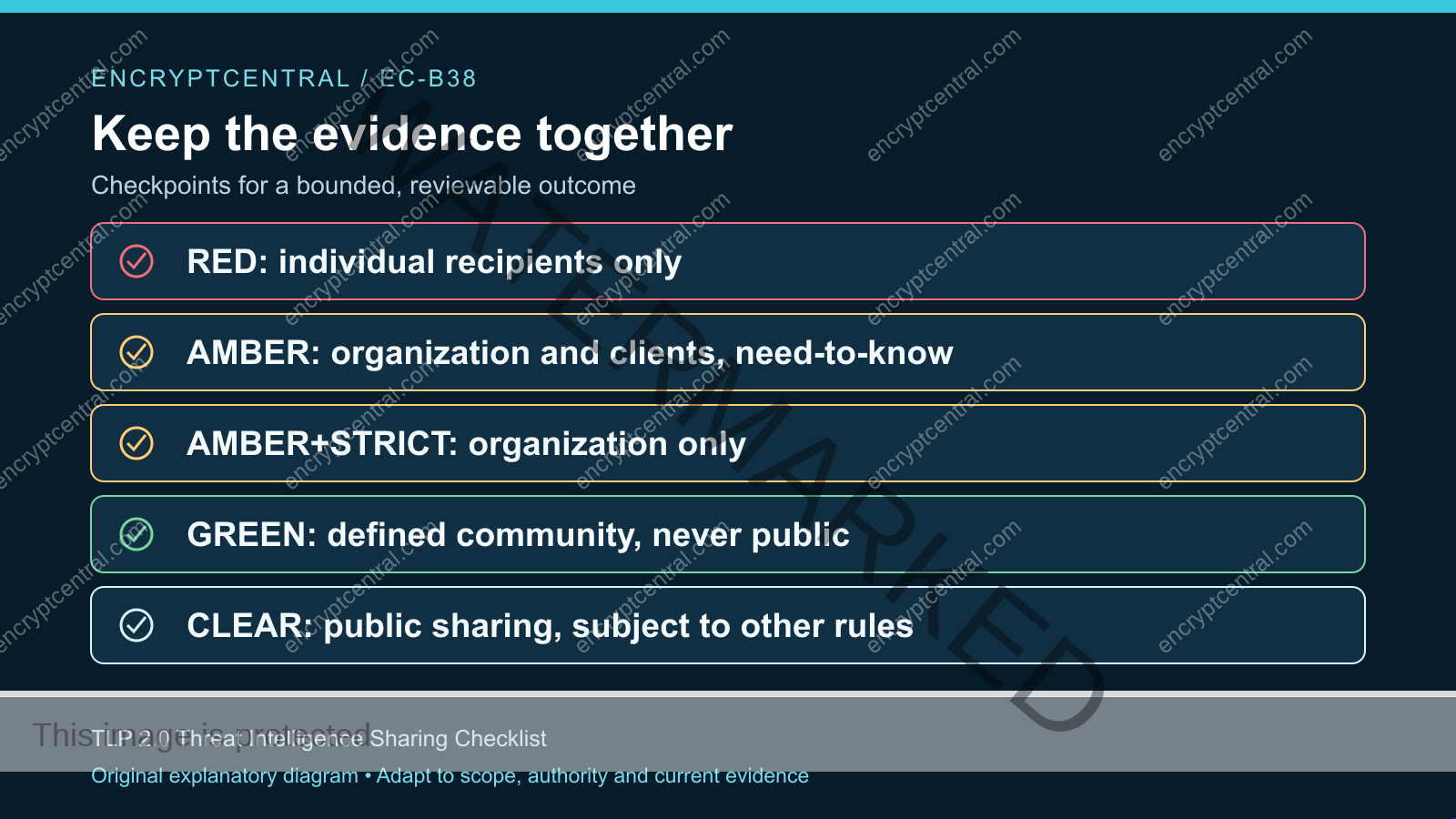
FIRST’s TLP 2.0 specification defines these distribution boundaries: TLP:RED is limited to the individual recipients; TLP:AMBER supports need-to-know sharing within the recipient’s organization and its clients; TLP:AMBER+STRICT limits sharing to the recipient’s organization; TLP:GREEN permits sharing within a community, not on public channels; and TLP:CLEAR permits public distribution subject to other applicable rules.
These are handling instructions, not an assessment of truth, urgency, or business impact. A CLEAR report can be wrong. A RED observation can be incomplete. Keep source confidence, analytical judgment, incident severity, and distribution permission as separate fields in your workflow.
If you want to share more broadly than the source’s marking permits, obtain the source’s explicit permission. Removing the marking or paraphrasing the report should not be treated as an automatic route around its restriction. Where additional source instructions apply, retain them with the material and resolve ambiguity before distribution.
Define the actual recipient before choosing the channel
Start with people and organizations, not a channel name. “Our intelligence channel” might contain employees, contractors, external guests, connected applications, and an export bot. List the audience that can actually read the message and any systems that receive a copy. The friendly name of a workspace does not establish its distribution boundary.
For AMBER, ask whether each proposed recipient is within the organization or a client with the relevant need to know. Do not assume every vendor, partner, or social connection is a client for this purpose. For AMBER+STRICT, do not extend the organization-only boundary to clients merely because ordinary AMBER would permit that distinction.
For GREEN, identify the intended community and how membership is established. A public forum about cybersecurity is still public. A search-indexed page, open invitation link, or unrestricted file share can change the audience beyond what the sender intended.
For RED, create a recipient-specific handling record. A department mailing list is not interchangeable with named individual recipients. Before forwarding, ask whether the source permitted those specific additional people to receive the information. If not, seek permission rather than relying on their job title.
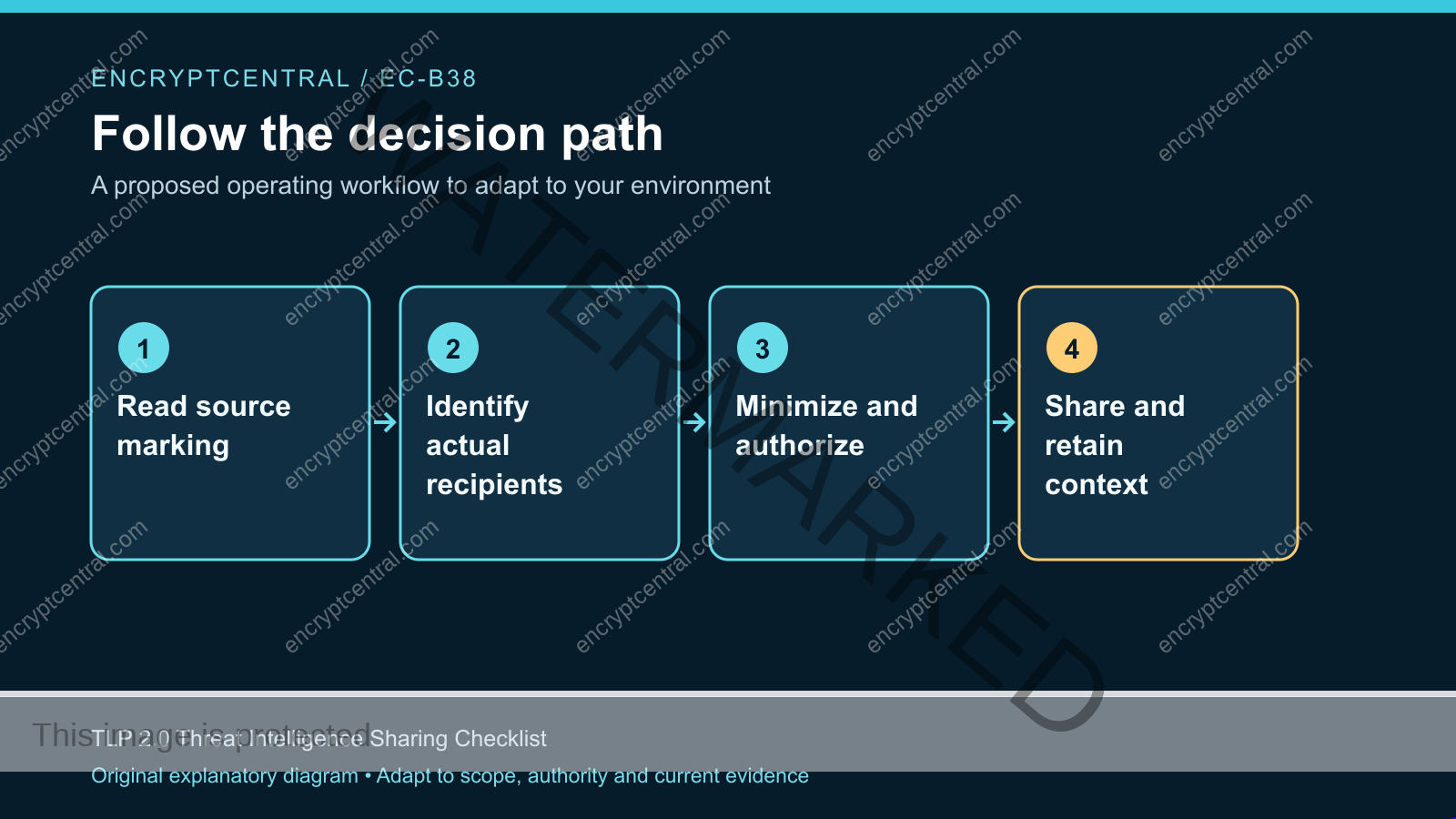
Separate permission, necessity, and minimization
A permitted audience does not mean everyone in that audience needs the entire report. Define the decision the recipient must make: investigate a host, block a confirmed indicator through an approved process, contact an affected customer, or assess a campaign. Share the material necessary for that task and preserve enough context to prevent misleading interpretation.
Review whether the package contains personal information, credentials, victim identifiers, sensitive infrastructure details, or material under a separate agreement. TLP does not resolve those issues. Use the appropriate organizational review process rather than assuming the color is the only rule.
When creating a derivative summary, retain attribution and the applicable handling context. Distinguish source observations from your team’s analysis. Do not imply that the original source endorsed a conclusion you added. If the derivative combines several sources, document which restrictions apply to each component and obtain guidance where they conflict.
NIST’s SP 800-150 information-sharing guide provides broader planning context for sharing objectives, relationships, and rules. The workflow here turns those planning questions into a per-release decision record; it is not a claim that NIST prescribes this exact checklist.
Preserve markings across the whole export path
Map the path from source receipt to final consumption. Common steps include ingesting an email, extracting indicators, importing a platform object, creating an analyst note, exporting a file, sending a notification, and copying selected material into a response ticket. Each transformation can lose the original handling context.
Define where the marking should appear in the human-readable report and where it belongs in structured metadata. Then check the actual output. Do not assume a platform’s “TLP support” statement proves that every connector, CSV export, webhook, PDF, or downstream integration preserves the same boundary.
OASIS STIX 2.1 provides structured threat-intelligence and marking mechanisms, but accepting STIX is not proof of complete TLP 2.0 enforcement. Require the product owner to document how the installed version represents the specific marking and how receiving systems interpret it. Treat undocumented mappings as a test question, not an established capability.
Keep an immutable reference to the original source item and its handling instructions. When an export strips fields, the export may no longer contain the evidence required for an informed sharing decision. Repair the mapping, choose a different supported format, or stop that route until the limitation is resolved.
Test the boundary with harmless sample information
Build a synthetic report containing no real incident, personal data, credentials, or sensitive indicators. Mark it clearly as a test and use controlled recipients. The purpose is to validate your workflow without creating an actual disclosure while testing it.
Exercise one allowed route and one route that should be rejected or require review. Include a source item, an analyst-created summary, an attachment, and a structured export if those are normal operations. Check the resulting audience and the visible handling context at the destination, not just the sender’s compose window.
For AMBER+STRICT, specifically check that the workflow does not silently downgrade it to ordinary AMBER. For GREEN, check that a public publishing integration is not treated as a permitted community destination. For RED, check whether a group expansion or forwarding rule introduces recipients outside the intended individual set.
Record the platform version, connector configuration, sample identifiers, expected result, observed result, and any manual control required. If the software only displays a label but does not prevent an unauthorized route, say so. A documented human review can be a deliberate control; an assumed automated block is not.
Use a release record that survives a shift change
A compact release record should identify the source item, exact marking, additional instructions, intended purpose, actual recipients, delivery channel, and reviewer. Include the artifact version and a reference to the final exported file or saved message. Keep this record in a location whose own access matches the information it describes.
Record the reason for including the audience. “Security team” is weaker than “the named incident responders handling the affected service.” If a source authorizes a wider distribution, preserve the permission and its scope: which information, which recipients, which purpose, and any conditions. Permission for one release is not necessarily permission for every future reuse.
Use decision states that expose uncertainty: approved within stated scope, awaiting source permission, blocked by recipient ambiguity, or blocked by export limitation. Do not hide all nonapproved cases under “pending” without an owner and next action.
Our existing threat intelligence platform overview can help frame tooling questions, but the saved release record should describe the behavior of your chosen system rather than borrowing a review’s general capability claims.
Plan corrections, withdrawals, and audience changes
Intelligence can change after distribution. Establish how the team links an update to the earlier artifact and reaches the people who received it. A correction should make clear whether the analytical content changed, the source withdrew an indicator, or the allowed distribution changed.
Do not assume deleting the sender’s message recalls every attachment or downstream copy. Record the controls actually available in the channel and ask recipients to follow the applicable correction instructions. Where a source changes the marking, preserve the new instruction alongside the earlier release history rather than silently rewriting the record.
Review channel membership and automation changes as well. A private group that gains external guests may no longer match the audience assumptions of older material. Assign an owner to evaluate those changes before the channel becomes a routine destination for restricted reports.
If an unintended disclosure occurs, use your organization’s incident and source-notification process. Preserve the original artifact, audience details, timestamps, and relevant permissions. Do not delete evidence merely to make the channel look clean. The response should address the actual disclosure and its scope.
Make the handoff understandable to the recipient
Include a short purpose statement and handling note with the released material. Ask the receiving team to confirm that it understands the intended action, source context, and onward-sharing boundary. This is especially useful when a responder receives extracted indicators rather than the original report.
If the recipient cannot carry the restriction into its own ticketing or automation system, pause that route and agree on a supported alternative. Do not assume that a verbal reminder fixes a connector that sends data to an uncontrolled audience. Retain the recipient’s acknowledgment with the release record, while recognizing that acknowledgment is evidence of the handoff, not a technical guarantee against every future disclosure.
Failure modes that a color label cannot prevent
AMBER and AMBER+STRICT are merged. A connector or analyst treats the two as identical. Correct the mapping and test the client-versus-organization distinction explicitly.
GREEN reaches a public audience. A community label is interpreted as permission to publish on a website or social account. Identify the real recipients and block public routes unless the source provides the required permission.
Metadata disappears during export. The analyst sees the marking in the platform, while a downstream responder receives only a context-free indicator list. Inspect the destination artifact and retain the source relationship.
The report’s reliability is inferred from its marking. Handling and confidence become one field. Maintain separate analytical review and distribution decisions so a restricted rumor does not become a verified fact.
Tool selection replaces policy. A team buys a platform without defining its audiences or approval process. The existing platform comparison is background, not permission to assume any installation enforces your exact sharing rules.
Frequently asked questions
Does TLP:CLEAR mean we can use the material without conditions?
No. Public distribution under TLP does not remove other applicable obligations. Check copyright, privacy, agreements, and source instructions through the appropriate review process.
Can we replace TLP with encryption?
No. Encryption protects information under particular technical conditions; it does not tell a recipient who may receive a decrypted copy. Use handling rules and technical controls for their separate jobs.
Should a SIEM receive every restricted indicator?
Not automatically. Identify who can access the data, integrations, support exports, and retained copies. Evaluate the intended operational use and distribution boundary. Our SIEM explainer describes the tool category, not your installation’s audience.
Make one sharing decision explicit
Take one synthetic report through the complete source-to-recipient route. Verify the marking, actual audience, export behavior, approval record, and correction path. Fix any ambiguous boundary before sharing real material. The outcome should be a reviewable decision supported by evidence, not confidence that a colored label will do the work alone.
Related posts:
 Threat Intelligence Platform RFP and Pricing Checklist
 CrowdStrike Falcon® Intelligence: Automated Threat Intelligence Review
 Cisco Talos Intelligence Group – Comprehensive Threat Intelligence Review
 Battle of Threat Intelligence Platforms: Cisco, ManageEngine, CrowdStrike, IBM, Security X-Force
 Threat Intelligence Platforms: Enterprise, MSSP and SMB
 ZeroFox Threat Intelligence Services Review


