


Choose manual versus automated penetration testing by the question you need answered, not by declaring one method the winner. Use configured automation for repeatable checks against a defined target. Use human-led investigation when the work involves understanding unfamiliar behavior, deciding what should be allowed, or interpreting how weaknesses interact. Then turn suitable discoveries into regression checks.
The important purchase is not a label such as “manual,” “automated,” or “hybrid.” It is an agreed set of questions, enough access to investigate them, and evidence showing what was actually assessed. A human-led engagement can use substantial automation. An automated workflow can authenticate and execute prepared sequences. Neither description establishes coverage on its own.
Compare the work, not the labels
In this guide, human-led testing means that a tester develops and revises hypotheses, chooses follow-up work, and interprets results against the application’s intended behavior. It does not mean performing every request by hand. Configured automation means executing defined checks or sequences with specified inputs and boundaries; the configuration may be sophisticated, but it still needs examination.
A vulnerability scan and a penetration test should not be treated as interchangeable merely because both produce findings. NIST’s SP 800-115 assessment guide distinguishes vulnerability scanning from penetration testing and discusses interpretation and combinations of weaknesses. The publication dates to 2008: its process distinctions are useful here, but it is not a survey of current autonomous products.
Before comparing approaches, specify the target. A public login page, an authenticated API, and a cloud control plane present different assessment questions. Our web, API, mobile and cloud testing comparison addresses that separate surface-selection decision.
For method selection, ask the provider to finish this sentence: “For this target and these identities, we will investigate this behavior and retain this evidence.” A response that names only tools or tester days has not yet answered it.
Match each security question to a method and an evidence request
The worksheet below is an original buying aid, not a testing standard or a recommended manual-to-automated percentage. Its purpose is to make an otherwise vague proposal inspectable.
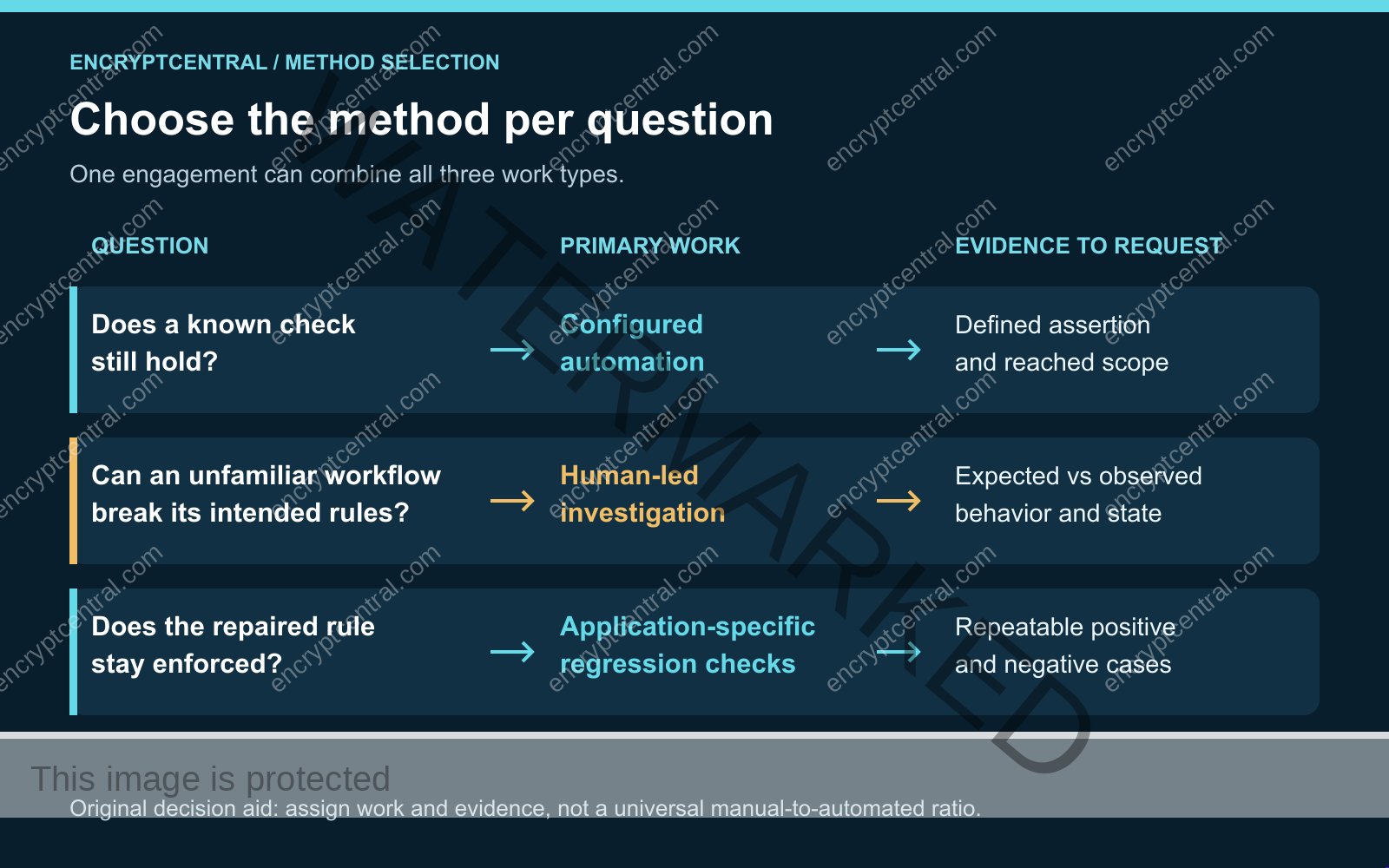
| Question | Work to assign | Evidence to request |
|---|---|---|
| Does a defined check still pass on this release? | A repeatable automated check with explicit inputs and expected results. | Build, target, configuration, actual execution and assertion outcome. |
| Can this unfamiliar workflow violate an intended business rule? | Human-led exploration informed by the rule, roles and relevant states. | Expected behavior, investigated alternatives, observed behavior and limitations. |
| Did the automated assessment reach the protected function? | Reachability verification before accepting its findings or absence of alerts. | Identity used, session checks and records tied to the protected route. |
| Does a repaired rule remain enforced? | Application-specific positive and negative regression cases, automated where suitable. | The permitted case succeeds; the prohibited case is rejected for the intended reason. |
| Do separate weaknesses create a meaningful combined exposure? | Contextual investigation within explicitly authorized boundaries. | A supported chain of conditions, prerequisites and impact, not an unsupported severity upgrade. |
Several rows can belong to one engagement. The same human might configure the automated checks, investigate unexpected results, and help define a regression. The distinction is the work being performed, not the job title attached to it.
Reject a forced choice when the proposal has not separated these questions. A recurring scan may answer a recurring baseline question well while leaving a new approval workflow unexamined. A focused human review may investigate that workflow without providing continuous evidence about every later deployment.
Do not confuse configurable automation with automatic understanding
It would be inaccurate to describe all automation as an unauthenticated, single-request scan. The current ZAP Automation Framework documentation describes environments, authentication, imports, crawling, scanning and job tests. ZAP also documents sequence import and sequence scanning, including context and user configuration. These are documented capabilities, not results from an EncryptCentral tool test.
Executing a prepared sequence and deciding which sequence represents abuse are different tasks. Your application might permit an administrator to approve an export but prohibit that administrator from approving their own request. A sequence can be executed without the testing system knowing that this separation is the rule that matters.
Ask where the expected behavior comes from. Was it supplied by your team, encoded in a test, inferred by a tester, or asserted by a product without an inspectable explanation? When a vendor describes autonomous reasoning, request evidence for your scoped question rather than accepting or dismissing the claim solely because it involves AI.
Older guidance needs care too. The OWASP WSTG business-logic introduction emphasizes intended rules and application context, but includes an absolute statement against automation. We do not adopt that as a universal 2026 capability verdict. OWASP SAMM’s control-verification guidance explicitly describes application-specific requirements testing and automated regression for identified and fixed bugs.
The defensible distinction is between discovering and interpreting an unfamiliar rule violation and repeatedly checking a rule you have already defined. A repeatable business-rule test is still valuable even though it does not discover every other way to misuse the application.
A worked example: a tenant export with an approval step
Consider a hypothetical business application. A requester creates a tenant-specific data export. A separate approver authorizes it. The application should prevent self-approval and keep each tenant’s exports separate. This example illustrates test planning only: we did not assess a real system or observe a vulnerability.
Start by having the product owner confirm the rules. What counts as the same person if someone holds several roles? Does approval apply to one export version or to later changes too? Can a support role cross tenant boundaries under any circumstances? If the answers are undocumented or contradictory, record that uncertainty before calling behavior a security defect.
Human-led investigation can then examine which roles, states and transitions deserve attention. The tester should explain the hypotheses selected, what was investigated within scope, and which assumptions remained unresolved. Merely writing “business logic tested” supplies none of that context.
Configured automation has a different contribution. Prepared requests and test data can exercise the agreed workflow repeatedly, with assertions about the expected result. If the self-approval rule is encoded, the suite should demonstrate both a legitimate separate approval and the rejection of self-approval. Testing only the rejection can hide a broken workflow that refuses everyone.
Reachability matters before either conclusion is accepted. A test that receives a login redirect may never reach the approval function. A request rejected because its fixture is invalid does not demonstrate enforcement of the self-approval rule. Preserve enough sanitized evidence to distinguish those cases without placing customer data or live secrets in reports.
After a confirmed issue is repaired, agree which exact behavior becomes a regression case and who maintains it. A future workflow redesign may make the old test irrelevant. The useful handoff is a rule, its conditions, a meaningful assertion and an owner—not simply another successful job in a dashboard.
Build an engagement around decisions, access and safe execution
Use the following sequence when a proposal leaves you unsure how much of each method you need. It is a planning workflow, not permission to test a system.
- Write the decision you must support. “Assess whether the new export approval preserves separation of duties” is more useful than “get a pentest.” Keep unrelated objectives separate so that a broad scan cannot quietly substitute for the workflow investigation.
- Identify the prerequisites. List the target build, relevant roles, test identities, tenant fixtures, states and necessary documentation. Confirm who supplies and maintains them. Mark inaccessible areas as dependencies rather than assuming they will become available.
- Allocate the work explicitly. State which checks repeat, which questions need investigation, and who interprets the outputs. Ask what happens when authentication fails, evidence contradicts an assumption, or a tester finds an unexpected route that is outside scope.
- Agree boundaries before active work. Obtain documented authority and define targets, permitted activity, data handling, operating windows, incident contacts and stop conditions. Active scanning and human-led testing can both affect systems; “automated” is not a safety exemption.
- Set acceptance evidence before delivery. Decide how the provider will show reachability, executed work, exclusions and supported conclusions. Leave room for an honest “not assessed” result when a prerequisite fails.
- Assign follow-up ownership. Name who validates fixes, maintains regression checks and reassesses material changes. An engagement ends at a point in time; a maintained check needs continuing ownership.
NIST’s assessment-planning sections underpin the authorization and operational-risk precautions above. A staging environment may be appropriate, but its relevance depends on how it represents the target; do not silently treat different access controls or integrations as equivalent.
Use our penetration-test RFP and scoping checklist to turn the agreed plan into a more complete procurement brief. For commercial comparison, use the penetration-testing pricing guide. This method worksheet does not establish a market price or prove that either approach is cheaper.
Verify the path from configuration to conclusion
A passing job and a plausible report are starting points for verification, not substitutes for it. Keep four stages separate so a failure in one cannot be hidden by success in another.
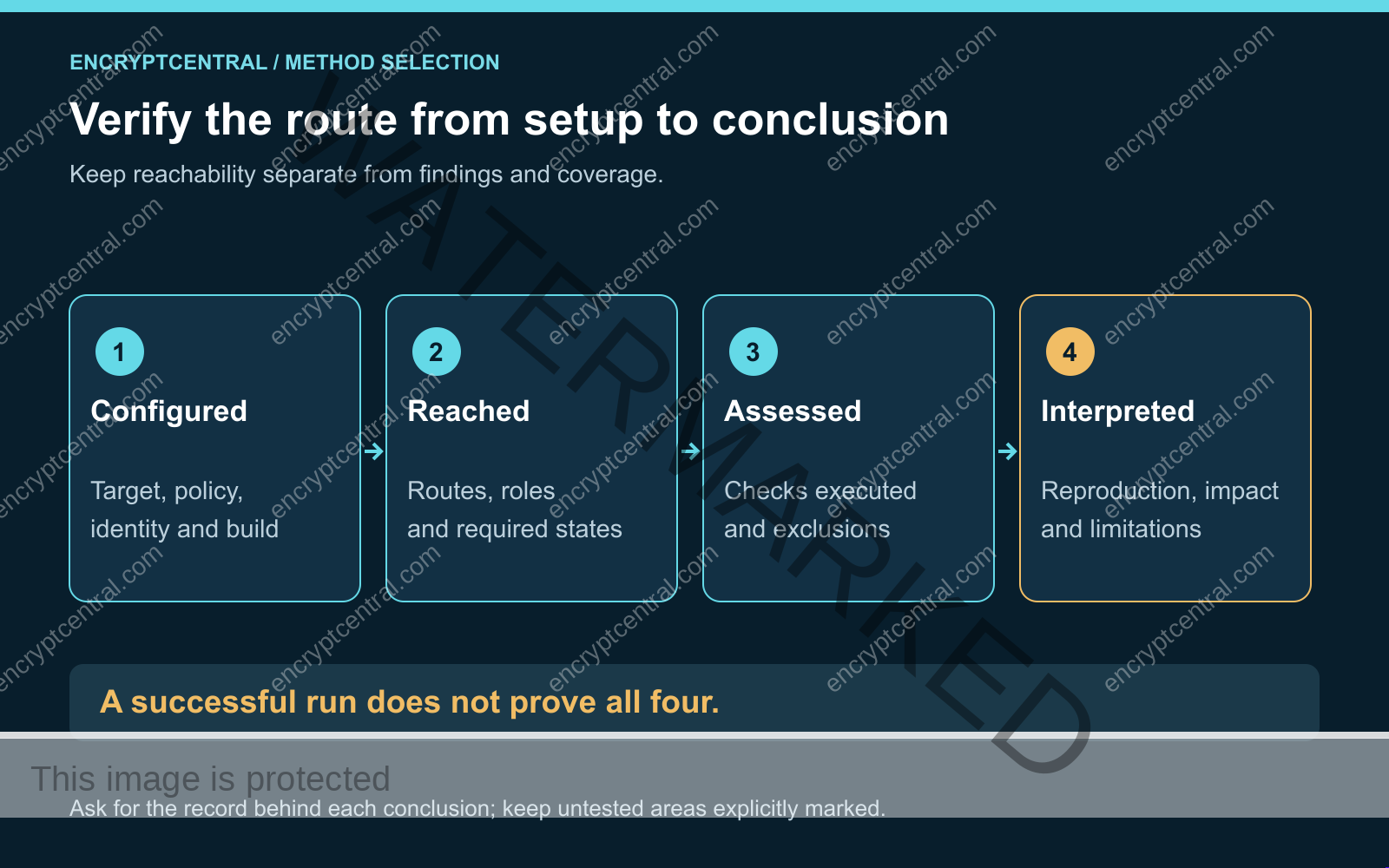
Configured: Which target, build, policy, identity and intended check were selected? A screenshot showing credentials were entered is not proof that a valid session existed throughout the work. Request sanitized records; do not ask a provider to email working passwords or tokens.
Reached: Which protected routes, roles and required states were demonstrably accessible during the assessment? Distinguish “credentials supplied” from “authenticated route reached.” If a prerequisite failed, preserve the affected area as unassessed.
Assessed: What actually ran or was investigated there, and what was excluded? An endpoint inventory does not establish that every endpoint received every relevant check. For human-led work, request the connection between the question, the selected investigation and the recorded evidence.
Interpreted: What conclusion follows from those observations, under which assumptions? A finding should connect behavior with the expected rule and supported impact. No finding should not become “secure” when it means only “none identified within this work.”
ZAP’s job outcome tests illustrate how assertions can check alert, statistic and URL/request/response conditions. Those checks can help verify a configured run. Their significance depends on the conditions chosen; a passing assertion cannot prove everything the assertion did not examine.
For a detailed look at finding evidence and remediation handoff, continue to our guide to reading a penetration-test report. Here, the acceptance question is narrower: can you trace each conclusion back through assessed work and reachability to the agreed setup?
Recognize failure modes on both sides
Automation without a meaningful assertion. The job finishes, but no check establishes that the protected workflow was reached. Ask which observable condition would cause the job to fail when access breaks. Until that is resolved, do not accept the run as evidence for that workflow.
Manual work without an investigation record. A consultant’s name and a list of tools do not establish contextual assessment. Ask for the scoped questions investigated, supporting evidence and explicit limitations. Human involvement does not guarantee depth or eliminate mistakes.
A regression suite mistaken for discovery. A suite can keep checking yesterday’s known cases while a new feature introduces different rules. Revisit the question inventory after material changes rather than assuming that more repeated executions expand its meaning.
Evidence stripped of its prerequisites. A report may show a response without identifying the role, state or environment. Request enough context to interpret the result safely. If disclosure constraints prevent this, agree a controlled review route instead of inventing confidence.
Coverage reduced to an effort ratio. A promised percentage of manual work tells you little unless you know what the effort addresses. Ask which important question remains unanswered if that effort is removed, and how the answer will be demonstrated.
Methodology, evidence and limits
Research checked October 22, 2026. We evaluated question fit, access prerequisites, repeatability, contextual judgment, evidence quality and safe operating boundaries. Gemini supported public-source discovery and coverage analysis; the cited original sources were inspected separately. This is a source-led buyer framework, not a product ranking.
| Evidence | Use here | Limit |
|---|---|---|
| NIST SP 800-115, selected assessment and planning sections | Method distinctions and authorized, bounded assessment planning. | Published in 2008; not current product, price or compliance-acceptance evidence. |
| OWASP WSTG v4.2 and SAMM control verification | Contextual test design, combined techniques and requirements-based regression. | Guidance, not comparative detection-rate measurements; historical absolutes are qualified. |
| Current ZAP framework, sequence and outcome-test documentation | Examples of configurable automation and inspectable assertions. | Documented features only; no installation, target scan or efficacy test performed. |
We reviewed selected sections of long publications, not every page or every current tool. No hands-on testing, vendor demonstration, customer interview or private quotation informed this article. The worked example and worksheets are original editorial aids. Qualified technical review remains pending; this is not a certification, legal opinion or compliance determination. Infrastructure and operational environments require their own scoped expertise. Affiliate disclosure: this article contains no affiliate links.
Choose an inspectable answer, then maintain it
Choose repeatable automation when you can define the check, supply the prerequisites and verify execution. Choose human-led investigation when you need to understand unfamiliar behavior and assess it against intended rules. Combine them when the decision requires both, and preserve useful discoveries as maintained regression cases.
Before accepting a proposal, write down one important security question, the work assigned to it and the evidence that would support an answer. Then identify what will remain unknown. That small exercise is more revealing than a manual-versus-automated label—and it gives you a concrete basis for accepting, narrowing or rejecting the proposed assessment.
Related posts:
 CrowdStrike Falcon® Intelligence: Automated Threat Intelligence Review
 Penetration Testing Review
 GuidePoint Security Penetration Testing Services Review
 Kroll Penetration Testing Services Review
 X-Force Red Penetration Testing Services Review
 Penetration Testing Pricing: Scope, Cost Drivers, and Red Flags


