

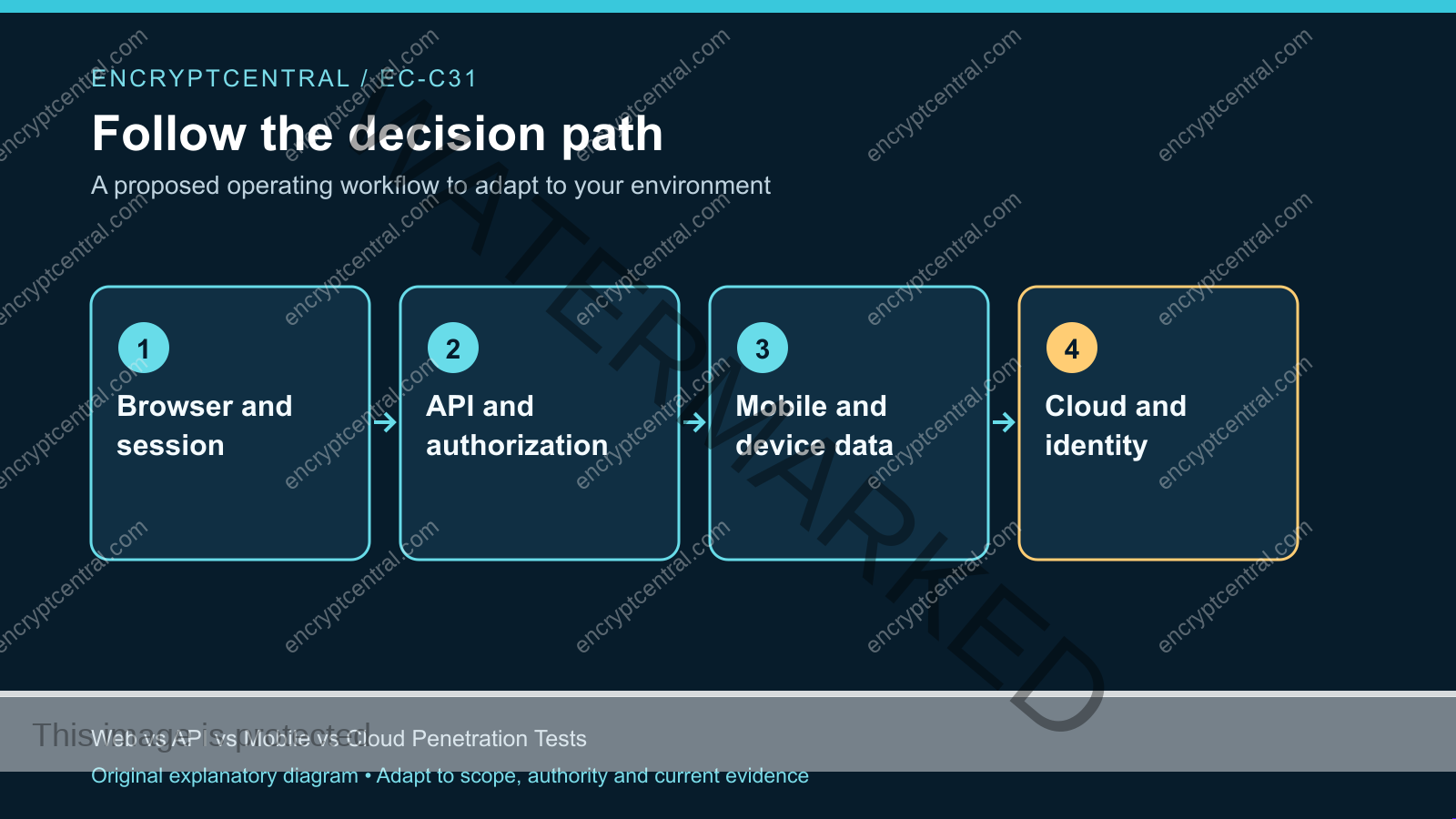
Choose penetration test scope by mapping the system’s surfaces and trust boundaries. Web testing examines browser-facing behavior and sessions; API testing examines service operations and authorization; mobile testing includes client and device-specific behavior; cloud testing examines the agreed infrastructure and identity boundaries. A modern application may need several of these perspectives in one coordinated assessment.
The labels alone are insufficient. Specify the assets, roles, environments, permitted techniques, and evidence expected for each surface. This guide proposes a scoping method using official sources checked on October 19, 2026. No penetration test or product benchmark was performed. Technical review is pending.
Map one application before choosing a package
Draw the path of a business transaction. A customer may open a web interface, authenticate through an identity provider, call an API, upload a file to object storage, and receive a notification from a third-party service. A mobile client may use the same backend while retaining data on the device.
Each step introduces questions about authority, data, and trust. Identify where the organization expects a control to apply and who operates it. An assessment described only as a website test may not address the cloud role that grants broad access to the storage service.
Use the cloud responsibility guide to clarify ownership. The testing scope must follow the customer’s actual authority and the provider’s rules, rather than treating every component used by an application as a customer-owned target.
What a web assessment should clarify
For a browser-facing application, define the assessed workflows, roles, session conditions, and deployment. Ask how the assessment addresses the business actions that matter, including transitions between ordinary users, administrators, and separate customers or organizations.
The OWASP Web Security Testing Guide provides a broad set of testing techniques and encourages tailoring them to application risk. Use it to discuss relevant coverage. Do not interpret a reference to WSTG as proof that every possible technique or business case is included in a limited engagement.
Clarify the relationship between browser behavior and backend enforcement. A hidden button is not the entire boundary if a user can request the underlying action directly. Ask who tests the corresponding API operation and where the report records that result.
What an API assessment adds
An API scope should identify the supported operations, authentication methods, roles, tenant boundaries, and business objects. Include representative accounts and controlled records that allow assessors to compare allowed and denied behavior. A list of public endpoint names may omit important authenticated functions.
Describe asynchronous work, exports, webhooks, and downstream effects where relevant. A request may start a job whose result appears later. The agreed evidence should follow the operation far enough to determine whether the tested boundary was enforced, without accessing unnecessary real data.
EncryptCentral’s API security testing guide covers a more detailed test workflow. In the procurement scope, identify who owns those cases and which are shared with the web assessment so they are neither omitted nor counted twice without explanation.
What a mobile assessment adds
A mobile application introduces a client running on a particular operating system and device context. Define the platform, application build, supported environments, local data, relevant device interactions, and backend services. Identify whether the engagement includes the server side or only the client.
The OWASP Mobile Application Security Testing Guide provides mobile testing knowledge and techniques associated with the mobile verification framework. Use it to discuss relevant client-side coverage rather than assuming a browser assessment is an equivalent review.
Do not let a successful client-side control become a claim about backend authorization. A server should enforce its own access rules even when an approved application normally hides invalid actions. Ask the assessors to identify which conclusions depend on the device, the client build, or the server configuration.
What a cloud assessment must define
“Cloud penetration test” can describe very different work. One proposal may examine externally reachable workloads. Another may review identity permissions, storage exposure, network boundaries, or the ability of a compromised workload to reach other resources. State the exact assessment perspective and allowed access.
Record accounts, subscriptions or projects, regions where relevant, representative roles, and shared services. Identify third-party managed components and provider-owned infrastructure outside the customer’s authority. Describe whether the engagement includes configuration review, architecture review, exploitation, or a combination.
AWS’s current testing policy illustrates why cloud permission must be explicit: permitted services and prohibited activities matter. Check the actual provider’s current terms for your target and technique. Customer ownership of an account does not authorize testing another tenant or disregarding platform restrictions.
Make shared boundaries visible
The most useful scoping exercise often happens between categories. Ask who tests the identity-to-API boundary, the mobile-to-backend boundary, and the application-to-cloud-role boundary. Write a named owner and expected evidence for each selected boundary.
| Boundary | Example question | Scope detail to settle |
|---|---|---|
| Web to API | Does the server reject an action the browser should not permit? | Operation, role and controlled resource. |
| Mobile to backend | Does changing the client alter server-side authority? | Client build and backend coverage. |
| Workload to cloud | What can the workload identity reach? | Role, account and authorized resource set. |
| Application to supplier | Which integration behavior may be examined? | Ownership, permission and data-handling limits. |
The questions are hypothetical scoping aids, not assertions that the system contains these defects. Their purpose is to reveal whether two assessment labels leave a consequential transition without an owner.
Use one rules-of-engagement record
When several specialists work on the same service, keep a shared authorization and coordination record. Identify targets, dates, contacts, approved techniques, stop conditions, data handling, and the authority to change scope. Surface-specific details can sit in linked schedules.
Agree on how teams communicate discoveries that affect another surface. A mobile assessor may identify an API route the API team did not receive. A cloud reviewer may find a shared role that changes the impact of an application finding. The teams need a route to coordinate within the approved scope.
Also agree on interference. One team’s account changes, test data, or configuration work can invalidate another team’s observations. Use an environment owner to coordinate material changes, and make the report explain any differences that affect conclusions.
Provide prerequisites that make the work meaningful
Prepare representative accounts, test data, architecture context, API descriptions where available, mobile builds, and access to the agreed environment. Validate them before the assessment window. Record what the assessor receives and what remains unavailable.
For a multi-tenant service, include controlled resources belonging to distinct tenants. For a mobile application, identify the supported device and operating system combinations actually selected for review. For cloud work, distinguish observation permissions from authority to perform potentially disruptive actions.
Do not assume production and staging are equivalent. Document the differences that matter to the assessment: integrations, identity configuration, security controls, data, or deployment architecture. A safer test environment can be appropriate while still limiting what its results establish about production.
Verify coverage with the final report
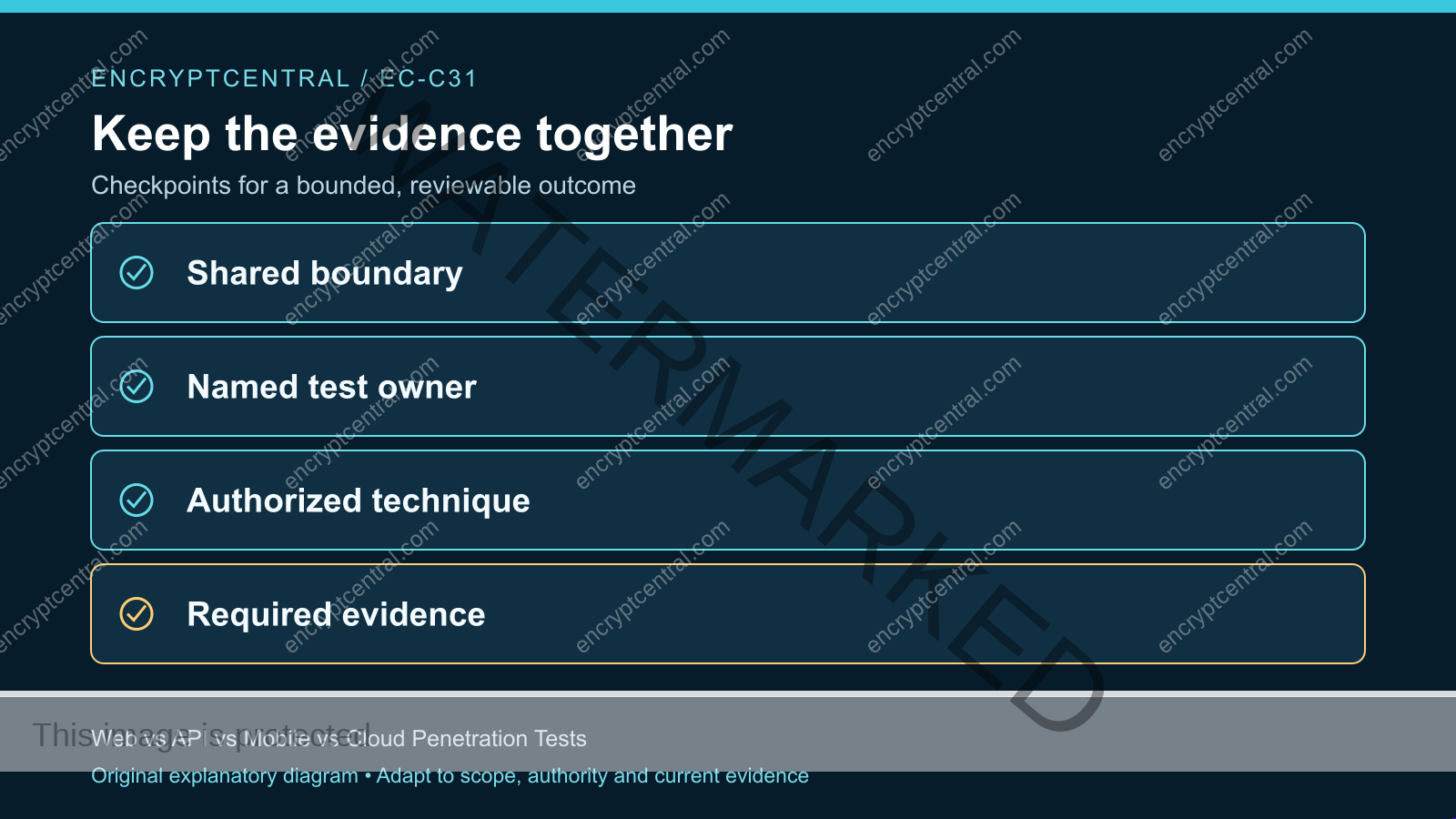
The report should identify the assessed surface, version, environment, role, business workflow, and relevant test boundary. Ask for important exclusions and blocked cases alongside findings. This lets the organization understand what evidence it purchased and what still needs review.
Give findings stable identifiers and connect related observations across surfaces. A client-side issue and a server-side authorization failure may contribute to the same scenario, but their evidence and repairs can differ. The report should make the relationship clear without turning an untested combination into a demonstrated attack chain.
Choose acceptance criteria for the report itself. Can an engineer reproduce a confirmed issue safely? Can a service owner identify the consequence? Can management see significant coverage limits? These questions assess decision usefulness without claiming the report proves complete security.
Choose scope under a limited budget
Prioritize according to the business service, exposed boundaries, sensitive operations, recent changes, and existing evidence. Ask the provider to propose a phased scope with explicit tradeoffs. A smaller assessment can be valuable when the organization understands what it leaves unanswered.
Avoid spreading a fixed amount of work across every category solely to obtain four labels. If a critical authenticated API workflow receives too little attention, the presence of mobile and cloud headings may create false confidence. Record why particular surfaces or cases were prioritized.
Plan how future changes trigger additional assessment. A new mobile client, a changed tenant model, or a new workload identity may alter the boundaries that mattered in the original engagement. Keep the coverage map with the architecture and release records so the next review starts from evidence.
Reconcile overlap before the final quotation
Ask each specialist to mark the same system map with the cases they will own. Where two teams claim a case, decide whether independent coverage is intentional or whether one team should lead and share its evidence. Where neither claims a boundary, assign it or record the exclusion explicitly. Keep the resulting map with the final scope, not only in meeting notes. This lets the buyer distinguish deliberate sampling from an accidental gap and gives the final report a clear coverage reference.
Common errors in assessment selection
Buying the same backend test twice. Clarify shared work between web and API packages. Duplicated activity can be useful for a reason, but it should be deliberate and documented.
Assuming a mobile test includes every server function. Ask for the backend scope in writing. Client analysis and service authorization are related perspectives with different prerequisites.
Calling a configuration review a penetration test without explanation. Both can be useful. State the actual activities and evidence rather than letting one label imply work that was not performed.
Leaving supplier permissions until the test starts. Identify ownership and approval early. An unresolved permission issue can remove a key integration from the assessment or delay the whole engagement.
Questions to resolve with the provider
Can one provider assess all four surfaces?
Possibly. Ask how the proposed team covers the relevant technologies, coordinates shared boundaries, and reports limitations. Evaluate the named work and evidence rather than assuming one organization or one specialist is automatically sufficient.
Should an internal API be included?
Consider who can reach it and which business boundaries it enforces. Internal placement alone does not answer whether the assessment should examine it. Select the scope according to the service’s risk and the decision you need to support.
What is the smallest useful first step?
Map one important transaction and name the surfaces and boundaries it crosses. Give that map to the provider and ask for an explicit coverage proposal, prerequisites, exclusions, and expected evidence.
Buy coverage you can explain
Choose the assessment perspectives that address the application’s important boundaries, assign ownership for shared cases, and preserve the limits in the report. Compare proposals against that map before comparing package names.
For foundational context, read the API endpoint guide and mobile application security overview. Your next deliverable is a scoped system map with a named assessor and an expected observation at every boundary selected for review.