

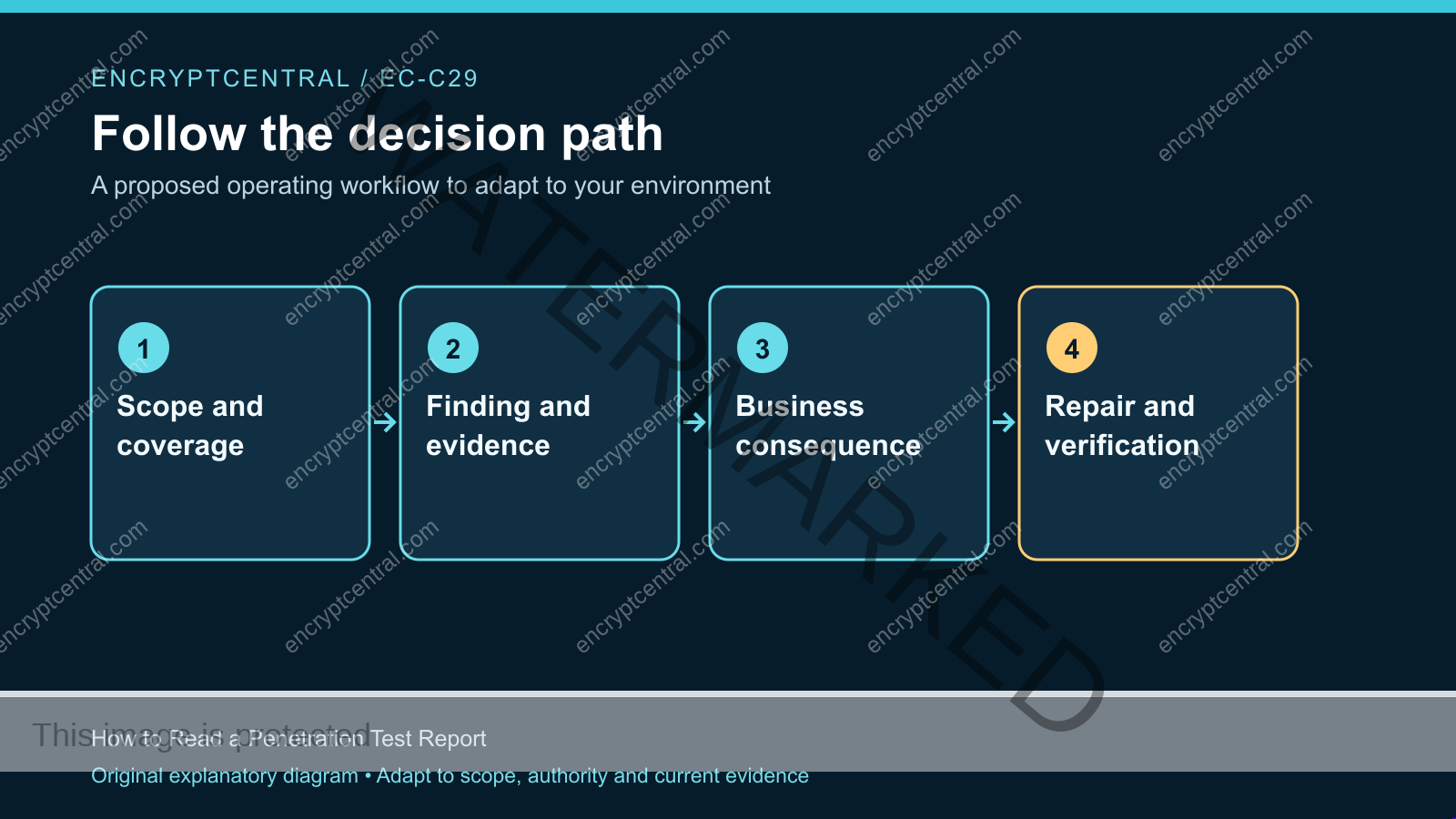
Read a penetration test report in this order: scope and limitations, confirmed evidence, business consequence, remediation ownership, and retest requirements. A severity label helps organize attention, but it cannot replace understanding which system, role, action, and result were actually tested.
The goal is to turn the report into decisions your organization can defend and repairs engineers can verify. This guide proposes a reading and handoff method based on official sources reviewed on October 19, 2026. No customer report or environment was tested. Examples are hypothetical; technical review is pending.
Read the coverage statement before the findings
Find the assessed targets, environments, dates, application versions, accounts, and roles. Identify what the assessors were allowed to do and what information they received. Then read the exclusions, inaccessible areas, time limits, and changes that occurred during the engagement.
A report can accurately describe a test while supporting a narrower conclusion than a reader assumes. An assessment of one staging build does not automatically describe a later production release. Testing without credentials cannot establish all authenticated authorization boundaries. A mobile client review may leave its backend outside scope.
Mark coverage questions separately from findings. “The payment API was not assessed” is a gap to resolve, not proof of a vulnerability. Conversely, “no critical findings” does not establish that untested systems are secure. Keep those categories distinct in any management summary.
Reconstruct one finding in plain language
Choose a significant finding and explain it without the severity label. Identify the actor, the access they already had, the action attempted, the resource affected, and the observed outcome. State what the application should have done instead.
For a hypothetical authorization issue, the useful sentence might be: “A user from customer A could request a synthetic invoice belonging to customer B through the assessed endpoint.” That is more actionable than “broken access control, high risk.” It also makes the prerequisite and customer boundary visible.
Compare the description with the evidence. Does it show the correct account, target, request, response, and relevant downstream effect? If the finding claims a data modification, a response code alone may not establish that the modification persisted. Ask for the specific evidence needed to support the stated consequence.
Distinguish observation, interpretation, and uncertainty
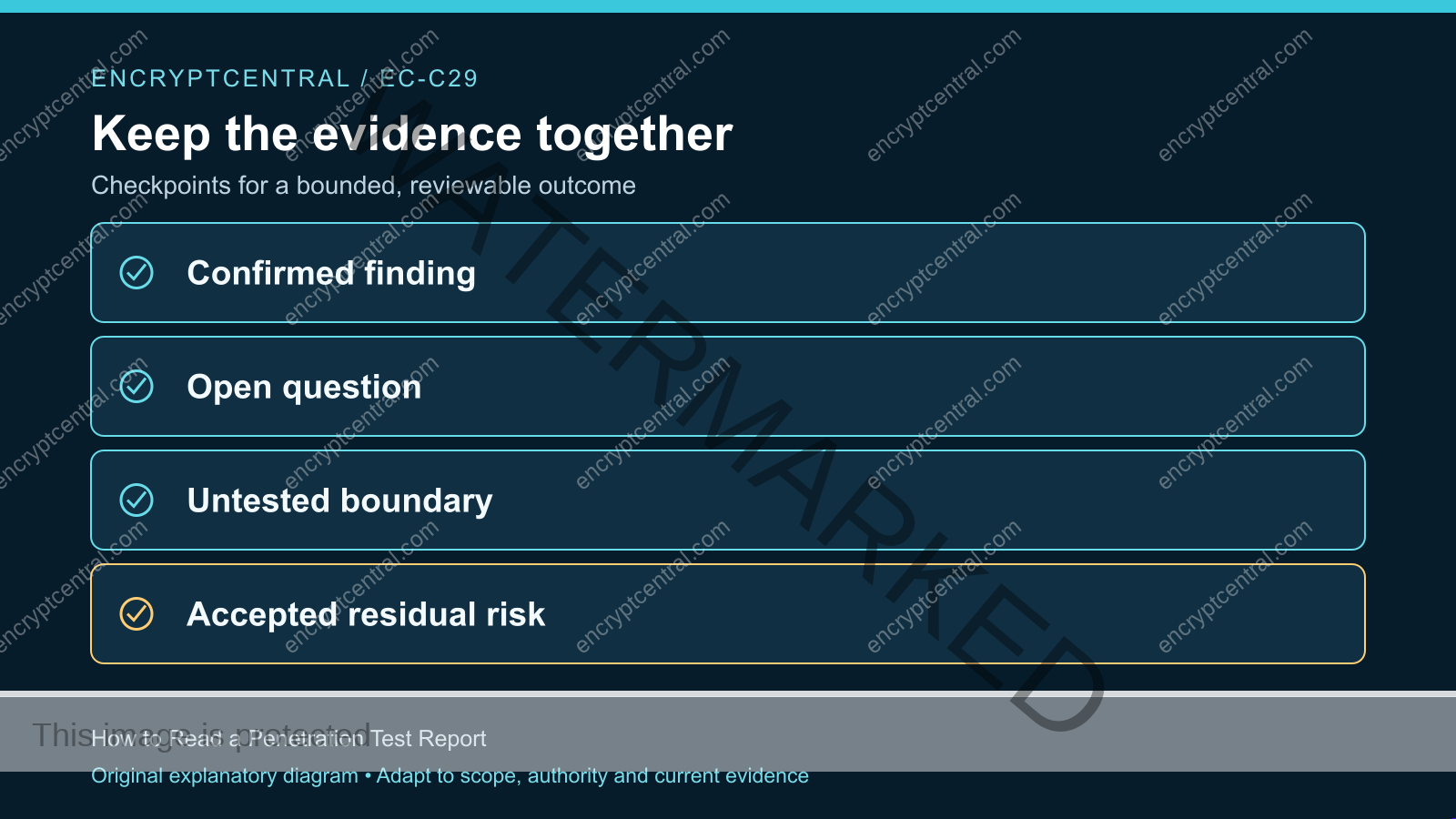
An observation records what the assessor saw. An interpretation explains what that result means. An uncertainty identifies what was not established. A strong handoff keeps all three visible instead of turning an inference into a stronger factual claim as it passes between teams.
For example, a report may demonstrate access to a controlled record and infer that similarly protected records could be affected. Ask what was sampled and which conditions make the wider inference reasonable. Do not require unnecessary extraction of real customer data merely to make a report look more dramatic.
NIST SP 800-115 discusses technical assessment planning, analysis of findings, and mitigation. It also emphasizes that assessment techniques have benefits and limitations. Use that process context when asking what a finding establishes; the publication is a foundational 2008 reference, not a current product certification.
Translate technical severity into your exposure
Retain the assessor’s severity and reasoning, then add organizational context. Is the affected service internet-facing? Does the tested role exist in production? Which information or business function is reachable? What compensating control was actually verified, and what is only assumed?
A severity score should not be edited casually to make a queue look smaller. If the organization disagrees, record the evidence and request clarification. Separate a factual correction, a different risk interpretation, and a temporary business acceptance. Each changes the decision in a different way.
Use the AppSec fix-first guide to connect findings with broader application risk. Avoid treating a named category as a complete repair instruction. Two findings in the same category can involve different owners, code paths, and consequences.
Check whether the recommendation addresses the cause
Read the remediation guidance alongside the observed failure. Does it explain where the control belongs, what behavior must change, and how the team can verify the result? A recommendation such as “validate input” may be insufficient when the actual defect is missing server-side authorization.
Ask the engineering owner to identify the authoritative implementation point: application code, identity policy, infrastructure template, deployment setting, or shared library. A temporary console change can reduce immediate exposure while leaving the source that recreates the defect unchanged. Record both the immediate action and the durable repair where they differ.
OWASP ASVS provides application verification requirements that can help frame the expected control. Select relevant requirements and a specific version rather than citing the standard as a blanket assertion that every weakness is covered.
Create a remediation record with a real owner
For each accepted finding, record its stable identifier, affected assets, current exposure, engineering owner, target date, change reference, and verification plan. Link related findings where one underlying repair may address several symptoms, but preserve the evidence needed to close each one.
Give the owner the context required to reproduce the issue safely in an approved environment. Identify which test accounts and controlled data are needed. Store sensitive report evidence under appropriate access controls; a broadly visible ticket should not contain live credentials or unnecessary customer records.
Assign unresolved prerequisites too. If the team cannot reproduce the issue because the test account expired, that is a task with an owner. Leaving the ticket in a generic “needs information” state can obscure whether the delay sits with the assessor, application team, or environment owner.
Read the report as a connected system
After individual findings are understood, look for shared causes and combinations. Several exposed administrative interfaces may point to one deployment inventory problem. Multiple authorization failures may indicate an inconsistent control pattern rather than unrelated coding mistakes.
Ask whether the report demonstrated a combined attack path or merely listed findings that could potentially relate. Preserve that distinction. An executive summary should not present a hypothetical chain as if the assessor executed it, and it should not overlook a documented chain by reducing every component to a separate ticket.
The OWASP Web Security Testing Guide encourages tailoring techniques to application risk and recognizes the role of manual judgment alongside tools. That supports asking about business context and coverage rather than interpreting a scanner count as the assessment’s full meaning.
Use the findings meeting to resolve decisions
Prepare questions in advance: Which results need clarification? Which repairs span several teams? Which limits change the management conclusion? Which findings need urgent containment? Ask the assessor and internal owners to answer against the same finding identifiers and evidence.
Record agreed corrections to the report and preserve the version history. If a finding is withdrawn because the original interpretation was wrong, retain the reason. If it remains valid but the business accepts it temporarily, record the acceptance authority and review date. Those are different outcomes.
End the meeting with specific actions. Each should have an owner, expected output, and next decision. A general statement that “engineering will review the report” is difficult to follow up and does not tell management which exposures remain open.
Define closure before the retest
For a technical repair, agree on the evidence that would establish success. Usually that means testing the original condition against the deployed change, checking the legitimate workflow, and examining related cases included in the retest scope. Identify what remains untested.
In the invoice example, the unauthorized account should be denied access, while the authorized account can still retrieve its own synthetic invoice. The team should inspect the response and any relevant export or saved effect. A universal denial may remove the visible attack while breaking the service.
Use the access-control testing checklist for that specific boundary. Keep the final closure statement narrow: name the finding, environment, version, accounts, test, result, and limitations. Avoid converting one successful retest into assurance about unrelated functionality.
Write a management brief without overstating assurance
After the technical discussion, prepare a short decision brief using the report’s actual boundaries. State which service and version were assessed, the important confirmed exposures, who owns repairs, and the material areas not examined. Keep customer identifiers and reproduction details in the restricted technical record rather than placing them in a widely circulated presentation.
Use separate sentences for test results and management decisions. For example, a finding may remain technically reproducible while an authorized owner temporarily accepts the exposure subject to a compensating measure. Describing that as “passed” would erase the distinction between an observation and a business choice.
List the next decision and its prerequisite for each major issue. An owner may need deployment approval, an assessor clarification, a supplier response, or a retest result. This gives management a way to remove a real obstacle rather than asking only why a ticket remains open. Keep the brief linked to the versioned report so later changes do not turn an old summary into an apparently current assurance statement.
Warning signs in a report handoff
Findings lack reproducible context. Request the missing target, account perspective, action, and result through the agreed secure channel. Do not invent the steps yourself and then attribute them to the assessment.
Every recommendation is a generic best practice. Ask which control failed and where the proposed repair should apply. The provider may need application-owner input to make the recommendation useful.
Untested areas disappear from management reporting. Include important limitations alongside the results. A short executive summary can still distinguish assessed exposure from outstanding coverage.
Tickets close when a developer says the fix is merged. A merged change is not necessarily deployed or effective. Link the repair to the running environment and the agreed verification result.
Questions readers commonly ask
Should we fix findings in score order?
Use the score as one input alongside exposure, business consequence, verified exploitability, dependencies, and the feasibility of immediate containment. Document why the organization changes the sequence. Do not substitute unsupported reassurance for a risk decision.
Can we share the whole report with every engineer?
Use the organization’s handling rules and give people the detail needed for their work. Full reports can contain sensitive architecture and reproduction evidence. A controlled report plus appropriately scoped tickets may support collaboration without unnecessary disclosure.
Does a clean report mean the system is secure?
It describes the results of the scoped assessment under its stated conditions. Treat it as evidence about that work, with its dates and limitations. Continue normal vulnerability management, change review, monitoring, and testing as the service evolves.
Turn the report into a usable repair queue
Read one significant finding with its owner and reconstruct the evidence. Then create a repair record that includes the expected control and the closure test. Repeat across the report while preserving shared causes and coverage limits.
For service context, refer to the penetration testing overview. The report has done its job when the organization can state what was demonstrated, what it means, who will act, and what evidence will establish the next decision.