


To review internet-exposed RDP, map every authorized route to the host, decide which routes the business needs, then verify the approved restrictions from named starting points. Include direct connections, gateways and alternate port mappings. A working gateway login does not settle whether the same computer remains reachable through another route.
The useful output is an access-path ledger: one record for each way a user could reach a Remote Desktop destination, with an owner, an intended permission boundary and evidence of the result. It gives the person approving the change something more specific than “RDP secured.”
This guide is for administrators reviewing systems they are authorized to manage. Agree on the review boundary, permitted checks and recovery arrangements before making changes. The operating aids below are original editorial tools; they are not results from testing a real network.
Decide which remote access the business needs
Start with the business purpose. Who needs access, to which computer, for what task and during which period? “The supplier sometimes uses it” needs a named sponsor, an approved destination and a way to end access. A dormant troubleshooting arrangement needs a retirement decision.
The joint CISA, FBI, NSA and MS-ISAC May 2023 #StopRansomware Guide recommends limiting RDP, auditing its use, closing unused RDP ports, applying MFA and logging login attempts. It also recommends phishing-resistant MFA for critical services. That is a dated defensive baseline, not a measurement of current attack prevalence.
For this review, give each path one proposed disposition: retain through an approved route, restrict, retire, or hold for an accountable exception decision. An unknown dependency should remain visibly unresolved until its owner responds. Avoid removing a production support route without an authorized recovery plan.
Keep the scope manageable. Begin with a named service, site or cloud subscription and its known remote-access dependencies. Record what you excluded. For broader endpoint, home-network and workforce policies, use the remote-work security guide; the task here is reconciling the paths into specific RDP destinations.
Build a ledger of entry paths, not just computers
Give each path its own identifier. One host might have an approved gateway route and a forgotten direct mapping. Combining them into a single “MFA enabled” row would hide the difference the review needs to resolve.
Start with authorized configuration records: asset ownership, public address assignments, gateway configuration, perimeter mappings, cloud rules and host settings. Ask the responsible administrators to reconcile those records. An external observation can then test a defined expectation; it should not substitute for understanding the configuration.
| Ledger field | What to record | Decision it supports |
|---|---|---|
| Path and destination | Path ID, host identifier, service purpose and asset owner | Which business need justifies this route? |
| Entry and translation | Public address or name, configured port, gateway and any address/port mapping | Where can the connection enter? |
| Permission boundary | Approved identities, source locations and destination scope | Who should reach what? |
| Enforcement points | Relevant gateway, identity, cloud, perimeter and host controls | Which saved settings implement the decision? |
| Observation | Authorized starting point, time, expected result, observed result and evidence reference | What did this particular check establish? |
| Ownership and expiry | Change approver, rollback owner, exception expiry and next review trigger | Who resolves or revisits the finding? |
Include configured ports rather than assuming every listener uses the default. Microsoft documents 3389 as the default Remote Desktop listening port and explains that it can be changed. The inventory implication is straightforward: checking only 3389 cannot account for a known custom listener or an external mapping to it. Changing the number also does not define who is authorized to connect.
Where applicable, record separate IPv4 and IPv6 entry points and distinguish the external port from the host’s listening port. Mark unavailable information as unknown, assign an owner and keep that row open. Do not turn a blank field into an assumed denial.

Check what the gateway actually enforces
Separate transport, identity and destination permissions. Microsoft’s RD Gateway architecture documentation describes an encrypted TLS tunnel, user authentication, authorization policies and proxying to internal resources. Those are architectural functions. The presence of the gateway does not establish how your saved policies constrain access.
For Windows Server RD Gateway, review the Connection Authorization Policy, or RD CAP, for who may connect, and the Resource Authorization Policy, or RD RAP, for the internal resources they may reach. Microsoft’s Entra MFA NPS-extension integration guide explains that CAP evaluation can use a central NPS policy store, while RAP processing remains on the gateway. Record the actual policy locations and the users, groups and targets covered by this path.
Record the actual MFA method and integration too. That same guide describes phone-call and Authenticator Approve/Deny support with constraints specific to this flow. “MFA enabled” alone does not establish phishing resistance or the organization’s required assurance level. Ask the identity owner to assess the supported method against that requirement; do not weaken authentication settings to make a legacy flow fit.
Apply the answer to this path only. An account enrolled in a cloud MFA service is not, by itself, evidence that every way into an RDP host invokes that service. Keep a direct host route as a separate review item until its own controls and behavior are reconciled.
In Azure, an approved brokered design may use Bastion. Microsoft’s Bastion NSG guidance explains that the target VM need not have a public IP, while private RDP access still requires appropriately scoped network rules. That Azure-specific example illustrates the distinction between removing a public entry and permitting the intended private route. It is not proof of any deployed rule set.
Plan the restriction and a safe recovery route
Translate the disposition into an exact change request. Identify the path being removed or restricted, the intended surviving route, the owner of each affected control and the people who depend on it. Include a maintenance window where the service requires one.
Before changing the access you currently depend on, confirm an approved recovery method with the system owner. It might be an existing authorized management console or another established administrative route. Record who can use it and who can authorize rollback. Do not discover during an outage that the person responsible cannot reach the recovery interface.
Define rollback as carefully as the forward change. Specify the condition that triggers it, the settings to restore, the approver and how the temporary state will be tracked. Avoid a vague instruction to reopen access broadly until someone investigates. A recovery action should preserve an accountable, bounded access decision.
For each change, write the expected permission boundary in plain language: “Approved support staff can reach this named host through the approved gateway; the old direct entry is unavailable.” Have the responsible administrators translate that intent into their platform’s configuration. This article deliberately provides no universal firewall command that could accidentally widen access.
Microsoft’s Azure NSG troubleshooting guide warns against exposing RDP port 3389 directly to the internet in production. It also describes rule priorities and combined subnet/NIC effects. Its connectivity troubleshooting examples should not become an unrestricted production baseline.
Keep before-and-after configuration evidence with the change record. Reference the security misconfiguration checklist for baseline and drift governance. The access-path ledger should identify which baseline decision applies here, rather than copying an entire general hardening checklist.
Verify allowed and denied cases from named starting points
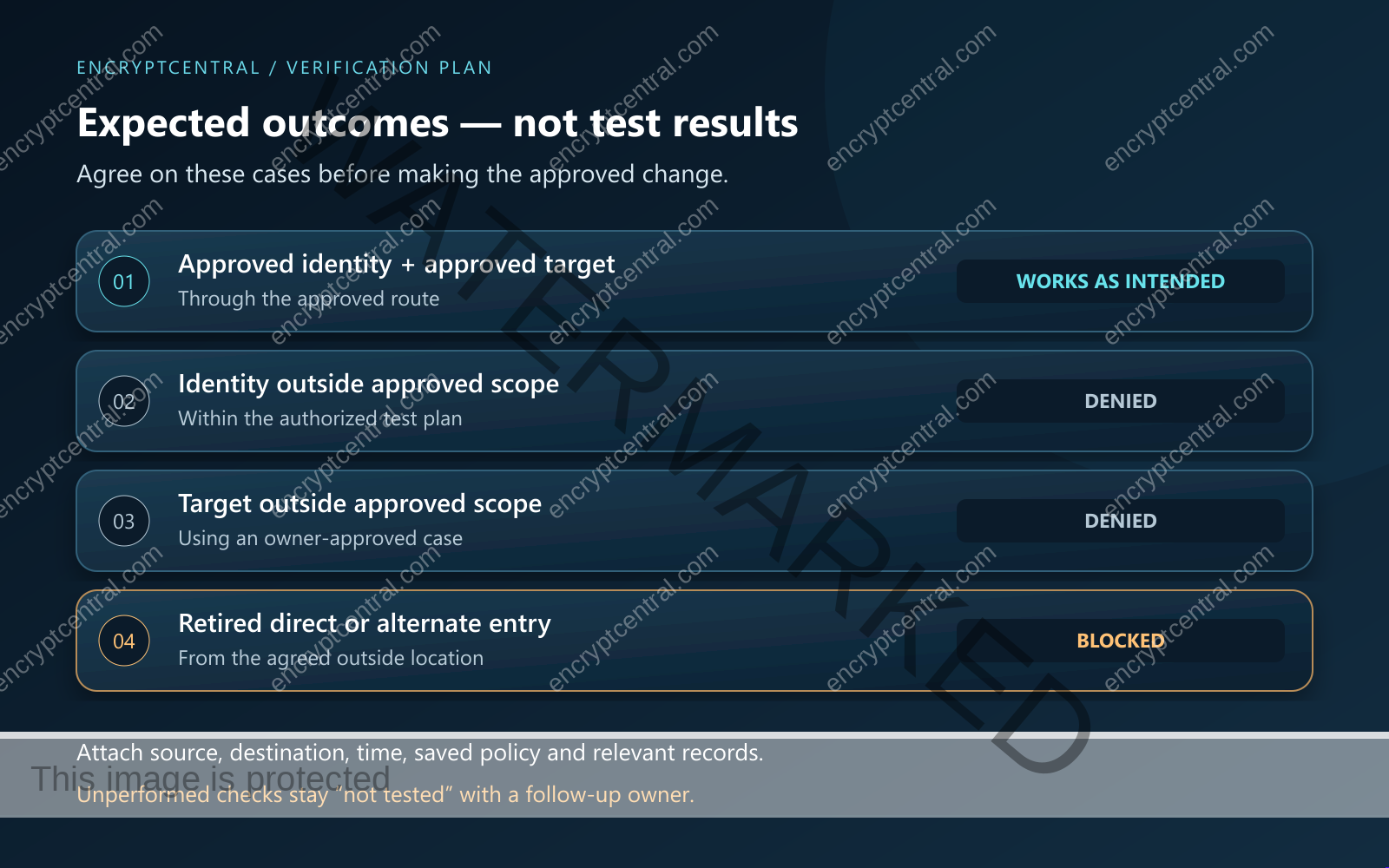
Agree on expected outcomes before the change. Otherwise, a successful connection can feel reassuring even when the review was supposed to remove that particular route. Use approved test identities and destinations, and keep the checks within the owner’s agreed scope.
- Approved identity, approved destination, approved route: confirm that necessary access works through the intended path and that the relevant records identify it.
- Identity outside the approved scope: confirm the expected denial without guessing passwords, using another person’s account or triggering uncontrolled authentication attempts.
- Destination outside the approved scope: use an owner-approved case to check that permission to enter the gateway does not imply permission to reach an unapproved target.
- Retired or unapproved direct route: check the intended restriction from the agreed external starting point, using the recorded address and configured mapping.
- Configuration and event reconciliation: compare the saved controls and relevant connection, authentication and session records with the intended path and observed outcome.
Use “not tested” when a case could not be performed. Attach the reason and a follow-up owner. A configuration review and an observed connection answer different questions; preserve both instead of marking the whole row passed because one looked right.
Record the source location, destination, route, time and observation window. A failed connection from one location supports a limited finding about that attempt. It does not establish that every other address, source, identity or alternate path is blocked. Equally, a successful connection needs a route explanation before it can confirm that the intended control was involved.
For Azure examples, reconcile the effective subnet and NIC rules rather than reading a single reassuring rule in isolation. For gateway examples, have the platform owner identify the appropriate policy and event records for the deployed version. Keep sensitive infrastructure details in the controlled review record, not in a public screenshot.
Work through a fictional alternate-route finding
Consider a fictional design studio reviewing access to Render-01. Its support team uses an approved RD Gateway. During an authorized configuration review, the network owner also finds an older public port mapping to that host, created for a contractor’s troubleshooting session.
The ledger gets two rows: RDP-A for the gateway path and RDP-B for the old direct mapping. RDP-A’s review includes the approved staff group, target-resource policy and actual MFA method. RDP-B has a different entry point, no current business sponsor and no recorded expiry.
A successful gateway check would address only RDP-A. It would not close RDP-B. The change approver therefore asks the network and host owners to reconcile the old mapping, confirm dependencies and propose its retirement with an authorized recovery arrangement.
After approval, the proposed verification would check that staff can still use RDP-A and that RDP-B produces the expected restriction from the agreed outside location. The reviewers would attach configuration and observation references to the respective rows. If the second check cannot be completed, RDP-B remains “verification pending,” even if the removal was saved successfully.
No connection, firewall change or authentication test was performed for this example. Its value is the decision rule: evidence about the approved route cannot silently stand in for evidence about an alternate route.
Handle exceptions and signs of compromise separately
An exception needs enough detail to be managed: business reason, sponsor, affected path, approved identities and destinations, relevant restrictions, start time, expiry, review owner and retirement action. “Temporary” without an end condition is an unresolved exposure decision.
At expiry, require either documented retirement with the planned verification or an explicit reassessment by the authorized owner. Carry forward the evidence gap if verification is incomplete. Do not reset the date automatically and describe the same unanswered finding as resolved.
Unexpected login records, unexplained sessions or suspected credential misuse need a separate incident decision. Involve the responsible response lead and follow the organization’s evidence-handling procedure. Restricting a route may be appropriate containment, but it does not establish that an intruder is absent or that affected credentials and hosts are trustworthy.
The small-business incident response plan provides a starting point for escalation roles and coordinated response. Keep that investigation distinct from the routine access-review closeout so a configuration change cannot accidentally substitute for an incident assessment.
Close the review with evidence and an owner
Close each path against its approved disposition. The record should show the saved configuration, the expected and observed outcomes, unresolved limitations, the person accepting the result and the next review trigger. A new public address, gateway replacement, identity-policy change or temporary support arrangement should prompt the responsible owner to revisit the affected paths.
Start with one service and reconcile its direct and brokered routes completely within the agreed scope. Keep unknowns and unperformed checks visible. That produces a review another administrator can understand and continue, without relying on an ambiguous “RDP secure” label.
Research and testing disclosure: this guide draws on six official sources reviewed on October 30, 2026, including the explicitly dated May 2023 joint guide. The ledger, verification sequence and fictional studio example are original editorial aids. We did not test an RDP client, gateway, account, server or network. Product documentation cannot establish the security of a live deployment; qualified technical review of this article and implementation-specific checks remain necessary.
Related posts:
 What Are The Security Considerations For Remote Work?
 AI Agent Risks Exposed in Salesforce Agentforce
 What Is The Internet Of Things (IoT), And What Are Its Security Risks?
 Microsoft Entra Emergency Access Account Checklist
 Employee Offboarding: Verify Access Revocation
 What Are 10 Safety Rules For The Internet?


