


What a Kubernetes RBAC review should answer
A useful Kubernetes RBAC review connects a workload to its service account, traces the grants that apply to that identity, and compares those permissions with an application owner’s documented needs. The result should be a defensible decision: retain a justified grant, investigate an unknown dependency, or reduce access through an approved change with verification and rollback.
Begin with one important workload. Produce a permission worksheet, a short list of unexplained grants and a test plan that states both required access and access that should be refused. Keep the initial review observational; changing a production binding before understanding its consumers can turn an access cleanup into an outage.
The technical foundation is simple: Kubernetes RBAC permissions add together. A new, limited grant does not cancel an older, broader one. The official RBAC reference explains the role and binding objects behind that behavior.
Start with one workload and a named owner
Choose a workload whose purpose someone can explain: a telemetry collector, deployment controller or scheduled reporting job. Record the cluster context, environment, workload reference, namespace, application owner and date of review. Ask who can approve a permission change and who will judge whether the application still performs its job.
A ServiceAccount is namespaced. Pods select one through spec.serviceAccountName; a namespace also has a default service account. Inspect the actual assignment and the workload’s maintained configuration rather than assuming that its application name identifies its account. The Kubernetes service-account guide also explains that an account can receive access in another namespace through a binding there.
Write the business dependency in plain language. “Collector reads Pod inventory in the metrics namespace” is more useful than “monitoring needs read access.” Ask about startup, scheduled work and recovery tasks as well as steady operation. A permission that looks unused during a quiet interval may belong to a monthly job; record the uncertainty and ask its owner for evidence.
If several applications share the account, list those consumers before proposing a change. Treat an unconfirmed consumer list as an open review item. Assign an investigator and a due date instead of silently accepting a shared identity as adequately understood.
Trace direct subjects, groups and target namespaces
Service-account usernames follow system:serviceaccount:<namespace>:<name>. Their standard groups include system:serviceaccounts and system:serviceaccounts:<namespace>; successful authentication also receives system:authenticated. These identity details come from the official authentication documentation. A search limited to bindings that explicitly name the ServiceAccount can miss a group grant.
For each applicable subject, follow its binding to the referenced role and preserve the evidence. A RoleBinding grants within the binding’s namespace and may reference a local Role or a ClusterRole. A ClusterRoleBinding applies its ClusterRole across the cluster. Keep the service account’s namespace separate from the namespace where access is granted.
Use an authorized administrator’s inventory or existing read permissions. These PowerShell examples inspect binding metadata; the namespace is a placeholder, and no commands were executed for this article:
$ReviewNamespace = "review-namespace"
kubectl get serviceaccounts -n $ReviewNamespace
kubectl get rolebindings -n $ReviewNamespace
kubectl get clusterrolebindings
This starting inventory does not establish coverage of every target namespace. Ask the cluster owner to supply relevant RoleBindings elsewhere, including bindings to the account’s groups. Record which namespaces and object types the reviewer could inspect. If permissions prevented a read, mark that part of the inventory unavailable; an empty visible list cannot resolve an unseen grant path.
Keep evidence in the approved internal review location. Binding names, subjects and rule references are sufficient for this task; collecting Secret values, bearer tokens or kubeconfig credentials adds no value to the permission worksheet.

Read the permission and its configuration owner
Inspect the actual rules. Capture the API group, resource or subresource, verb and any resource-name restriction. For a cluster grant, include relevant non-resource URL rules. A label such as “reader” is a clue for investigation, not a substitute for the rule evidence.
Aggregation and default-role reconciliation deserve special attention: control-plane processes can maintain role content. Record aggregation selectors and the configuration owner before planning edits. The RBAC reference describes both mechanisms. Route changes to the responsible owner rather than manually editing a managed role’s generated rules.
The official RBAC good-practices guide recommends least privilege and periodic review. It highlights Secret read access, workload creation, and the bind, escalate and impersonate verbs as important risk areas. Wildcards also deserve scrutiny because permissions can expand as resources or actions are added.
Turn those findings into questions for the application owner. What exact operation requires this grant? Which resource and environment does it concern? Is the requirement current, historical or unknown? Who maintains the underlying configuration? Give a high-impact unexplained grant an explicit investigation priority; do not turn a role-name heuristic into an automatic deletion rule.
Build a worksheet that supports a decision
Use one worksheet per reviewed service account, with a separate entry for each contributing grant path. The following is an original review aid. Adapt it to your change process; it is not a Kubernetes-required form.
| Record | What the entry should establish |
|---|---|
| Identity and consumers | Cluster, environment, account namespace/name, workload references and accountable application owner. |
| Grant path | Direct or group subject, binding type/name/namespace, referenced role and dated evidence location. |
| Permission details | Exact operation and scope under review, with the inspected rule or authorization evidence attached. |
| Business dependency | Required application behavior, supporting evidence, affected consumers and unresolved assumptions. |
| Configuration ownership | Maintained source, responsible team, reconciliation mechanism and approved change route. |
| Decision and risk | Retain, investigate or propose reduction; explanation, decision owner and investigation deadline. |
| Verification plan | Expected allow/deny cases, actual evaluated identity, observation method and application acceptance criteria. |
| Change and recovery | Approval, implementation window, recovery instructions, rollback trigger and person authorized to act. |
Keep “expected” and “observed” in different fields. An owner’s statement that a collector should read inventory establishes a requirement. A recorded authorization response establishes the outcome of a particular question at a particular time. Neither entry should silently stand in for the other.
Likewise, separate retained access from unresolved access. For a retained grant, explain why it remains appropriate and when it should be revisited. For an unknown grant, state the missing evidence and assign the next action. This makes a partially completed review useful without overstating its completeness.
Give the worksheet enough context for another operator to resume it. A screenshot labeled “permissions look fine” is hard to reproduce. A dated object reference, relevant rule, bounded question and named owner make the decision easier to challenge or confirm.
Work through a hypothetical excessive grant
Consider a fictional collector named telemetry-reader in metrics-a. Its owner says it needs Pod inventory in that namespace. The reviewer finds a direct grant for that work and a second grant through a group binding that also permits Secret reads across a wider scope. These are invented planning details, not results from a real cluster.
The first decision is to investigate the wider grant’s consumers and purpose. Do other service accounts depend on that group binding? Who introduced it? Is it maintained in an approved configuration repository? Record the answers before choosing how to change it.
Adding another Pod-reading binding would leave the excessive path in place. The proposed change must address the grant that supplies the unwanted permission, while preserving documented dependencies for the affected identities. A broadly shared group binding may require a wider owner review than the original collector ticket.
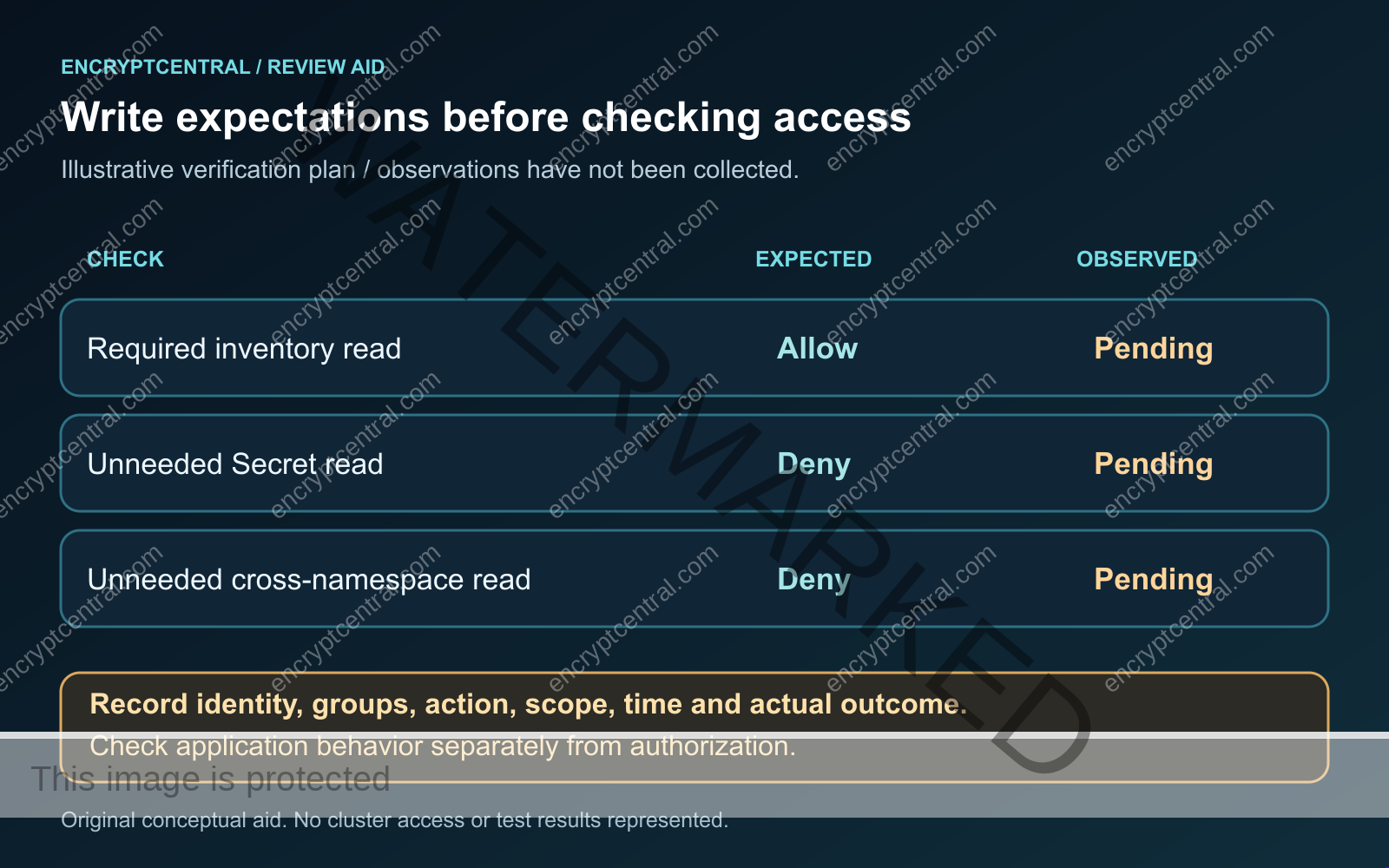
Write two separate acceptance questions: does the collector retain its required inventory access, and is the unwanted Secret-reading authorization absent for the reviewed identity and scope? Add an application health check agreed with its owner. Leave every observed-result field blank until someone actually performs and records the authorized checks.
Define expected access before checking it
Build a small verification matrix before implementation. Include a required operation, an unnecessary operation against a sensitive resource, and an unnecessary operation in another namespace. Choose cases that match the proposed reduction; a generic “can read Pods” check may say little about the permission you intend to remove.
The official kubectl auth can-i reference documents action, namespace and subresource checks. An administrator who already has appropriate impersonation permission could evaluate this fictional inventory question:
kubectl auth can-i list pods -n metrics-a --as=system:serviceaccount:metrics-a:telemetry-readerDo not infer its output from the example. Record the actual cluster context, evaluated identity, groups, action, scope, time, result and any error. If the reviewer lacks authorization to make the check, ask the responsible administrator to perform it through the existing review process.
Take care with group context. The inspected upstream traditional impersonation implementation supplies standard service-account groups when no group headers are given. Explicit group input changes that context. Have the administrator verify the evaluated identity for the deployed version and mechanism; do not blindly add group flags or grant new impersonation privileges.
Authorization is one layer of evidence. The Kubernetes authorization guide explains that admission follows authorization and that clusters can configure multiple authorizers. A positive authorization answer does not demonstrate admission acceptance, network reachability, external cloud access or successful application behavior. Record those observations separately when they matter to the change.
Plan and validate a controlled reduction
Turn the worksheet into a bounded change proposal. Name the grant path to change, the consumers affected, the reason for reducing it and the evidence supporting the expected replacement behavior. Have the application and platform owners agree on the acceptance checks, implementation window and recovery trigger.
Preserve the reviewed configuration and the recovery instructions in the approved change system. Confirm that the person implementing the change can follow those instructions and that a responsible owner will be available. If a controller or deployment process maintains the objects, change its approved source and account for its reconciliation behavior.
Where practical, exercise the proposal in a suitable non-production environment with the same relevant dependency. Record differences that limit what the exercise proves. A successful staging check is useful evidence, but an unexplained production-only dependency should remain an open question.
After implementation, capture fresh permission evidence and repeat the agreed authorization questions. Then have the application owner check the required startup, steady-state or scheduled behavior. Compare the observations with the written expectations. Investigate an unexpected result before declaring the review complete; use the approved recovery route if the agreed rollback trigger occurs.
For continuing configuration monitoring, connect the decision to the broader security misconfiguration checklist. The RBAC worksheet records the access decision; the ongoing configuration process should detect when its underlying assumptions change.
Recognize failure modes that leave the review open
- Only one binding was inspected. Keep other subject and namespace coverage explicitly open until the administrator supplies the missing evidence.
- The expected account was never confirmed. Return to the workload assignment and evaluated identity before interpreting the test result.
- A shared grant lost its consumer list. Pause the proposed reduction and identify affected application owners.
- The configuration returned after a manual edit. Identify the maintained source and reconciliation owner; attach the intended change there.
- An authorization answer became an application sign-off. Request the separately agreed functional observation and keep its status pending.
- Automatic token mounting was disabled and the ticket was closed. Review the grants themselves. Token delivery and RBAC permission are different controls, as the service-account documentation makes clear.
Keep neighboring reviews connected without merging their conclusions. Application object, tenant and function access belongs in the broken access control testing checklist. Provider and customer ownership belongs in the cloud shared-responsibility guide. Completing this workload RBAC review does not close those separate decisions.
Close the review with evidence and an owner
Close a permission decision when its identity, grant path, business requirement and disposition are documented, and any implemented reduction has the agreed authorization and application observations. Record residual uncertainty, accepted exceptions and a review trigger such as an application change, owner change or platform upgrade.
Start with one workload today. Ask its owner to explain the most consequential unexplained grant, attach the relevant binding evidence and define the next authorized check. A small completed decision with a clear scope is a useful foundation for reviewing the next account.
Research and methodology: official Kubernetes documentation and an immutable upstream source-code snapshot reviewed October 30, 2026. The worksheet, diagrams and fictional scenario are original editorial aids. We did not access a cluster, collect credentials or execute the example commands. Deployed versions, authorizers and managed-platform settings require local verification. Qualified technical review and owner QA remain pending.
Related posts:
 Microsoft Entra Emergency Access Account Checklist
 AI Agent Security: Permissions, Injection, and Data Exfiltration
 Astra Penetration Testing Service Review
 How Do I Choose A Secure Web Hosting Service?
 Internet-Exposed RDP: Review and Restrict Remote Access
 Employee Offboarding: Verify Access Revocation


