


An unsolicited vulnerability report can arrive through a security inbox, customer-support ticket, social message, or employee contact. The first hours are easy to mishandle: an attachment may be unsafe, the affected system may belong to a vendor, the report may duplicate an open case, and a well-meaning reply may accidentally promise payment, legal protection, or a repair date that nobody approved.
A useful vulnerability disclosure intake process gives the report an owner without treating every submission as a confirmed incident. It preserves the original evidence, restricts access, identifies the asset owner, separates duplicates and third-party issues, checks for signs of exploitation, and sends a controlled acknowledgement. The goal is a repeatable path from receipt to accountable action.
This guide covers operational intake and triage for unsolicited reports. It does not grant anyone permission to test systems, provide legal advice, create a bug bounty, or certify a particular vulnerability. No live disclosure inbox, proof-of-concept attachment, production asset, or reporter communication was tested for this article.
Give vulnerability reports a clear front door
Start with one monitored primary channel and at least one internal fallback route. A dedicated HTTPS form can collect structured fields and reduce email-encryption maintenance. A shared security@ mailbox can be simpler for a small team, especially if it is monitored by more than one authorized person. Whichever route you choose, document who owns it, who provides backup coverage, and how reports that reach support, sales, or social media are transferred without copying sensitive details into broad channels.
The RFC 9116 security.txt specification provides a machine-readable way to publish vulnerability reporting contacts. A file at /.well-known/security.txt can point to a contact method, policy, encryption information, canonical location, and an expiration date. Keep its Expires value current and make sure the published contact is actually monitored.
Publishing security.txt does not authorize testing. RFC 9116 explicitly separates contact discovery from permission. Scope, allowed methods, safe-harbor language, and disclosure expectations belong in an approved vulnerability disclosure policy. An organization without that policy can still accept and triage a report; it should avoid improvising legal commitments in the first reply.
Treat every submission as untrusted input
A vulnerability report may contain malformed files, hostile links, exploit code, secrets, personal information, or data copied from a production system. RFC 9116 warns that submitted reports and files can be malicious. Protect the people and systems doing intake before attempting to reproduce the issue.
- Keep the original message, headers, received time, channel, and attachments in a restricted location.
- Do not open attachments or run proof-of-concept code on an ordinary workstation.
- Do not paste exploit details, credentials, or reporter personal information into a general chat room or public engineering issue.
- Record a cryptographic hash for original files when that fits the organization’s evidence-handling procedure.
- Create a sanitized working summary for the system owner instead of forwarding unrestricted raw evidence.
- Use an approved isolated analysis environment when reproduction is necessary and authorized.
NIST’s SP 800-216 vulnerability disclosure guidance supports limiting non-public vulnerability information and reporter personally identifiable information to people with a need to know. The document describes federal roles, so a private organization should adapt the responsibility model rather than copy its hierarchy. The control principle remains useful: access should follow the case, not curiosity.
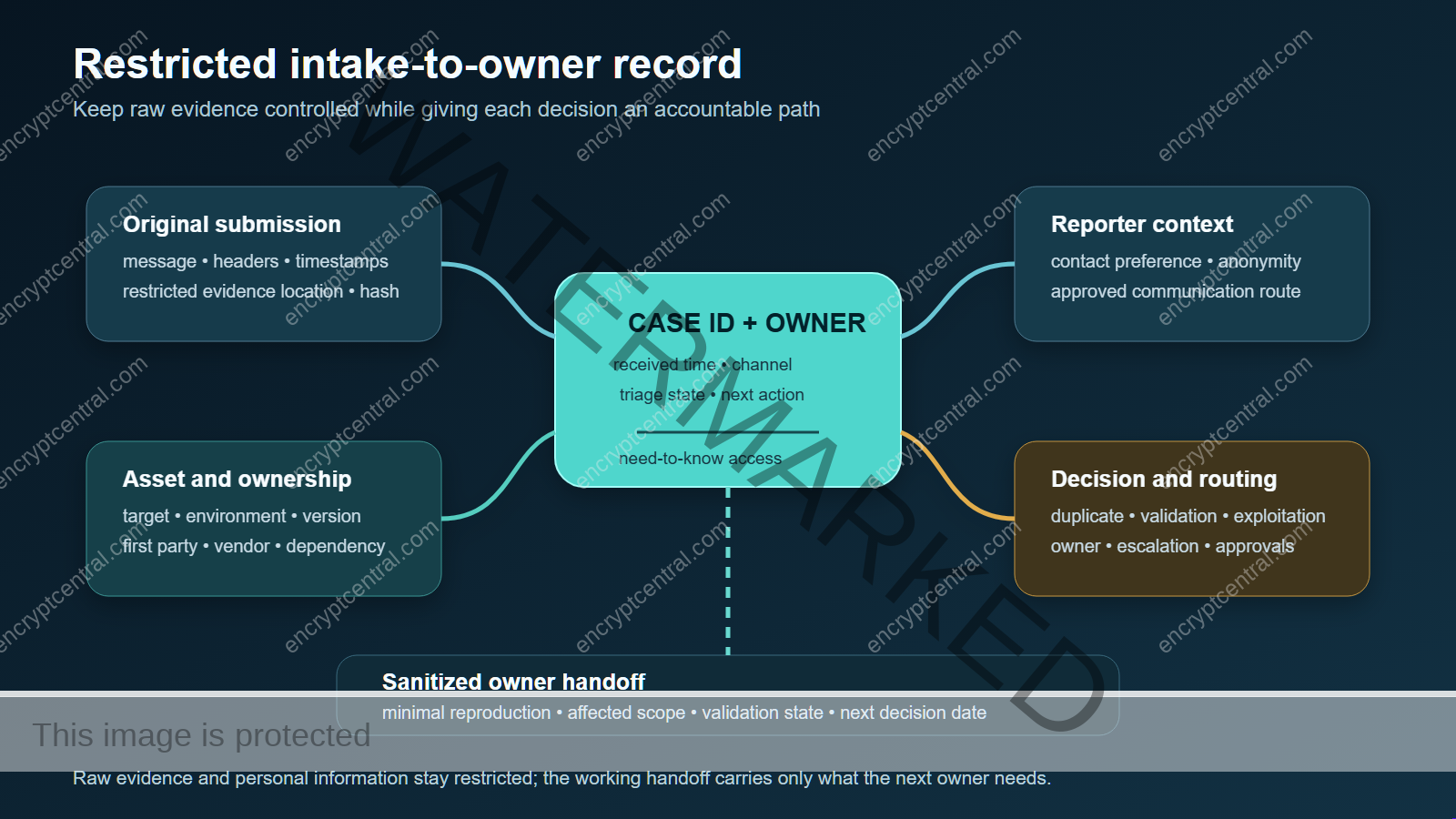
Create one restricted intake record
Assign a case ID as soon as a report is accepted into triage. The intake record should preserve what arrived while making ownership and decisions visible. It can live in a restricted case-management system, security ticket queue, or other approved repository. The specific tool matters less than consistent fields, access controls, and an audit trail.
| Field | What to record | Why it matters |
|---|---|---|
| Case identity | Case ID, received time, channel, and intake owner | Creates a stable reference and accountable starting point |
| Reporter preference | Contact details if supplied, anonymity request, and approved contact route | Prevents accidental exposure and missed replies |
| Original evidence | Restricted location, file names, hashes where used, and access history | Preserves what was submitted without spreading it |
| Affected target | Hostname, application, version, tenant, component, and environment | Supports asset and ownership checks |
| Reproduction summary | Sanitized steps, observed result, expected result, and validation state | Gives the owner actionable context |
| Related cases | Duplicate, dependency, incident, or prior finding links | Avoids fragmented remediation and inconsistent replies |
| Routing state | First-party owner, vendor coordinator, incident response, or closed as invalid | Shows who must act next |
| Communication state | Acknowledged, information requested, status approved, and disclosure constraints | Prevents unreviewed promises |
Keep the raw and working views separate. A developer may need a minimal reproduction and the affected code path, but not a reporter’s personal details. A privacy or incident-response lead may need to know that sensitive data was exposed, but not every exploit step. Design the record so the right people can act without granting the entire organization access to an unpatched weakness.
Run a disciplined first-pass triage
The first pass should determine where the report belongs, not produce a final severity score. Use a consistent sequence.
- Screen obvious noise safely. Separate spam, generic scanner output, unsupported claims, and messages with no identifiable target. Do not discard a low-detail report solely because it is poorly written; request the minimum missing information when a real asset may be involved.
- Confirm the asset. Determine whether the hostname, application, API, repository, or product is owned or operated by the organization. Check environment and version rather than assuming a familiar brand name proves ownership.
- Check scope and authority. An out-of-scope report may still describe a real risk. Scope determines handling and communication; it does not erase the need to protect evidence or identify the proper owner.
- Search for duplicates. Compare affected component, root cause, endpoint, parameter, version, and evidence. Link related reports to one remediation record while retaining each reporter and submission record.
- Validate in isolation. If validation is necessary, use an approved environment and the least intrusive method that can confirm the issue. Do not run supplied code in production merely to accelerate triage.
- Check for exploitation or exposure. Look for indicators that the vulnerability was already used, that secrets or personal information were accessed, or that the report itself contains live sensitive data.
- Assign the next owner. Route a sanitized handoff to engineering, a system owner, an upstream vendor coordinator, privacy, legal, or incident response according to the evidence.
Formal severity and remediation priority can follow validation. A report can be technically valid but low impact, or initially incomplete but urgent because it suggests active exploitation. If the concept of a previously unknown flaw is unfamiliar, EncryptCentral’s guide to zero-day vulnerabilities explains why unknown exposure and evidence of exploitation need separate attention.
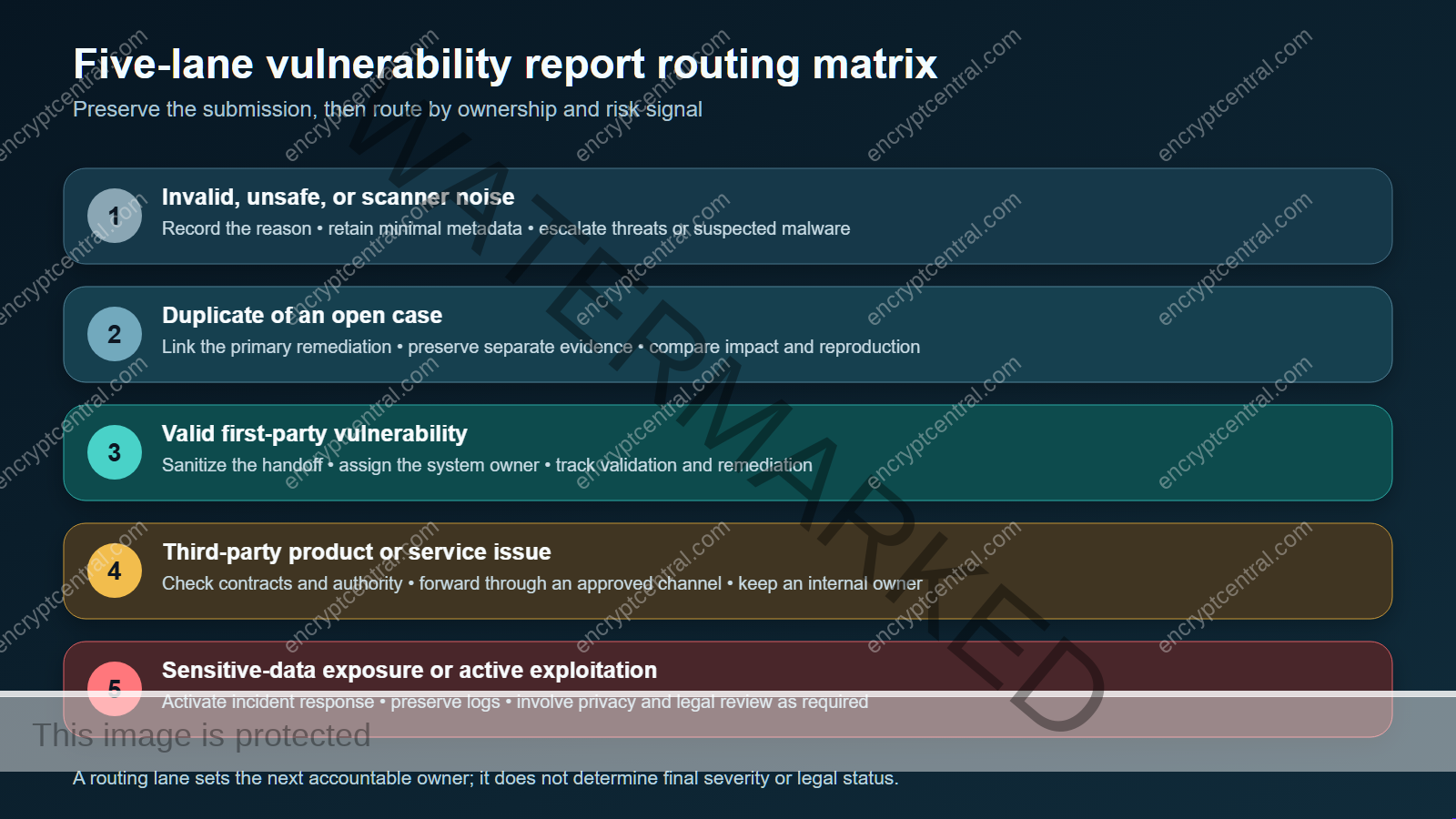
Use five routing lanes
A simple routing matrix helps a small team make consistent decisions without pretending that every case follows the same workflow.
1. Invalid, unsafe, or scanner noise
Close spam, non-actionable automated output, or claims unrelated to an owned asset with a recorded reason. Preserve enough metadata to detect repeated campaigns or future corroboration. If a message is threatening, extortionate, or contains suspected malware, follow the organization’s security and legal escalation process rather than continuing an informal negotiation.
2. Duplicate of an open case
Link the new submission to the primary remediation case. Keep its arrival time, evidence, and reporter communication separate. A duplicate may contain a better reproduction, a different affected version, or proof of broader impact. “Duplicate” describes case relationship; it does not mean “delete.”
3. Valid first-party vulnerability
Send a sanitized, reproducible handoff to the accountable system owner. Record validation status, affected versions or environments, known exposure, temporary controls, remediation owner, and the next internal review date. Restrict detailed exploit information until a fix or other risk treatment is ready.
4. Third-party product or service issue
Confirm who owns the affected system and what the contract allows before forwarding evidence or authorizing further testing. The CISA BOD 20-01 handling model explicitly addresses reports involving third-party services. NIST SP 800-216 also describes coordination with vendors and external coordinators. Private organizations should use their vendor contacts, contracts, and approved disclosure route.
Do not promise that a cloud provider, software maintainer, or customer will respond on your timeline. Share only the information you are authorized to disclose, preserve the forwarding record, and keep an internal owner until the external handoff is acknowledged.
5. Sensitive-data exposure or active exploitation
Escalate immediately when the report shows accessed personal information, exposed credentials, live secrets, persistence, suspicious log activity, or credible evidence that the weakness was exploited. CISA’s directive tells agencies to consider whether a disclosed vulnerability indicates an ongoing or past incident or breach. For any organization, this is a useful separation point between normal remediation and incident response.
Incident escalation does not confirm a legally reportable breach. It activates the people who can preserve logs, contain access, assess affected data and systems, and obtain qualified legal or privacy guidance. EncryptCentral’s incident response preparation guide provides background on the broader response lifecycle.
Acknowledge without making unauthorized promises
An acknowledgement should be prompt enough to show that the report reached an owned process, but its wording must match approved policy. A safe operational reply can:
- confirm receipt and provide the case ID;
- thank the reporter without validating an unconfirmed claim;
- request specific missing details, such as the affected URL, version, time observed, or minimal reproduction;
- ask the reporter not to send additional sensitive data or run further intrusive tests;
- state the next communication step or that updates will follow the published policy; and
- provide an approved secure method for additional evidence.
Do not invent a bounty, payment amount, safe-harbor commitment, remediation deadline, nondisclosure agreement, or public-advisory date. The CISA vulnerability disclosure policy template shows that authorization boundaries, prohibited methods, sensitive-data handling, payment language, and response targets are policy choices. The U.S. Department of Justice’s vulnerability disclosure framework likewise emphasizes organization-specific scope, third-party authority, and legal review. These sources are useful models, not a substitute for approved language.
Operational acknowledgement pattern: We received your report and assigned case [ID]. Our team is reviewing the affected asset and the information provided. Please do not send additional sensitive data or perform further testing while we assess it. If we need more detail, we will contact you through [approved channel]. This acknowledgement does not alter our published policy or create a payment, authorization, or remediation commitment.
Have counsel and communications owners review any reusable template before deployment. The final sentence may need different language in your jurisdiction or policy; it is included here to show the boundary the intake team must protect, not as legal text to copy automatically.
Define internal targets without turning them into public guarantees
Internal service targets help prevent reports from disappearing. Track time to first review, acknowledgement, ownership assignment, validation decision, incident-escalation decision, and next status review. Choose targets based on staffing, risk, and on-call coverage. Escalate missed targets internally.
A public promise is different. Publishing “we will fix every vulnerability within 30 days” can create expectations that do not fit complex vendor dependencies, incomplete reports, or emergency changes. If the organization publishes response targets, make sure security, engineering, legal, and leadership have approved the wording and the operation can support it.
Close the loop and retain the decision trail
A case should close only after its disposition is recorded. For a fixed issue, retain the validation result, affected versions, remediation reference, deployment evidence, and any approved retest outcome. For an accepted-risk or invalid case, document the decision owner and rationale. For a vendor case, record the handoff and current dependency. For an incident, link to the restricted incident record without duplicating sensitive evidence into the disclosure queue. When relevant records may expire, use a controlled SaaS audit-log export and preservation process.
Send a closure message only when it is approved and appropriate. Avoid revealing internal architecture or other reporters’ information. If public coordinated disclosure is being considered, treat it as a separate legal, communications, and release decision rather than an automatic final step of intake.
Five intake failures to avoid
- Opening submitted files on a normal workstation. Quarantine evidence and use an approved isolated analysis path.
- Forwarding raw reports into broad engineering channels. Preserve the restricted original and share a sanitized owner handoff.
- Calling every report an incident. Validate and route the claim while escalating credible exploitation or sensitive-data signals immediately.
- Closing duplicates without retaining them. Link each submission to the primary case so better reproduction details and separate reporter communications remain traceable.
- Improvising policy in an acknowledgement. Confirm receipt without promising payment, legal protection, disclosure timing, or a repair deadline that has not been approved.
A practical vulnerability disclosure intake checklist
- Publish a monitored reporting route and keep security.txt contact and expiration fields current.
- Assign primary and backup intake owners, including a route for reports that reach other departments.
- Quarantine attachments and restrict raw evidence and reporter information.
- Create a case ID and preserve the original submission, received time, channel, and evidence location.
- Identify the affected asset, environment, system owner, and any third-party dependency.
- Search for duplicates and link related reports without deleting their separate submission records.
- Validate only in an approved isolated environment using the least intrusive method needed.
- Check for prior exploitation, sensitive-data exposure, credentials, or active incident indicators.
- Route the case to the first-party owner, vendor coordinator, incident response, privacy, or legal review.
- Acknowledge receipt with approved language and no improvised bounty, legal, timing, or disclosure promises.
- Track internal review targets, remediation state, approved communications, and the next accountable owner.
- Close with a documented disposition and retain the restricted decision trail under the organization’s policy.
A strong intake process is deliberately modest. It does not need to prove every report immediately. It needs to protect the submission, preserve the facts, find the responsible owner, recognize incident signals, and communicate within approved boundaries. That discipline gives valid reports a path to remediation while reducing the legal, privacy, and security mistakes that rushed triage can create.
Related posts:
 How Can I Safely Use Public Wi-Fi Networks?
 How Can I Safely Use Browser Extensions?
 What Is A Zero-day Vulnerability, And Why Is It Significant?
 Vulnerability Prioritization: CVSS vs EPSS vs CISA KEV
 AI Agent Security: Permissions, Injection, and Data Exfiltration
 GitHub Actions OIDC: Replace Long-Lived Cloud Secrets


