


A security alert is only useful when a meaningful event reaches someone who can act. To find logging and alerting failures, follow one safe test event from the application, through collection and detection, into the responder’s queue. Check the saved evidence at every handoff. A green collector dashboard cannot prove that the right person received the right alert.
This guide is for small security teams and application owners who already collect logs but cannot confidently explain what happens after a risky action. It proposes a practical verification workflow based on official guidance reviewed on October 19, 2026. We did not test a customer environment or security product. Technical review is pending.
Start with the decision the alert should support
Before adding another data source, choose a question that matters to your organization. Can a privileged account export customer records? Can an administrator change a production permission without a ticket? Can a disabled account keep using an application session? These questions lead to different records and different response decisions.
Write the intended action in plain language. For example: “When an unapproved production administrator grants a new export permission, the on-call analyst must identify the change, contact the service owner, and decide whether to suspend that permission.” The sentence identifies the actor, object, consequence, and responder. It also exposes the context a detection needs.
Use the SIEM overview to orient colleagues who are unfamiliar with the collection platform. Keep this exercise focused on the whole operational chain. Buying a different tool before identifying the broken handoff may simply move the same failure somewhere else.
Separate four kinds of failure
A collection failure means the relevant event never arrives, arrives late, or arrives without essential fields. A detection failure means usable data arrives but the rule cannot recognize the condition. A routing failure means the detection fires but the notification goes to the wrong destination. A response failure means the notification arrives but nobody owns the next decision.
These categories overlap, but they make diagnosis faster. If the source record exists and the central copy does not, editing the alert threshold is premature. If an alert exists in the platform but the paging service has no matching delivery, changing application instrumentation will not repair the missing responder.
OWASP’s Logging Cheat Sheet emphasizes useful application context, careful treatment of sensitive data, and testing logging behavior. Its guidance supports checking what was recorded and how failures behave, rather than assuming infrastructure logs alone capture every important application action.
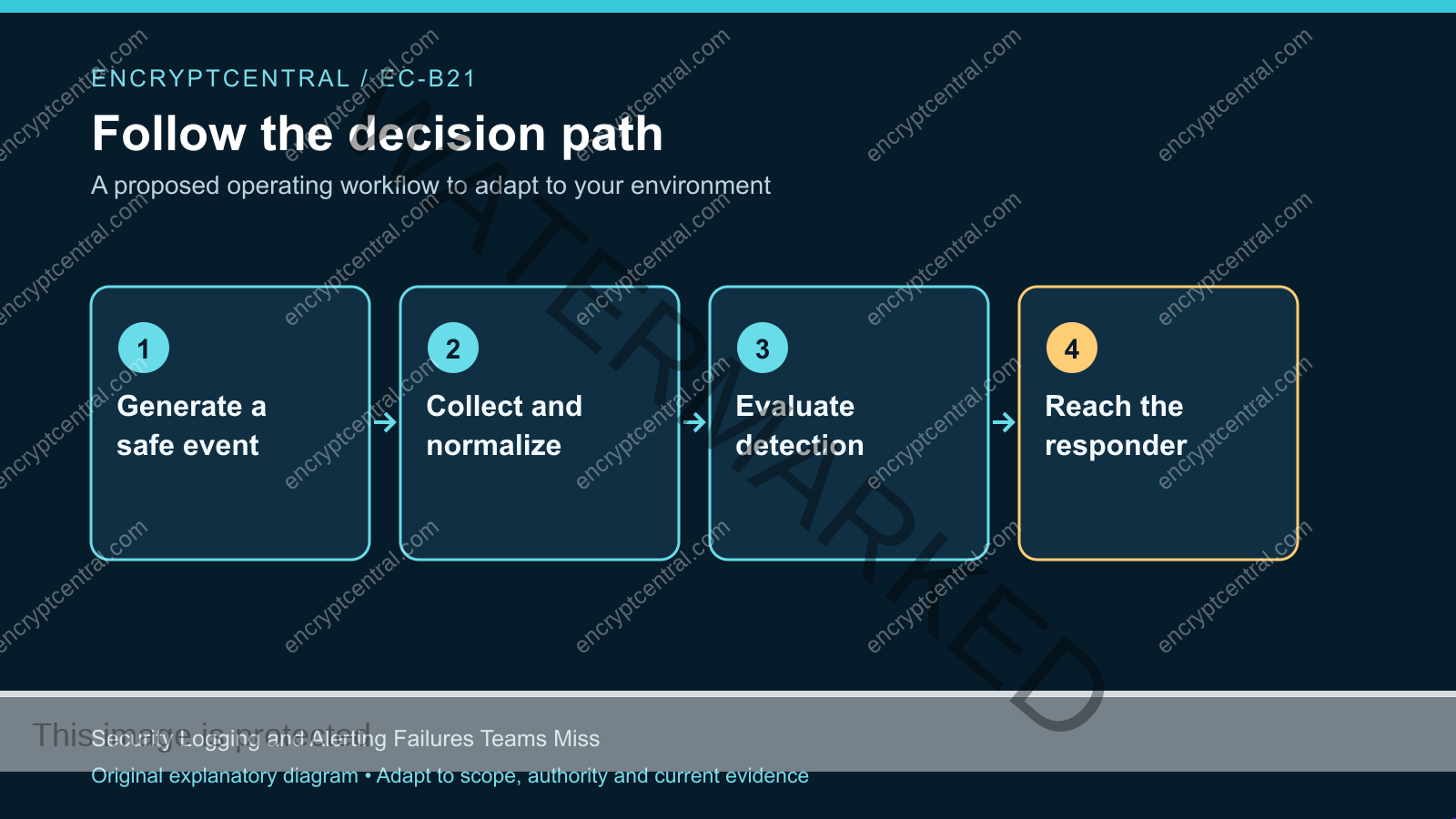
Design one safe event-to-responder test
Choose a controlled action and identifier
Select an authorized nonproduction workflow or a tightly approved production check with harmless test data. A denied export of a synthetic record is often easier to reason about than a vague “suspicious activity” exercise. Define who may run it, when it may run, what side effects are acceptable, and how the test will be stopped.
Assign a unique test identifier that can travel through the application, collection service, and case record. Do not put passwords, live tokens, customer content, or confidential payloads into that identifier. Agree on the expected event time, actor identity, affected resource, requested action, and outcome before execution.
Describe the expected result at each stage
Create a short worksheet with four rows: source record, collected record, detection result, and responder receipt. For each row, record the owner, the query or view used to inspect it, the expected delay, and the evidence to retain. A screenshot may support the record, but retain the underlying event or case reference where available.
Set expectations for the environment you actually operate. An overnight batch import and a real-time paging rule need different acceptance windows. Document those differences instead of choosing an arbitrary universal threshold. A missed agreed deadline is a failed test even when the event eventually appears.
Run the action once and inspect downstream
Have one operator perform the action while another traces the result. Record the actual application outcome first. Then find the source event, its central representation, the rule evaluation, and the destination notification. Ask the receiving responder to acknowledge the specific test, not merely confirm that their phone works.
If any stage is missing, preserve the last successful observation and investigate that boundary. Avoid repeating the action continuously: duplicate test traffic can confuse correlation, exhaust limits, or make the exercise look more successful than a single real event would be.
Check the data before tuning the rule
Compare source and central records field by field. Look for a missing actor, a resource name that changed during parsing, an outcome converted into a generic success label, or timestamps interpreted in different time zones. Ask whether the same field means the same thing across application versions.
Also distinguish event time from ingestion time. A delayed client, disconnected collector, or queued export can make a recent arrival describe an older action. Your worksheet should preserve both times where the system provides them. Otherwise an analyst may build a misleading timeline even though every record was technically collected.
Inspect sensitive fields using approved access. OWASP advises excluding or protecting items such as access tokens, passwords, and primary secrets. The practical test is not “does this record contain enough detail?” alone. It is also “does this record disclose information the logging system should never hold?” Redaction must preserve useful event context without becoming an excuse to remove every meaningful attribute.
Make detection and routing explainable
For the chosen rule, record its input fields, conditions, suppression logic, lookback window, and exclusions. Explain why a test event should match. If the rule relies on a privileged-user list, verify that the test account is represented correctly. If it relies on a resource classification, confirm that the resource still carries that classification.
A rule can appear healthy while depending on a stale allowlist or an empty data field. Review exceptions as carefully as the main expression. An exclusion originally added for a migration may continue hiding activity long after the migration ends. Assign an owner and review date to each exception that changes important coverage.
Next inspect the notification route. Record which destination receives the event, what happens outside business hours, when escalation occurs, and who substitutes for an unavailable responder. Test the actual route used by this rule. A successful test message from a paging integration does not establish that a specific production detection is connected to it.
Test failure without creating a new outage
Once the normal path is understood, choose one controlled failure to examine. In a test environment, that might be a temporary collector disconnect or a deliberately malformed optional field. The aim is to learn whether the system preserves evidence, reports degraded coverage, and recovers predictably.
Do not disable production logging, fill disks, or flood a live service merely to prove a point. Agree on a bounded scenario, rollback, and service owner. Record whether the system signals the failure separately from the security condition it normally detects. A quiet dashboard during a collection outage should not be mistaken for a quiet threat environment.
NIST SP 800-137 provides the broader continuous-monitoring context: monitoring should support awareness of security state and risk. The worksheet here is an editorial application of that principle, not a claim that NIST prescribes these exact rows or test intervals.
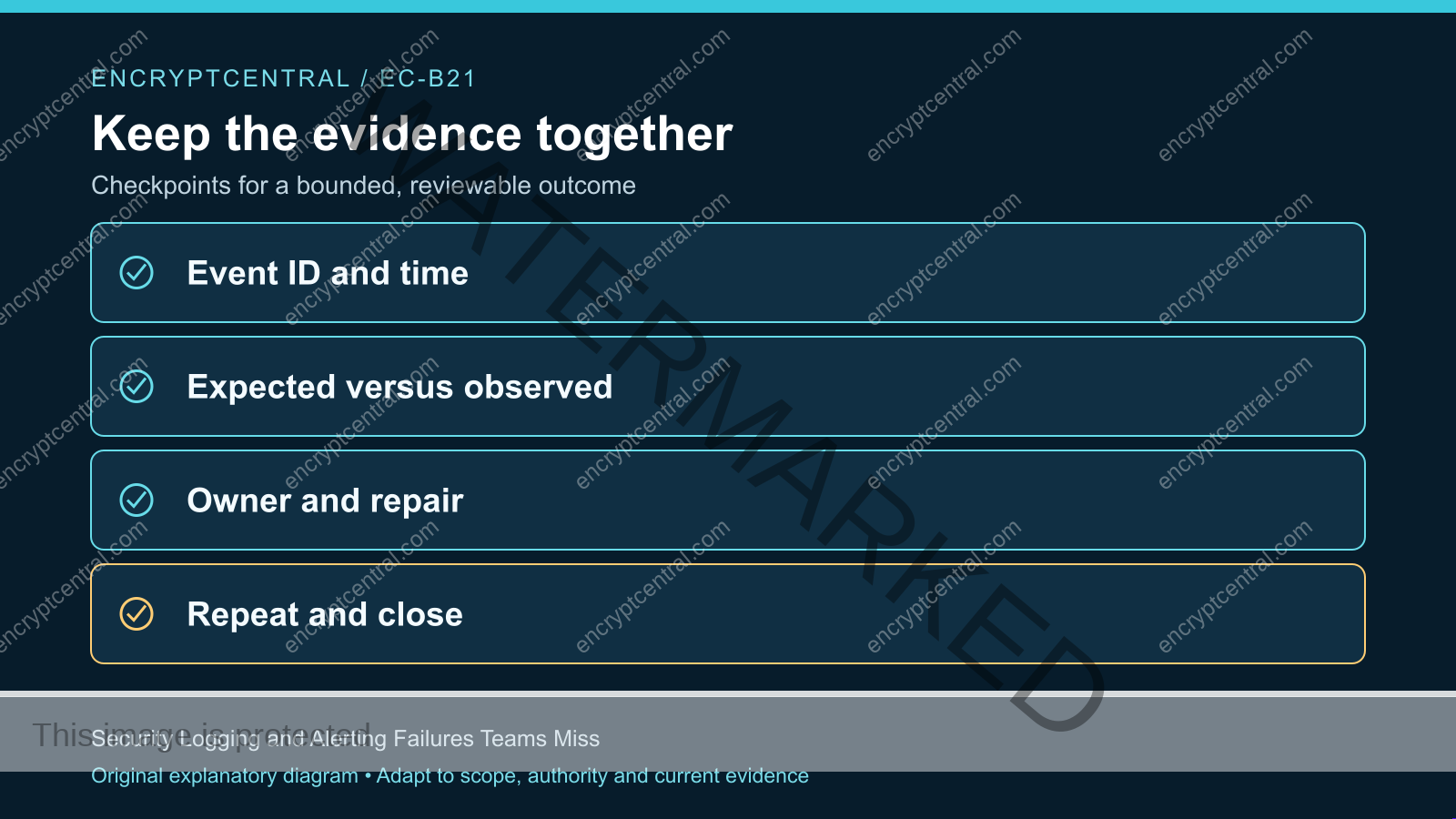
Use a closure record that survives the next release
For each failure, preserve the original test identifier, expected behavior, observed break, repair owner, and change reference. After the repair, repeat the same safe scenario and attach the new evidence. State exactly what passed. “The synthetic denied export reached the named responder within the agreed window” is more useful than “logging fixed.”
Then identify what could invalidate the result: an application release, parser update, changed service identity, revised notification policy, or staff rotation. Attach the verification check to that change boundary. A test that worked last quarter may no longer cover an application that now emits a different event schema.
Review a small set of operational measures: which critical scenarios have been tested, which sources are overdue for verification, how often delivery misses its agreed window, and which failures remain without an owner. Raw event volume is a capacity measure. It does not by itself show that the organization can investigate or respond.
Common mistakes that create false confidence
Counting logs instead of checking a scenario. Millions of records can coexist with a missing permission-change event. Begin with the decision the team must make and confirm the evidence needed for that decision.
Closing a ticket after a configuration save. A saved setting is an intermediate state. Trace a new event through the running pipeline and compare the destination record with the expected result.
Suppressing noise without recording lost coverage. A noisy rule may need better context, a narrower condition, or a different response. If it is disabled, record the resulting gap and an owner-approved alternative rather than leaving an apparently complete dashboard.
Sending every alert to everyone. A broad mailing list can obscure responsibility. Name the responder for the chosen scenario and verify how acknowledgment and escalation work.
Questions teams ask during the first check
Must every event page someone immediately?
No. Decide which actions require immediate response, scheduled review, or historical investigation. The acceptance test should reflect that decision. A low-urgency record can be useful without waking an operator, provided its review path and retention are intentional.
What if the application cannot emit the required field?
Record the limitation explicitly. Identify whether another trustworthy source can supply the missing context and how the records will be joined. If the decision still cannot be supported, treat that as an instrumentation gap rather than filling the field with a guessed value.
Can a tabletop replace this exercise?
A tabletop can establish ownership and expected decisions. It cannot prove the running collector, parser, detector, and destination behave as described. Use the tabletop to prepare the safe test, then retain evidence from the actual path.
Make the next alert a verified handoff
Keep the test record accessible to the people maintaining the application and the detection. If the only evidence lives in a departed analyst’s notebook, the next team cannot distinguish a previously verified path from an undocumented assumption. Store approved queries, harmless test inputs, and the expected destination alongside the change record, with access limited to the people who need them.
When coverage cannot be restored immediately, write a temporary operating decision. Identify the affected scenario, the observation that is missing, a practical alternative review where available, the risk owner, and a date for reconsideration. Calling the gap accepted does not repair it; the record makes the limitation visible while a specific person remains responsible for resolving it.
Choose one high-value scenario and name its application owner and responder. Write the expected four-stage result, run the authorized check, and repair the first boundary that fails. Expand coverage only after the team can explain the evidence already collected.
For wider context, connect the results to your network monitoring approach and the AppSec fix-first review. The useful deliverable is a repeatable decision path with an accountable owner and current proof.
Related posts:
 Battle of Threat Intelligence Platforms: Cisco, ManageEngine, CrowdStrike, IBM, Security X-Force
 Beagle Security: OWASP Security Testing review
 What Is A SIEM System, And How Does It Work?
 What Is A Honeypot, And How Does It Protect Against Hackers?
 Threat Intelligence Platforms: Enterprise, MSSP and SMB
 What Are The Security Risks Associated With BYOD (Bring Your Own Device) Policies?


