

Penetration retesting verifies a specific repair against the original finding and an agreed set of related cases. A useful retest checks that the unauthorized action is blocked, the legitimate workflow still works, and the change exists in the environment being assessed. It also records what was not tested.
A closed development ticket or a successful deployment is not the same evidence. This guide proposes a finding-to-closure workflow using official guidance reviewed on October 19, 2026. We did not perform a penetration test, verify a customer repair, or benchmark a testing service. The examples are hypothetical and technical review is pending.
Define the question the retest must answer
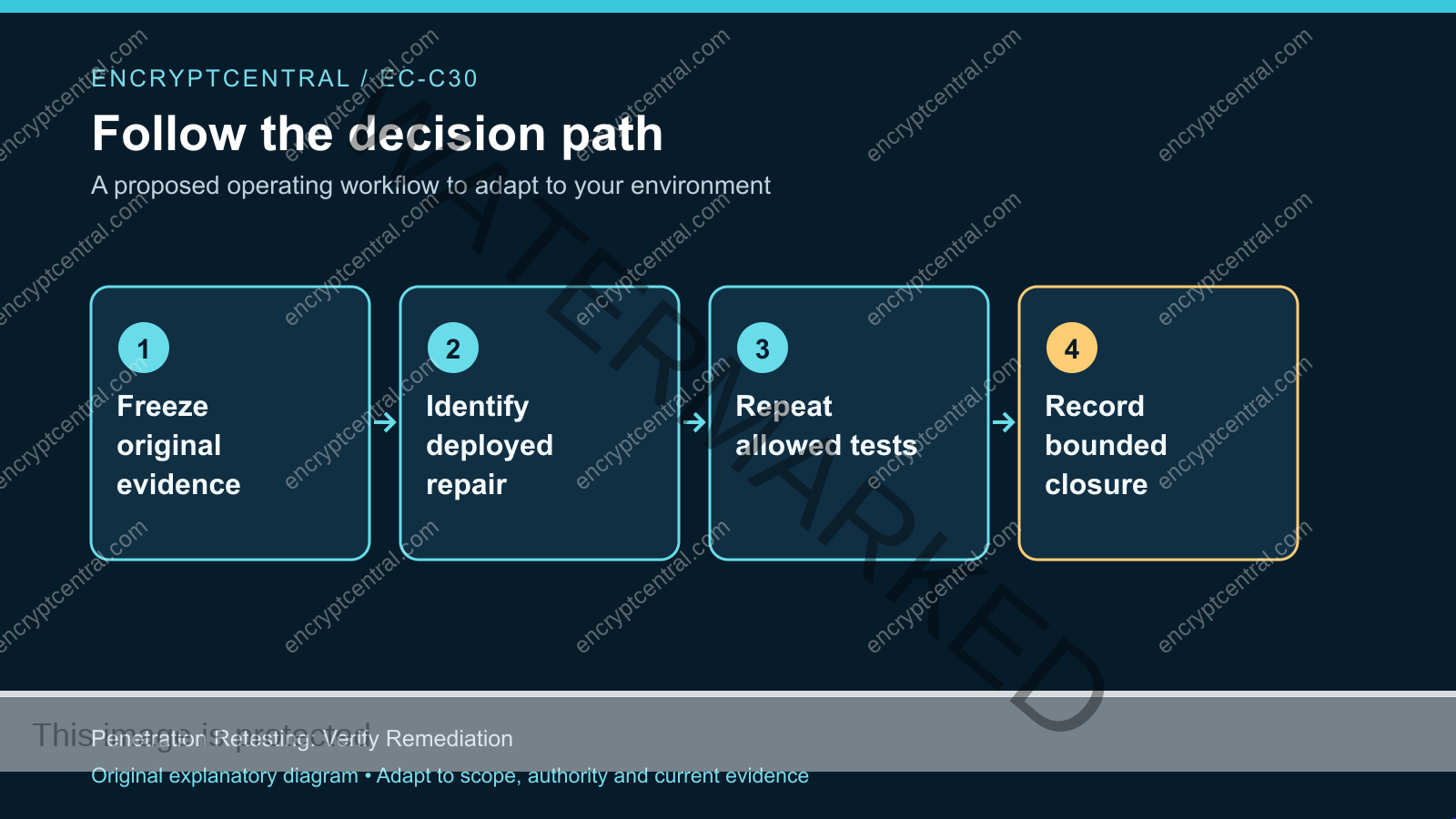
Start with the finding’s stable identifier and original evidence. Identify the actor, prerequisite access, affected resource, tested action, and observed consequence. Then state the expected corrected behavior. A retest without this baseline can become a new assessment that does not actually resolve the reported defect.
For a hypothetical customer-record issue, the question could be: “Can account B still retrieve the controlled record belonging to account A after the server-side authorization repair?” That question is narrow enough to test and precise enough to connect with the original report.
Then add the legitimate behavior: account A should still retrieve its own record. Testing only the denial can reward a repair that disables the entire feature. Use the access-control checklist for more detail on paired allowed and denied actions.
Agree on scope and authority again
Confirm the targets, environment, access roles, approved techniques, and time window. The original engagement’s authorization may not cover a new domain, a different supplier, a later test period, or a newly introduced service. Record scope changes rather than assuming the original contract covers everything needed.
Clarify whether the retest covers only the original proof, selected adjacent cases, a wider root-cause review, or a new release assessment. These are different amounts of work. A limited retest can be useful when its conclusion is equally limited.
NIST SP 800-115 provides a foundational framework for planning technical assessments, analyzing results, and developing mitigation strategies. Its process guidance supports defining objectives and limitations. It does not make a particular retest package or provider certification universally sufficient.
Trace the repair into the running system
Ask the engineering owner to identify the change and where it is deployed. Record the relevant code revision, package, image, configuration source, or policy revision. Capture the environment and application version the assessor will use. Avoid placing credentials or confidential implementation detail into an unrestricted ticket.
Check whether the repair addresses the underlying control or just one visible symptom. An endpoint-specific filter may leave a parallel export path unchanged. A console setting may be overwritten by the next deployment. The retest plan should reflect the repair’s intended scope and the system’s architecture.
The misconfiguration guide discusses durable configuration fixes. Connect the retest evidence to that authoritative source of configuration where relevant. A screenshot of a temporary operating value does not establish that a rebuilt service will retain it.
Prepare controlled accounts and data
Recreate the important prerequisites safely. Use synthetic records and authorized test identities that represent the original roles. Confirm the accounts have the intended privileges before interpreting a denial. An expired account or empty dataset can make a broken test look like a successful repair.
Write down the expected data ownership and role boundaries. If the original finding involved two tenants, preserve two tenants in the test. Replacing that arrangement with two users in one tenant may miss the boundary the repair is supposed to enforce.
Document unavoidable differences from the original conditions. The system may have changed significantly, or an old test route may no longer exist. Those changes can be relevant evidence, but the conclusion should explain what was tested instead and why it addresses the original exposure.
Run the original case and its valid counterpart
Execute the agreed unauthorized action against the deployed repair and record the result. Where the finding involves saved changes or exports, inspect the relevant downstream state rather than relying on a response message. A denied-looking response is insufficient if the operation still completes asynchronously.
Then run the legitimate counterpart. Verify that the authorized user can complete the intended work and that the result reaches the correct destination. Preserve both observations under the same test record so a reviewer can see the security boundary and the service behavior together.
Do not expand testing into production stress, destructive behavior, or unrelated targets to make the evidence stronger. Use the written rules and stop conditions. If the retest reveals a different issue, preserve it as a new finding and clarify the authority needed for further examination.
Select adjacent cases for a reason
Adjacent tests should follow the root cause and the repair design. For an authorization control, that might include another supported operation on the same resource or another role using the same shared enforcement point. For a deployment setting, it might include a rebuilt instance and a second path through the same template.
Explain why each adjacent case matters. Avoid adding an unexplained list of tests simply because the tools can run them. The organization needs to understand whether the cases support confidence in the repair pattern or merely add unrelated activity.
OWASP ASVS can help define relevant application verification requirements. Freeze the chosen version and requirements in the retest brief. A reference to the standard is useful context; the evidence must still identify the actual actions, results, and limits of the assessment.
Check for recurrence after rebuild or redeployment
For repairs that depend on deployment inputs, agree on a controlled rebuild or redeployment check. Confirm that the authoritative source produces the corrected operating state. The aim is to find whether the next routine change can recreate the reported weakness.
This may require coordination with an infrastructure or release owner. Record which revision was deployed, which environment received it, and how the relevant behavior was verified afterward. A successful pipeline run does not by itself prove the application control worked.
NIST SP 800-40 Revision 4 treats enterprise patch management as preventive maintenance. Use that lifecycle context when deciding how a repair enters normal operations. The retest should be connected to the continuing change process rather than filed as an isolated document.
Write closure with a bounded result
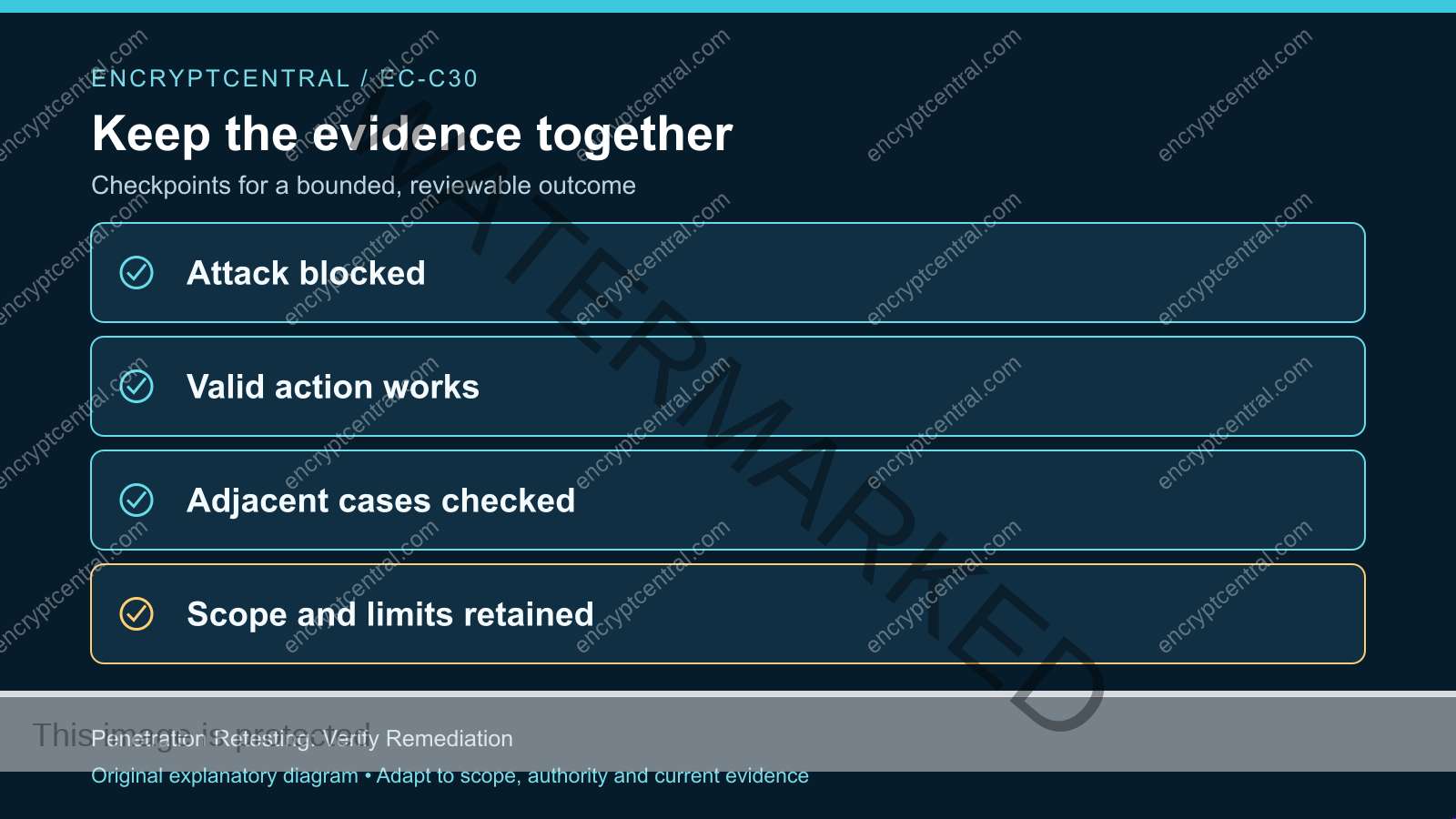
A useful closure statement names the finding, environment, build or revision, roles, test date, tested scenarios, result, and remaining limits. It should distinguish a corrected defect from a compensating control and from temporary business acceptance.
For the record-access example: the retest might show that the unauthorized account could no longer retrieve the synthetic record, the authorized account still could, and a selected export case also enforced the same boundary. The statement should not claim that all authorization across the product is now secure.
Attach the relevant evidence references and identify who accepted the result. Preserve the original finding and the repair history. Replacing the original report with a green status erases context that engineers and future assessors may need.
Use clear outcomes when the repair cannot pass
If the original behavior remains, record the retest as failed and identify the observation. If the environment or prerequisite prevents a meaningful check, record it as unverified or blocked. If the feature has been removed, verify that the relevant routes and residual access are actually unavailable within the agreed scope.
A temporary protective control may reduce exposure while the durable repair is pending. Record its owner, limits, monitoring, and review date. Do not describe the original defect as corrected merely because a firewall rule or disabled feature makes one proof unavailable.
If the business accepts remaining risk, identify the authority and the conditions of that decision. Acceptance is an organizational action, not a test result. Keep it distinct from the assessor’s observation so future readers can understand why the finding was administratively closed.
Handle disagreement with a controlled evidence review
If engineering and the assessor disagree, compare the exact conditions before arguing over the closure label. Confirm the account’s effective role, deployed revision, request path, controlled data, and any protective control that changed between observations. A different result can reflect a different test rather than a difference in technical competence.
Ask each side to state the narrowest claim its evidence supports. One team may have verified that a specific request is blocked, while the other is concerned about another route through the same control. Record both claims and agree on an authorized case that resolves the outstanding question without expanding into an undefined new assessment.
Preserve the original evidence and the disputed result. If a correction is necessary, issue a versioned clarification identifying what changed and why. Avoid replacing the record with an unexplained green status. If the remaining question cannot be tested safely or within the purchased scope, assign an owner for the next decision and retain it as unverified rather than treating disagreement itself as proof of repair.
Failure modes that weaken retest evidence
Testing the wrong build. Confirm the running environment and deployment reference before the scenario. A repair in source control does not establish the state of a staging or production service.
Using an account with no access at all. Validate the intended role and run the allowed case. Otherwise a denial can be caused by an unrelated account problem rather than the repaired control.
Changing the test without explanation. Preserve the original case and record why a replacement is necessary. A new proof should address the original exposure rather than merely produce a convenient result.
Closing every related finding after one pass. Identify which findings share the verified control and which require their own evidence. A common cause can support a coordinated repair without making every test result interchangeable.
Questions before the assessor returns
How soon should we request a retest?
Request it when the relevant repair is deployed, prerequisites are ready, and the provider’s agreed window is available. High exposure may justify immediate containment and a focused verification sooner. Record the difference between containment evidence and final closure.
Is retesting the same as a new penetration test?
No. Retesting usually addresses specified findings under a defined scope. A new assessment may examine broader changes and undiscovered issues. Choose the work according to what changed and what decision the organization needs to make.
Can internal staff perform the check?
Internal verification can provide useful repair evidence when staff have the necessary competence and authority. Contractual, customer, or assurance requirements may call for a particular external retest. Confirm the actual requirement rather than assuming any internal result satisfies it.
Make closure a reproducible decision
Choose one finding and prepare a retest brief with the original evidence, deployed change, valid counterpart, adjacent cases, and closure criteria. Resolve missing prerequisites before booking the work. Afterward, retain the result with the repair record.
Connect prioritization with the vulnerability prioritization guide. The practical goal is a repair the organization can explain and verify under stated conditions, with remaining uncertainty visible and owned.