


Choose between OpenCTI and MISP by testing the intelligence work your team needs to complete. OpenCTI emphasizes structured threat knowledge and relationships; MISP provides a rich environment for collecting, correlating, and sharing intelligence. Their capabilities overlap. A useful comparison follows the same information through both workflows and includes the people and infrastructure required to keep it useful.
This is a documentation-led evaluation framework, checked on October 19, 2026. We did not deploy either platform, benchmark performance, obtain quotations, or test integrations. The proposed pilot and cost worksheet are original evaluation aids. Technical review is pending, and no vendor relationship or affiliate link influences this comparison.
Begin with an intelligence question
“We need a threat intelligence platform” is not yet a requirement. Ask what decision the platform must help someone make. A detection engineer might need a reviewed set of indicators with context and expiry. An analyst might need to connect an incident to previous reporting and explain the confidence behind that connection. A sharing community might need controlled exchange among organizations.
Choose one primary job for the pilot. Write who performs it, the information available at the start, the output required, and the person who accepts that output. This prevents an attractive graph or a large feed count from displacing the actual decision the platform must support.
EncryptCentral’s SOCRadar and OpenCTI comparison covers a different pairing. This article focuses on OpenCTI and MISP as operational choices, including when using both may create more integration work than a small team can justify.
Understand the documented starting points
OpenCTI’s documentation describes a platform for structuring, storing, organizing, and visualizing threat intelligence knowledge and observables. Its value proposition includes relationships among technical and nontechnical information. Evaluate that model against the way your analysts ask questions and maintain context over time.
MISP’s documented capabilities include structured events, attributes and objects, correlation, analyst collaboration, and controlled sharing. It also supports richer relationships and reports. Describing it as nothing more than an indicator list would misrepresent the product and produce a poor selection decision.
These descriptions are starting points, not measured findings. Product editions, versions, optional services, modules, and integrations can change the experience. Record the exact configuration evaluated. A feature demonstrated in one deployment is not automatically available or configured correctly in another.
| Decision area | Question to test in OpenCTI | Question to test in MISP |
|---|---|---|
| Analyst context | Can the analyst preserve and explain the needed relationships? | Can the analyst preserve the event, object and report context needed? |
| Operational output | Can the required consumer receive an accurate, scoped result? | Can the required consumer receive an accurate, scoped result? |
| Sharing | Does the evaluated configuration enforce the agreed audience? | Do distribution and sharing controls match the agreed audience? |
| Operations | Who owns the platform and its dependencies? | Who owns the platform and its dependencies? |
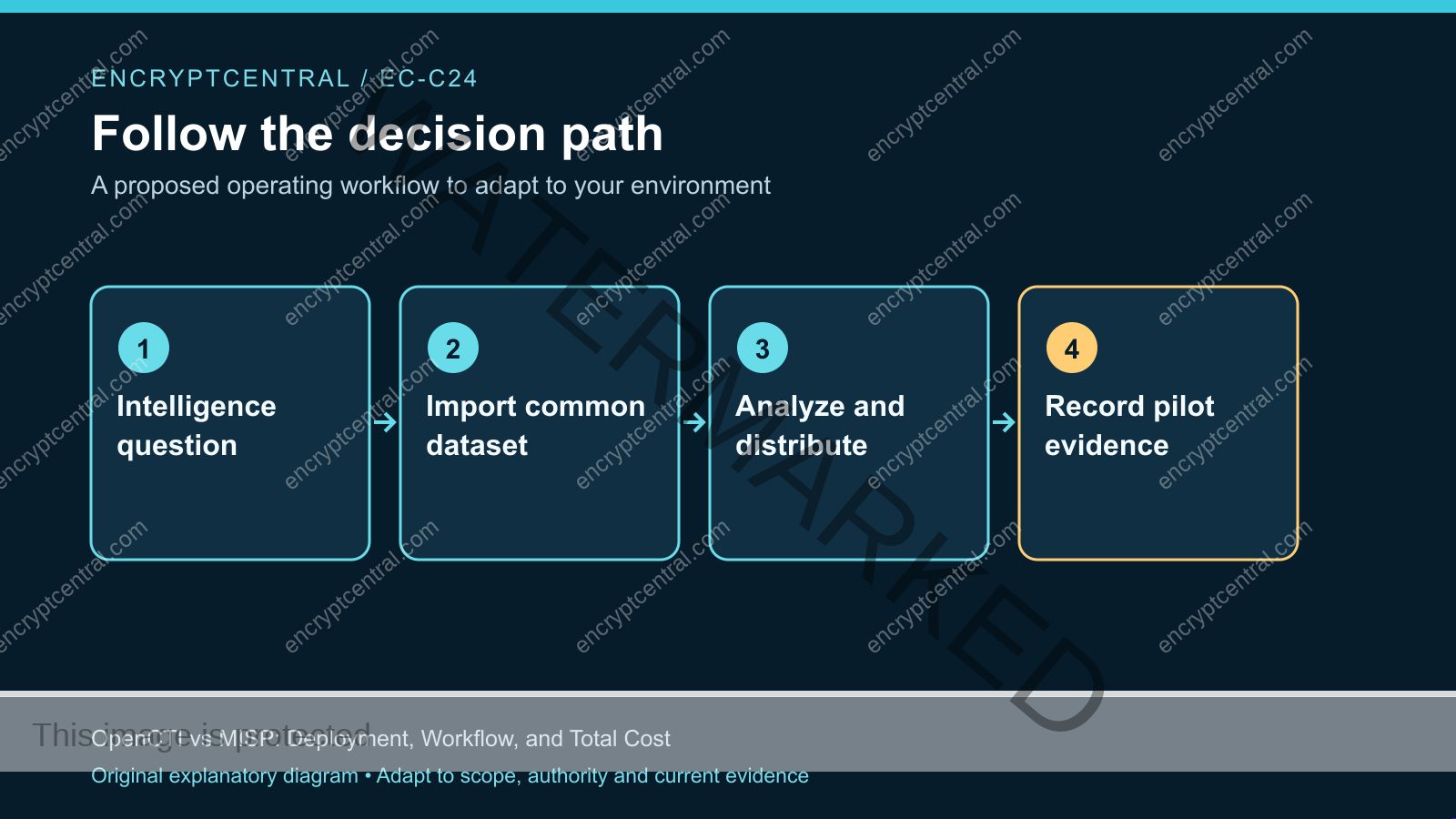
Create a small, common pilot dataset
Prepare a synthetic or explicitly authorized dataset that resembles a real analyst task without exposing private incident information. Include a report, several indicators, a relationship that needs interpretation, a duplicate observation, a correction, and an item with restricted distribution. Mark which values are deliberately uncertain.
Write the expected outcomes before importing anything. The analyst should be able to find the report, trace an observation to its source, distinguish a duplicate from corroboration, and explain why a connection is accepted or uncertain. The sharing test should prove that an unauthorized recipient cannot retrieve the restricted item through the tested route.
Keep the dataset, expected results, and evaluation instructions identical across platforms where practical. If one system requires transformation, retain the transformation rule and resulting data. Otherwise you may end up comparing the quality of two preparation efforts rather than the suitability of the platforms.
Follow the analyst’s complete task
Have the intended analyst complete the task, rather than relying entirely on an administrator’s demonstration. Record where the analyst must leave the platform, manually repair data, ask for elevated access, or consult a specialist. Those transitions can matter more to everyday use than a long feature table.
Ask the analyst to produce a short decision note. It should identify the question, answer, sources, uncertainty, and proposed action. Then ask a second analyst to inspect the same evidence. Can they reconstruct why the conclusion was reached, or do they need a private explanation from the first person?
A successful pilot should show how the platform supports reasoning and handoff. It should also reveal what remains a human judgment. A connected entity, correlation, or imported confidence value should not silently become proof that an attribution or indicator is correct.
Test sharing as a separate acceptance case
Define two audiences with different access rights. Use a harmless restricted record and test the actual export, API, or synchronization route your team plans to use. Check the saved recipient-side result, including markings and source context. A screen showing a sharing setting is not enough.
Then change the record. Correct an indicator or narrow its distribution and observe what downstream consumers do. Record whether the receiving workflow updates, retains a stale copy, or requires a separate correction process. The goal is a clear handling procedure, not an assumption that every integration retracts information automatically.
NIST SP 800-150 provides guidance on information-sharing goals, relationships, and distribution rules. Use those goals to determine what the pilot must demonstrate. A platform’s exchange capability cannot grant permission to redistribute information the source restricted.
Map the operating responsibilities
Open-source software still requires an operating model. List deployment, upgrades, backups, restoration, identity integration, access review, connector maintenance, monitoring, and incident handling. Assign each responsibility to a person or contracted service and identify what happens when that owner is unavailable.
The OpenCTI deployment overview documents a platform with workers, connectors, and external service dependencies. That makes dependency ownership an explicit part of the evaluation. Do not turn published minimum requirements into a capacity guarantee for your data volume or query pattern.
Apply the same discipline to MISP. Record the exact deployment method and required services from the documentation for the version selected. A successful installation is an early milestone. The acceptance question is whether the organization can maintain and recover the service while protecting the information entrusted to it.
Build a cost worksheet without invented prices
Use your own quantities and written quotations. Separate initial setup from recurring operations. Include infrastructure, backups, monitoring, analyst time, integration work, feed rights, support, training, and recovery testing. Identify whether a line is a fixed commitment, a measured quantity, or an unresolved assumption.
For a simple internal model, multiply expected hours by your organization’s chosen labor rate, then add quoted external costs. Document the period and workload behind every estimate. Show a lower and higher workload scenario if the volume is uncertain. This is a planning calculation, not a claim about either product’s market price.
Include the cost of maintaining two systems if a combined design is proposed. Identify which platform owns the authoritative record, who maintains the integration, how permissions map, and how corrections propagate. “Use both” can be reasonable, but it needs its own evidence and operating budget.
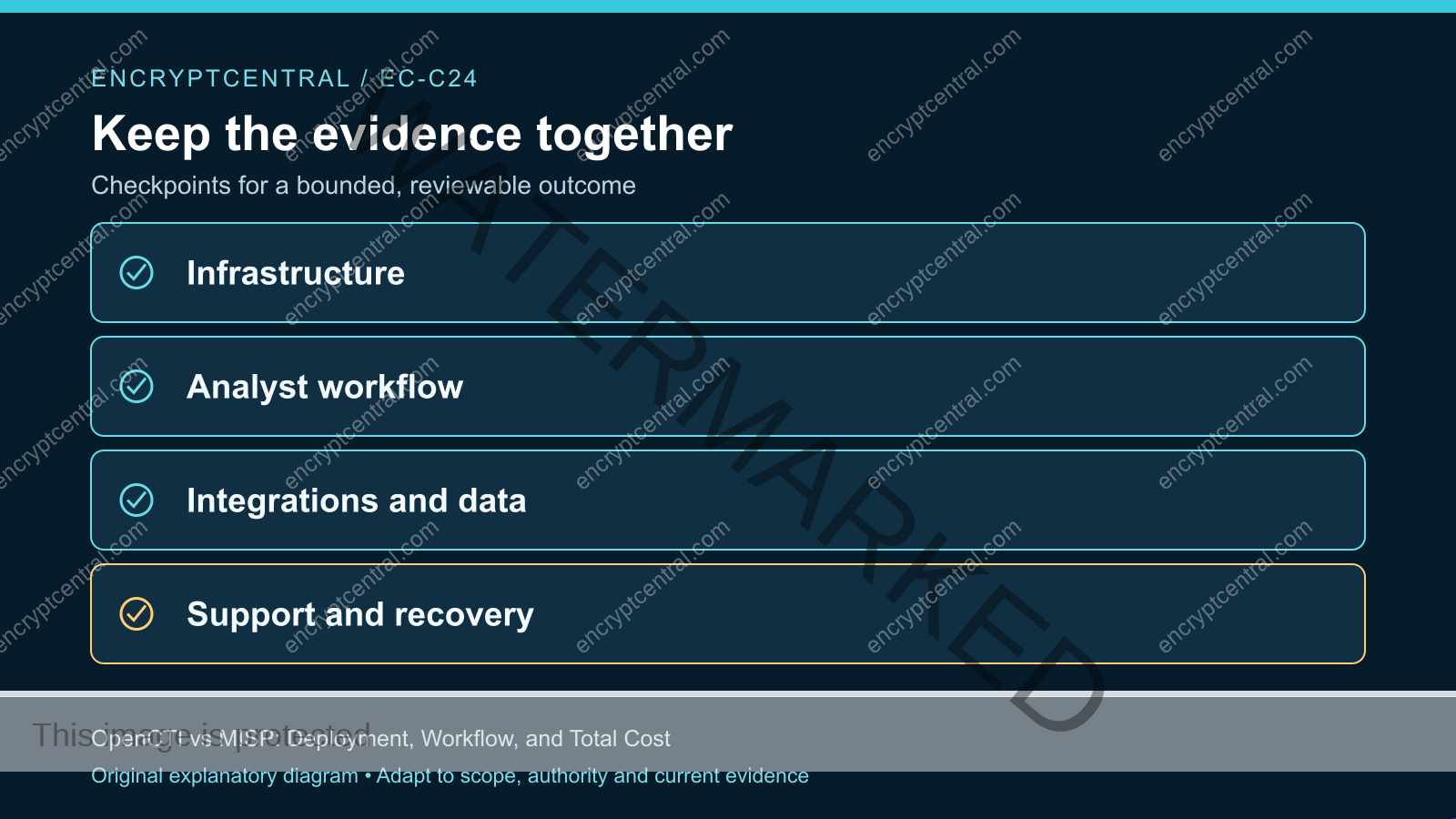
Use a decision record instead of a universal winner
Score only criteria that affect the chosen job. You might require a reproducible source trail, acceptable analyst effort, a tested sharing boundary, supported integrations, recoverable operation, and a feasible cost envelope. Define what passing means before the demonstration, and distinguish a mandatory requirement from a preference.
Record the evidence behind each score. A claim from documentation is different from an observed pilot result; a vendor demonstration is different from a task your own analyst completed. Keep those evidence types visible so the decision does not acquire more certainty each time the table is copied.
Document the reason for the selected option and the conditions that would cause reconsideration. For example, a community-sharing requirement may change, or the organization may hire an analyst who needs richer long-term context. A decision tied to a job is easier to revisit than a claim that one platform is simply best.
Verify a recovery before committing to the operating model
Add one recovery case to the pilot rather than evaluating only normal operation. In an isolated, authorized environment, ask the proposed operator to restore the selected sample and confirm its source context, relationships, permissions, and integration state. Do not perform a destructive recovery exercise on the only copy of live intelligence.
Record which components the backup covers and which must be recreated separately. A restored database may not restore connector credentials, identity configuration, file attachments, scheduled work, or external consumer state. The operator should identify these dependencies from the actual selected deployment rather than assuming that a successful backup job captures the whole service.
Have an analyst repeat the common task after recovery. Check the restricted record under its intended recipient role and verify that a corrected item remains corrected. Retain the recovery instructions, observed limitations, and time spent as pilot evidence. This gives the cost worksheet a concrete maintenance activity to include and reveals whether the team has a feasible recovery owner before the platform becomes operationally important.
Common comparison errors
Treating feed quantity as intelligence quality. A large amount of data can increase review work. Evaluate whether a source helps answer the chosen question and whether its terms permit the intended use.
Ignoring overlap. Both platforms have capabilities beyond a single label. Avoid artificial categories such as “graphs versus indicators” when the actual workflows and data models are more nuanced.
Evaluating with an administrator account only. Analysts and external recipients need appropriate permissions. Repeat the selected task under the roles intended for production so the pilot does not hide an access problem.
Calling open source free to operate. License access and operating cost are different questions. Include the people, dependencies, and recovery work required by the selected design.
Questions before approving a pilot
Should a small team start with both?
Only when two concrete jobs justify the additional integration and ownership. Start with the smallest deployment that answers the primary question, then add another system when the extra value and maintenance responsibility are clear.
Is a successful import enough?
No. Confirm that the imported information retains the context needed for analysis and sharing, reaches the intended consumer accurately, and behaves correctly when corrected. Import success is one stage of the workflow.
What if neither passes?
Review whether the requirement, dataset, permissions, or integration design caused the failure. Preserve the evidence and repair only the failed component before repeating the relevant task. Do not lower a mandatory sharing boundary merely to complete a selection.
Select the workflow you can sustain
Choose one intelligence question, run the same bounded pilot, and compare the evidence with an explicit operating budget. Select the platform that fits that work under the configuration you verified. Keep unresolved questions in the decision record.
For broader context, review the existing platform landscape and the SIEM workflow introduction. The next useful step is a documented pilot brief with an analyst owner, a harmless dataset, and acceptance criteria the team can actually inspect.
Related posts:
 Cyber Threat Intelligence Showdown: SOCRadar® vs. OpenCTI
 Understanding AI Software Architecture: Security Implications of Different Deployment Models
 Battle of Threat Intelligence Platforms: Cisco, ManageEngine, CrowdStrike, IBM, Security X-Force
 Security Logging and Alerting Failures Teams Miss
 What Is A SIEM System, And How Does It Work?
 Threat Intelligence Platforms: Enterprise, MSSP and SMB


