


Executive Overview
Traditional Application Security (AppSec) pipelines rely heavily on deterministic rules—regex matching for leaked secrets, abstract syntax tree (AST) queries in SAST tools, and signature-based DAST scanners. While effective for known anti-patterns, static rules struggle with business logic flaws, broken access controls, and multi-step authentication weaknesses.
Codex Security reviews repositories against a threat model and surfaces findings and proposed fixes for human review. The FBI’s ARTEX advisory provides a different kind of evidence: it describes observed misuse of an autonomous penetration-testing framework. Together these sources help defenders decide what code, infrastructure policy, and telemetry to verify.
The practical workflow is to take a reviewed repository finding, turn the intended control into a regression test, and use fabricated events to check whether a failure would reach the security team.
1. Repository Scanning and Infrastructure Verification
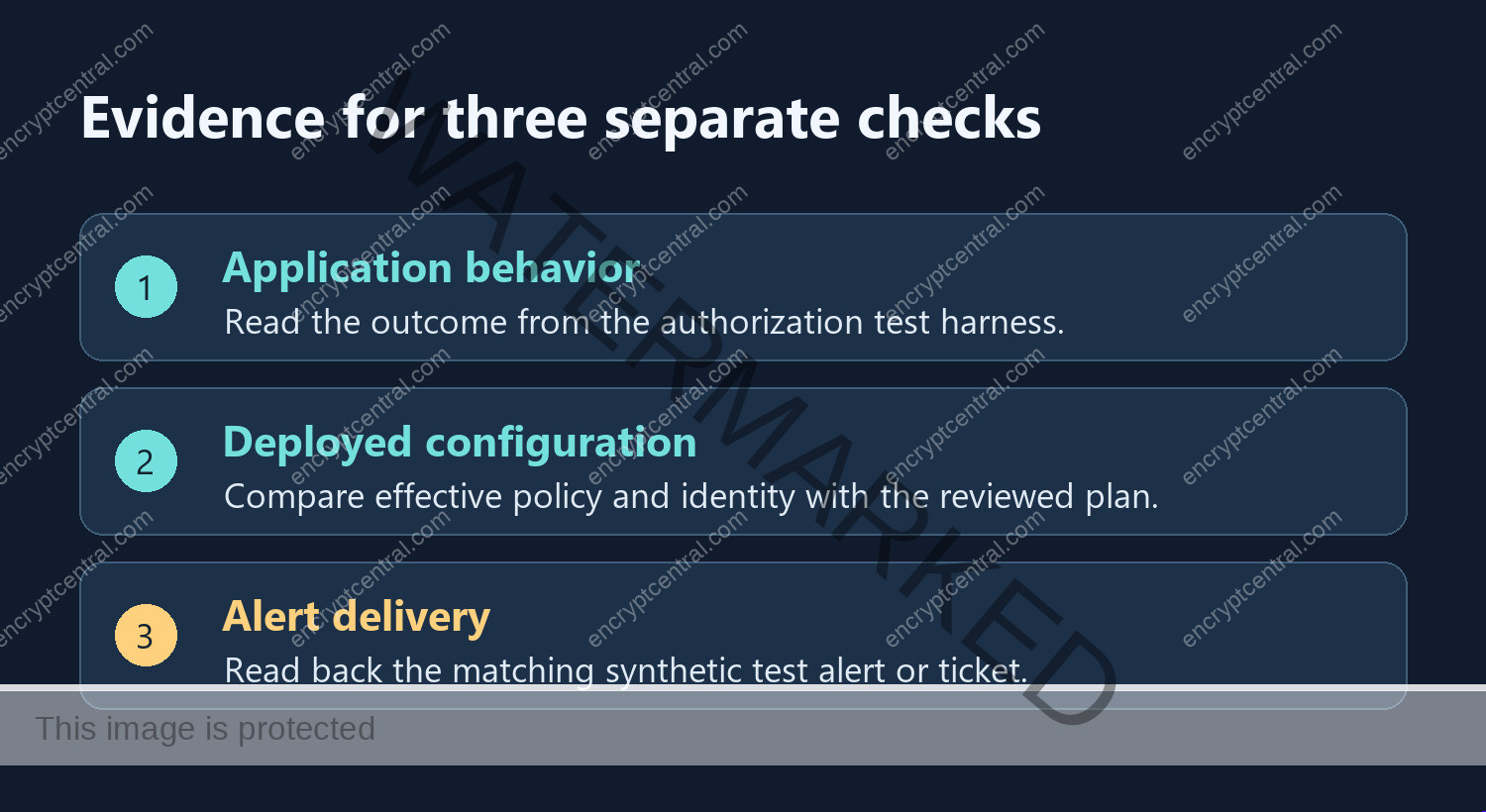
Start with the question each check can answer. Repository scanning investigates a code or configuration finding. A controlled regression check verifies the stated expectation against known inputs. A configuration read-back can show what policy was installed in a test environment. An alert receipt can show where an event landed. Each result needs its own evidence.
Imagine a finding that an internal worker may have broader access than its job calls for. A scanner can flag the deployment definition and help identify a responsible code path. The owner still has to define the intended policy. The relevant question could be whether the worker can read one approved resource and is denied a different operation. Decide what result would settle that question before preparing the test.
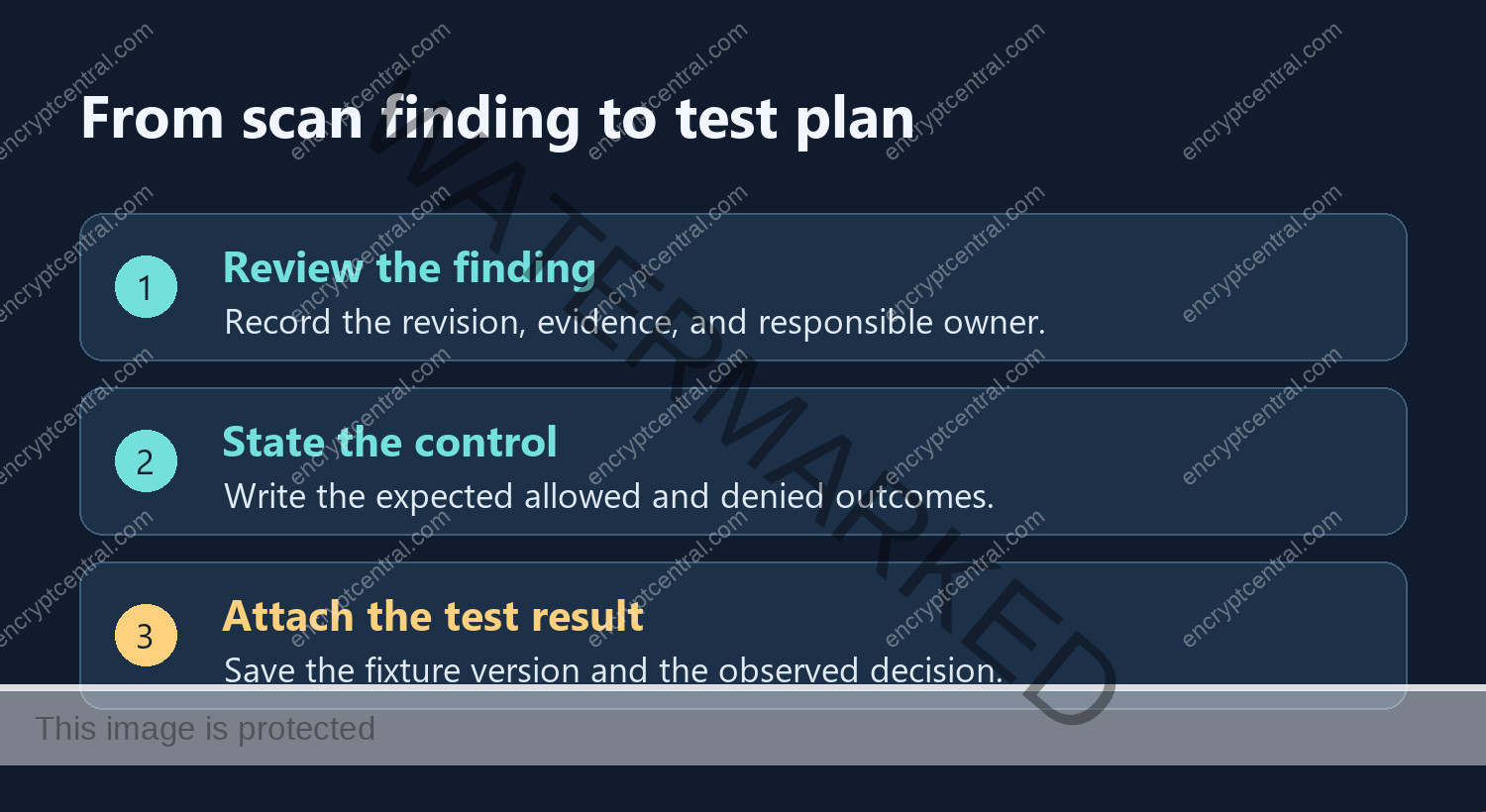
Write the expectation as a statement a second engineer could verify: “The invoice worker may read the approved object collection and has no write permission.” Include the repository revision, resource identifier, expected allowed action, and expected denied action. Keep the test inputs and evidence with the reviewed patch. This is one way to make defect remediation and future regression checks part of secure development, consistent with the NIST Secure Software Development Framework.
In this workflow the handoff is a reviewed finding and a test record. Choose the repository evidence that supports the finding, record the owner’s interpretation, and pass only the approved test inputs to the next stage. ARTEX provides threat context for prioritization. The exercises below evaluate control behavior, configuration and telemetry through fixed fixtures and read-only checks.
2. Three Use Cases for a Controlled Environment
Tenant isolation in a shared API
Suppose a repository scan flags a data-access path that may omit a tenant check. Ask the service owner to confirm the intended policy and review the proposed fix. In a unit or integration harness, seed two fictional tenants and exercise the authorization decision with test identities. Assert that the correct tenant can read its own record and the other tenant is denied.
Keep the fixture small: one record per tenant and one permitted caller for each. A successful same-tenant read catches an accidental blanket deny. A denied cross-tenant read checks the isolation rule. Exercise the behavior at the layer where access is enforced. A handler test with authorization mocked out can still pass even if an alternate handler calls the same data-access function without checking tenant context. The access control testing checklist covers related verification questions.
Keep a second check for observability. Give the test detector one fabricated denial event and one ordinary success event. Capture the matching case ID and test owner. The application check confirms the decision for the two invented identities. The detector check confirms how it handles those synthetic records. Record both outcomes so the team can tell whether a failed alert originated in the detector or in the application event contract.
Network policy and workload identity before deployment
Suppose a scan or review flags a broadly scoped egress policy or a workload permission grant that exceeds its documented purpose. Render the exact candidate deployment manifests or infrastructure plan and run policy assertions against them. Include a known-good fixture with a narrowly scoped dependency and a known-bad fixture with an intentionally broad rule. Compare the policy rule IDs and affected resources. A passing build with neither fixture evaluated is a failed check.
For a test deployment, read back the effective policy and identity bindings from the control plane. Look for differences between the declared objects and what the deployment applied. A test namespace might contain the right policy object while the workload labels select a different set of pods. An identity object can exist while the deployed workload still uses the wrong binding. Record the exact resource identity and version in the result.
Pass only when the narrow fixture is accepted, the broad fixture is flagged, and the effective test configuration matches the reviewed plan. The read-back records control-plane configuration. Any claim about end-to-end network behavior needs separate evidence. For a wider workflow to assign and verify drift repairs, see the security misconfiguration checklist.
Authentication alerts and analyst handoff
Suppose a finding shows that the authentication error path discards the reason for a denial. Review the logging change and verify it with a unit fixture whose outcome is already defined. Check the normalized reason code, the event ID, and the route label. Keep authentication headers, raw tokens, passwords, and customer identifiers out of this exercise. The OWASP Logging Cheat Sheet gives guidance on event fields and data to exclude.
Then put the invented records through the rule evaluator. Include an expected positive and a near miss, such as duplicate event IDs that should not increase the count. For routing verification, inject only tagged synthetic records into the test collector and read back the saved alert or ticket from the test destination. Record its ID, rule revision, delivery time, and queue. If the query returns the expected case but the ticket never appears, keep the rule result and investigate routing separately.
3. Set Up a Controlled Self-Testing Workflow
Document the test entry point and the components it actually exercises. A direct query checks rule logic. Sending fixed records through a test collector can also check parsing, normalization, scheduling, and routing. Use isolated test identities, fabricated data, and a test queue with automated containment and customer notifications disabled for that stream.
Keep deterministic CI checks in place. Secret scanning can flag configured credential patterns early. Static analysis can check known code patterns before merge. Review the rules, the files covered, and the job’s failure behavior. Verify branch protection actually requires each blocking check. Handle a confirmed exposed secret through revocation and rotation rather than treating a passing follow-up scan as closure.
Run the checks in a sequence that gives each owner a useful answer. The AppSec reviewer accepts or challenges the finding and its assumptions. The service owner writes positive and negative assertions for behavior. The infrastructure owner checks rendered and effective policy. The detection owner confirms the expected rule result and delivery. A small team can assign more than one role to the same person as long as the evidence for each decision is separate.
Pin the code revision, policy input, and rule version. Label every fixture with a run identifier and assign a separate case identifier to each expected result. Keep exact timestamps for the local rule test. For a scheduled test pipeline, translate the timestamps to the intended evaluation interval and preserve event order and relative spacing. Record a failed or missing stage explicitly so rerunning one check does not erase the first result.
Decide what to do when the checks disagree
Suppose the service tests pass and the approved manifest is correct, but the deployed worker still points at the wrong identity. Hold promotion and send the effective binding and manifest revision to the deployment owner. Repeating the code scan would answer the wrong question. After the binding is corrected, read it back again and record both versions beside the original finding.
Handle a missing alert with the same discipline. If the normalized test event never appeared, give the collector owner the run identifier and input timestamp. If the event appeared and the query matched, give the routing owner the matched event ID and the expected destination. If the expected positive stays quiet and the negative also produces no alert, treat the run as inconclusive until you find where the positive disappeared. Silence only means something when a working positive control proves the test path had a chance to produce an alert.
4. Check Synthetic Sigma and KQL Outcomes
An ordered Sigma exercise can use two fabricated records: a schema-view event and a denial event. Set one pair in the intended order and another with the order reversed. Add a pair that crosses a fixed bucket boundary while remaining within the elapsed time limit. The Sigma correlation specification distinguishes ordered correlation from co-occurrence. Read the converted rule and verify that the backend retains your grouping, order, and time semantics.
A KQL exercise can use a typed inline table of invented verdicts and route labels. If three unique verification failures across two routes should match, include a duplicate row and a case that reaches three rows on only one route. Compare case IDs and exact counts. Also document whether the rule uses fixed buckets or elapsed time. A fixed bucket can separate two rows only a few seconds apart when they straddle its boundary.
Use the companion synthetic AppSec alert guide for the full Sigma rule, record set, and token-free KQL query. Keep that fixture version with your test record so a later rule change can be checked against the same cases.
These examples check the detection logic and, when routed through a dedicated test stream, the alert handoff. They do not establish that a real authentication service emits equivalent events. Check that separately in the application harness. If an expected field disappears in the test collector, inspect the normalization step before changing the alert thresholds. For a broader diagnostic sequence, see security logging and alerting failures.
5. Close the Loop on Infrastructure Hardening
The FBI reported that some ARTEX-associated intrusions progressed from initial targeting to privileged access in under three hours. Treat that as an observation from particular cases. It gives security teams a reason to examine how quickly their own controls surface an issue and route it to someone who can respond.
Prioritize controls where a failing assumption would affect more than one system. Check which debug artifacts and API documentation your release exposes, assert the expected issuer and audience in authentication policy, review standing access for deployment identities, and confirm that test alert routing reaches the named queue. Assign an owner and a measurable expected result to each check.
Pick one reviewed finding for the first run. Attach the approved change, exact fixture version, expected and observed outcome, and the effective configuration or received alert when applicable. Close the finding when the evidence covers the behavior the owner agreed to verify. If a stage remains untested, record the gap and its owner before accepting the fix.
Related posts:
 How to Protect Accounts Beyond a Strong Password
 Enterprise AI Governance: Building Comprehensive Risk Management Frameworks
 Beagle Security: OWASP Security Testing review
 OWASP API Security Top 10 Testing Guide
 Broken Access Control Testing Checklist
 GuidePoint Security Penetration Testing Services Review