


A security exception should be a time-bounded, accountable decision—not an undocumented permission to leave a control gap open. A useful security exceptions register records exactly what is being excepted, who owns the affected service, which response was chosen, what compensating measures were verified, when the decision expires, and what evidence will close or renew it.
The register is the portfolio view. A linked detail record holds the deeper risk scenario, response rationale, test evidence, milestones, review history, and closure proof. Together they turn “we cannot meet this control today” into a governed decision that can be monitored and ended.
This guide covers cross-control exception governance from request through closure. It does not set a universal risk score, approval threshold, or expiry interval; those are organization-specific policy choices. It does not provide legal or compliance advice, and no real exception, production control, approval, audit, or closure was tested for this article.
Decide whether the request belongs in the exception process
Not every unresolved security task is an exception. A routine remediation ticket belongs in the normal backlog. A security exception is a deliberate request to depart temporarily from a policy, standard, baseline, or required control while the organization manages the resulting exposure.
Before opening a register entry, ask four questions:
- What exact requirement cannot be met? Name the policy, standard, baseline, or control statement. “Security is difficult” is not a reviewable scope.
- Which assets, identities, data, locations, and environments are affected? Avoid “all systems” unless the evidence actually supports that scope.
- Why is the deviation necessary now? Record the technical or business constraint, the remediation dependency, and the consequence of refusing the request.
- Is there a credible end state? Identify the fix, replacement, retirement, migration, policy correction, or other milestone that could end the exception.
Reject or redirect the request when the stated requirement is legally non-waivable, the requester cannot identify the affected scope, the proposed activity exceeds the organization’s authority, or the only plan is “accept forever.” A repeated exception against an unrealistic standard may indicate that the standard itself needs review; silently renewing individual waivers hides that larger governance problem.
Keep configuration-specific remediation in its own workflow. EncryptCentral’s security misconfiguration checklist explains how to identify and correct baseline drift. The exceptions register governs the decision to permit a bounded departure across many control types.
Record the risk decision, not just the requested waiver
The request describes what someone wants. The decision record explains what the organization is choosing to do about the risk. NIST’s IR 8286B-upd1 describes four broad negative-risk response options: accept within risk tolerance, mitigate, transfer or share, and avoid. A security exception often combines mitigation through compensating measures with explicit acceptance of the remaining residual risk.
Do not use the response labels as shortcuts. “Transfer” does not mean the exposure vanished because a vendor contract or insurance policy exists. “Mitigate” does not mean a proposed safeguard works. “Accept” must identify the authorized decision-maker and rationale. “Avoid” requires stopping or changing the activity that creates the exposure.
The decision should state:
- the risk scenario in plain language, including the asset, threat or failure, and likely operational consequence;
- the selected response and why it fits the organization’s risk tolerance;
- the compensating controls or other treatment actions;
- the remaining residual risk after those measures;
- the accountable risk approver and the limits of that person’s authority;
- the remediation owner and target milestone; and
- the expiration date and earlier events that force a recheck.
For vulnerability-specific deferrals, use the CVSS, EPSS, and CISA KEV prioritization guide as one input. A vulnerability score can inform an exception request, but it cannot replace business context, compensating evidence, or accountable approval.
Use a concise register row and a linked detail record
A single spreadsheet row cannot carry every risk scenario, test result, architecture note, and approval. It should not try. The NIST IR 8286 Rev. 1 family uses risk registers together with supporting risk detail records. A practical small-organization adaptation is a two-tier record.
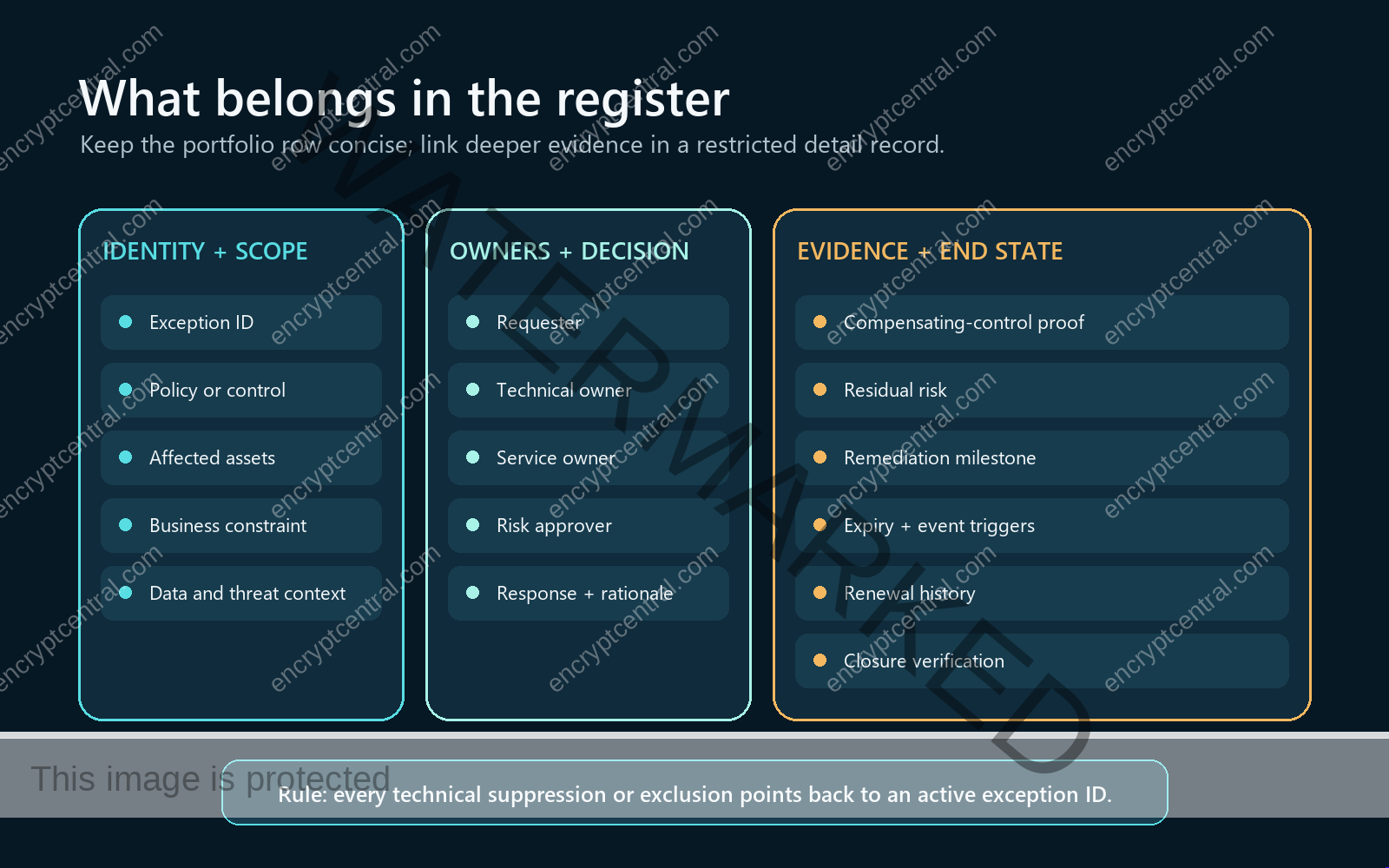
The register row supports portfolio review. It should include the exception ID, status, affected control and scope, service owner, risk approver, selected response, residual-risk summary, expiry, next review, and remediation milestone. It should also link to the detail record and any active technical exclusion.
The restricted detail record supports the decision. It can hold architecture context, sensitive asset identifiers, threat and impact analysis, proposed control design, test evidence, approval notes, monitoring results, renewal history, and closure proof. Restrict it according to the sensitivity of the information rather than copying it into broad ticket comments or dashboards.
Use one stable exception ID everywhere. If a vulnerability scanner suppression, conditional-access exclusion, temporary firewall rule, endpoint-policy bypass, or monitoring exemption implements the approved deviation, make that object reference the active exception ID where the tool allows. The register should point back to the technical object. This two-way traceability makes it easier to find shadow exclusions when an exception closes.
Separate the roles that request, fix, own, and accept
A requester can explain the constraint, but should not automatically accept the organization’s residual risk. Use four roles even when a small team has to combine some of them:
- Requester: describes the requirement, affected scope, business need, and requested duration.
- Technical remediation owner: owns the control change, migration, replacement, or retirement milestone.
- Service or business owner: owns the affected capability and explains operational consequences and dependencies.
- Risk approver: has delegated authority to accept the stated residual risk within defined limits.
If one person fills two roles, record both hats explicitly. The important question is not whether the org chart is large enough for perfect separation. It is whether the record shows who supplied the facts, who must deliver the fix, who owns the service, and who had authority to make the risk decision.
Define escalation in policy. A request may need more scrutiny because its duration, repeated renewals, data sensitivity, exposure, or affected business function crosses a threshold. It may need elevation when the decision exceeds the current approver’s authority and must move to a senior leader. Do not invent approval tiers inside an individual ticket; route the decision through the organization’s approved delegation model.
Prove compensating controls before activation
A compensating control is not a sentence in the request. It is a safeguard intended to reduce exposure caused by the missing or weakened control. Before an exception becomes active, define what the measure is supposed to prevent or detect, who operates it, where it applies, how failure would appear, and what evidence demonstrates that it works.
For example, if a legacy application cannot support the required identity control, the proposal might restrict network reachability, limit accounts, increase monitoring, and shorten session or credential lifetimes. The evidence might include an approved rule export, an external reachability check, an account list, a monitored alert test, and a named operator. The exact controls depend on the scenario; copying a generic list without testing it creates paper protection.
Use a pre-activation proof gate:
- Map each compensating measure to the weakness it is meant to reduce.
- Record the intended coverage and known gaps.
- Test the measure using an approved, minimally disruptive method.
- Save the result, time, tester, scope, and relevant configuration or query reference.
- Define the health signal and retest cadence.
- State the residual risk that remains after the measure works as designed.
A failed test does not necessarily end the business activity, but it changes the decision. The approver may require another measure, reduce scope, shorten the term, elevate the request, or refuse it. Do not preserve the original approval after its evidence basis has changed.
Pair calendar expiry with event-driven rechecks
An end date prevents indefinite authorization, but waiting for the date can be unsafe. Pair every expiry with events that reopen the decision sooner. Useful triggers include a compensating-control failure, a new exploited vulnerability, a material change in affected assets or data, a vendor or architecture change, an incident, a missed remediation milestone, or evidence that the exception is being used outside its approved scope.
The NIST CSF 2.0 Reference Tool illustrates how to select and track risk responses (ID.RA-06) and formally review, document, and track requested exceptions (ID.RA-07). Its examples also call for reassessing risks the organization accepted because it expected a future action or milestone. NIST’s SP 1303 quick-start guide describes a monitor-evaluate-adjust feedback loop: observe outcomes, evaluate them against risk expectations, and adjust detailed records, responses, tolerance, policy, or strategy as needed.
Translate that into operational monitoring. The register should show the next scheduled review, last evidence check, current milestone status, and active trigger conditions. A weekly or monthly review can be useful, but no universal cadence fits every organization. Use the sensitivity, exposure, control reliability, change rate, and policy-defined maximum term to set the frequency.
Run a fresh close, renew, or elevate review
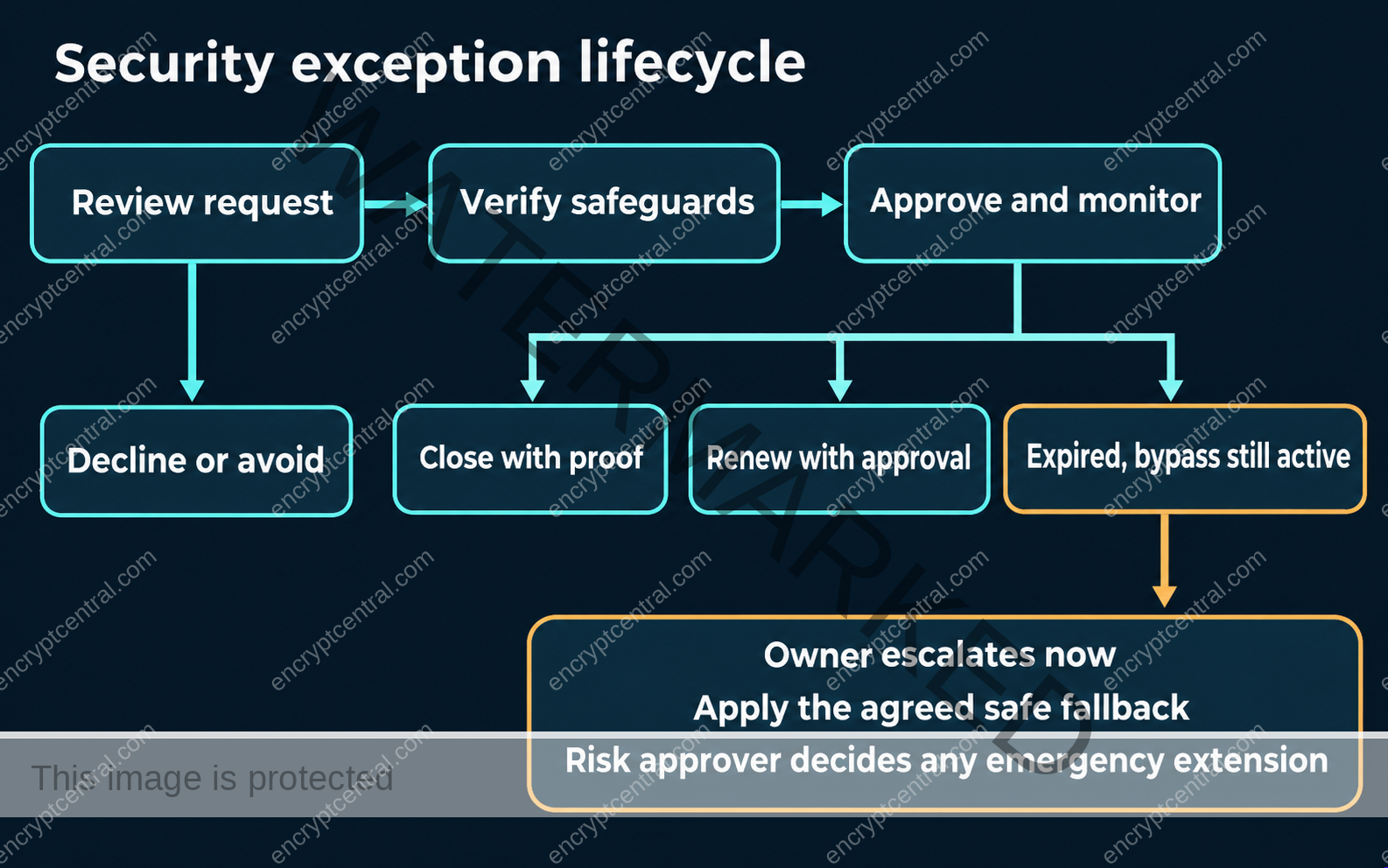
Review the exception before approval expires. Close it with proof, renew it with fresh approval, or elevate it while the current approval is still valid. If the deadline arrives with the bypass still active, use the expiry procedure below.
Close with verified restoration
Confirm that the original condition changed: the required control is operating, the affected asset was retired, the service migrated, or the approved requirement itself changed. Save test or deployment evidence, remove linked exclusions and suppressions, update the register and detail record, and record who verified closure. A ticket marked “done” is not enough if the technical bypass remains active.
Renew through a new risk decision
A renewal is not an extension of old confidence. Reconfirm the affected scope, current threat and impact, service dependency, compensating-control health, remediation progress, residual risk, approver authority, and next end date. Preserve the previous decision and add a new review event so repeated renewals remain visible.
Reduce scope where possible. If only one environment still needs the exception, do not renew the original enterprise-wide scope. If the same control repeatedly produces exceptions, open a separate policy, architecture, funding, or standard-review action instead of hiding the pattern inside individual records.
Elevate or change treatment
Elevate when exposure exceeds the current approver’s authority, compensating evidence fails, milestones repeatedly slip, or the business choice has become strategic. Leadership may accept the risk under a different delegation, fund mitigation, transfer a financial component, stop the activity, or change the service. Record the result; “sent to leadership” is a routing state, not a final disposition.
Act when approval expires and the bypass is still active
Before activation, name the technical owner responsible for acting at expiry, identify the authorized risk approver or delegate, and agree on a safe fallback with the service owner. Record the fallback and who can execute it in the exception record.
If approval expires while the bypass is still active, the technical owner marks the exception expired and unresolved, records what is still active, and immediately notifies the service owner and authorized risk approver. The technical owner carries out the agreed fallback through the organization’s change process. That may mean restoring the required control and verifying service health, or using a pre-approved containment measure while a safe restoration is arranged.
If immediate restoration would disrupt a critical service and continued operation still requires the bypass, only a risk approver with delegated emergency authority can authorize a short extension. Record the approver, residual risk, scope, safeguards, new expiry, and next review time. Keep the exception expired and unresolved until the bypass is verified as removed or an authorized decision is recorded.
Review the portfolio, not only individual records
Individual approvals can look reasonable while the aggregate exposure becomes unacceptable. Review the register for concentrations: many exceptions against one identity requirement, one vendor, one legacy platform, one business unit, or one approver. Track repeated renewals, overdue milestones, missing tests, and technical exclusions without active IDs.
Use the findings to improve the system. Repeated exceptions may justify a funded migration, a baseline change, a vendor requirement, a reusable compensating pattern, clearer approval delegation, or a revised risk-tolerance statement. EncryptCentral’s NIST CSF 2.0 small-business roadmap provides the broader governance context; the register supplies evidence about where that program is struggling.
When insurers or other reviewers request exception evidence, share only what the organization is authorized to disclose. The cyber-insurance readiness checklist covers the broader evidence package. The exception register’s primary job remains internal risk governance, not producing a favorable underwriting answer.
Common exception-register failures
- Vague scope: “legacy systems” cannot be monitored or closed. Name the exact affected population.
- Requester self-approval: business need and risk authority are treated as the same role without documenting delegation.
- Paper controls: proposed safeguards have no test result, operator, failure signal, or retest plan.
- Universal expiry periods: a copied duration table replaces organization-specific tolerance and policy.
- Silent rollover: an unanswered renewal becomes continued authorization.
- Orphaned exclusions: scanner suppressions, firewall rules, or access bypasses survive after closure.
- Missing portfolio review: individually approved records accumulate around the same systemic weakness.
A practical security exception checklist
- Name the exact policy, standard, baseline, or control being excepted.
- Bound the affected assets, identities, data, environments, and business capability.
- Record the constraint, rejected alternatives, and credible remediation or retirement milestone.
- Select the risk response and state the residual risk in plain language.
- Assign requester, technical owner, service owner, and authorized risk approver roles.
- Define compensating controls and verify them before activation.
- Bind technical exclusions and suppressions to the stable exception ID.
- Set an organization-approved expiry and event-driven recheck triggers.
- Monitor control health and milestone progress during the active term.
- Before expiry, close with proof, renew through fresh evidence and approval, or elevate the decision.
- If the bypass is still active at expiry, record it as expired and unresolved, notify the service owner and risk approver, and follow the agreed fallback.
- Remove linked technical exclusions when the exception closes.
- Review the portfolio for concentration, repetition, and overdue systemic fixes.
A disciplined security exceptions register does not make risk disappear. It makes the decision visible, bounded, testable, and reversible. When every exception has an accountable owner, verified safeguards, a real end date, and a fresh close-or-renew review, temporary deviations are less likely to become permanent blind spots.
Related posts:
 How Do I Conduct A Risk Assessment For Cybersecurity?
 Third-Party Cyber Risk Checklist for Small Businesses
 What Are Cookies, And Are They A Security Risk?
 What Are The 7 Steps To Minimize Technological Risk?
 Brandefense Digital Risk Protection Platform Review
 Enterprise AI Governance: Building Comprehensive Risk Management Frameworks