


Threat indicator expiration should trigger a decision, not an automatic delete and not an automatic renewal. The source indicator may be past its stated validity window while a firewall, DNS, proxy, email, or endpoint block derived from it remains active. That gap is where stale rules accumulate, legitimate infrastructure changes owners, and a temporary containment measure becomes an undocumented permanent control.
A safe review links each upstream indicator to every downstream enforcement object, checks current evidence and business impact, chooses a controlled disposition, and preserves a tested rollback path. The outcome may be to retire the block, downgrade it to alerting, renew it for a bounded period, or remove it urgently because it is causing harm. Expiration alone does not decide which outcome is correct.
This guide is an operational framework for reviewing aging indicators and derived rules. It does not prescribe a universal IOC lifetime, claim that every platform propagates removals, or provide vendor-specific commands. No live threat-intelligence platform, firewall, DNS service, proxy, SIEM, or EDR environment was operated or tested for this article.
Separate indicator state from enforcement state
The first mistake is treating one field as the whole truth. An indicator can have several related but distinct states:
- Validity window: when the producer considers the indicator pattern valid for detection.
- Confidence: how strongly the producer supports the assessment, using that producer’s scale and method.
- Revocation: a creator-controlled retraction of an object, usually because it should no longer be used as published.
- Decay: a platform-specific estimate of declining relevance based on time, sightings, mappings, or other inputs.
- Sightings: records that an observable or indicator was seen, reported as a false positive, or marked for expiration in a particular system.
- Enforcement state: whether a downstream control is blocking, alerting, logging, disabled, or absent.
The OASIS STIX 2.1 specification treats an Indicator’s optional valid_until, the common revoked property, and confidence as separate concepts. If valid_until is omitted, the standard does not supply a latest validity time. A Sighting links an object such as an Indicator to observed data; it is not a universal instruction to extend every block rule.
Consumer behavior also matters. A feed or TIP may stop exporting an expired record, mark it revoked, or keep it for history. A connector may update existing objects, append new ones, or only push additions. A static list imported last quarter may never receive the source-side change. Review both sides of the integration before assuming that upstream expiration changed enforcement.
Do not mistake decay for deletion
The MISP Decaying Models documentation describes model-specific scores and decayed states calculated from configured formulas, parameters, mappings, and evidence. Different applicable models can produce different results. Most importantly for operations, a decay result does not automatically delete the attribute, clear its IDS flag, or guarantee that a downstream detector filters it out.
MISP’s Sightings documentation distinguishes observation, false-positive, and expiration records. What a team can see may depend on sharing policy, anonymization, filters, range, and synchronization. A lack of visible sightings therefore is not proof that nobody saw the indicator, while a recent sighting is not automatically proof that the original malicious use continues. It may reflect repeated feed ingestion, sinkholed infrastructure, scanning noise, or a different context.
Treat decay and sightings as inputs to reassessment. They can help prioritize work, but the decision to keep or remove prevention should also use local telemetry, asset scope, current infrastructure ownership, source provenance, and the consequences of both blocking and unblocking.
Build an indicator-to-rule ledger
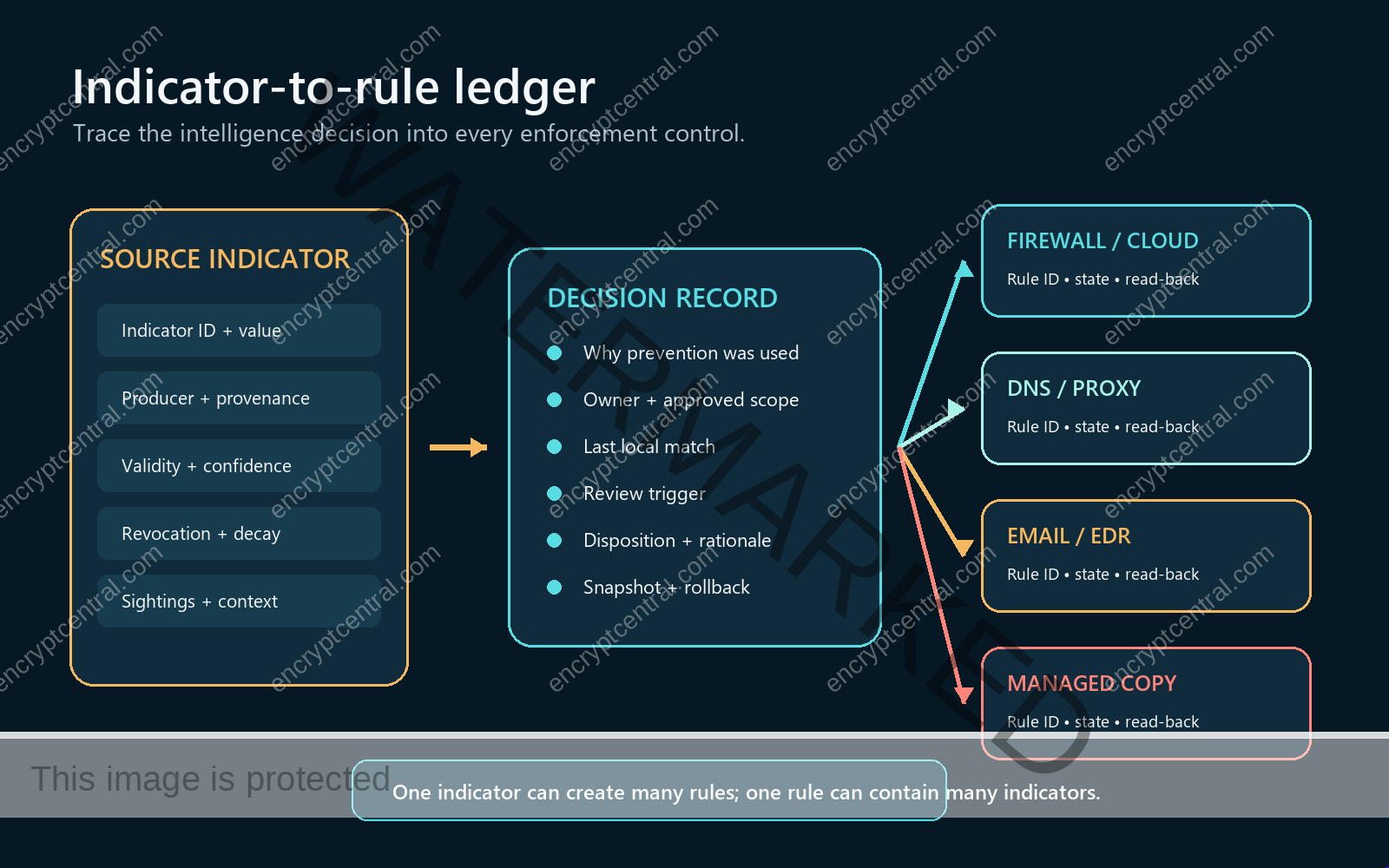
You cannot retire safely if you cannot trace what was deployed. Create a small ledger that binds the intelligence record to each enforcement object. A useful row includes:
- the source indicator ID, observable value and type;
- the original producer, feed, report, and first-seen or publication time;
- source validity, confidence, revocation, decay, and relevant sighting state;
- the internal decision that authorized prevention;
- every target control and rule, list, policy, or exception identifier;
- the deployment time, owner, scope, and intended outcome;
- the last local match, affected asset, and investigation result;
- the next review trigger and current disposition; and
- the pre-change snapshot and rollback reference.
One observable may have several downstream objects. An IP address might appear in a perimeter firewall rule, a cloud security group, a DNS response policy, a secure web gateway list, and an EDR indicator set. Conversely, one enforcement rule may contain indicators from several sources. Keep the many-to-many relationship explicit rather than storing only a comment such as “threat feed.”
If the team is still choosing a platform, EncryptCentral’s OpenCTI vs MISP comparison covers deployment and workflow considerations. The ledger here begins after ingestion: it records what the organization actually enforced and how that control can be reviewed.
Choose review triggers without inventing a universal TTL
There is no single safe lifetime for every IP address, domain, URL, file hash, certificate fingerprint, email address, or behavior pattern. Use triggers tied to volatility, ownership, exposure, false-positive cost, intelligence quality, and the rule’s operational purpose.
Review sooner when an address belongs to a cloud provider, CDN, shared hosting service, VPN exit, mobile carrier, or other fast-changing pool. Reassess domains when registration or DNS ownership changes. Treat URLs as combinations of host, path, content, and time rather than assuming the host remains malicious forever. File hashes can retain historical value because the bytes do not change, but an active block may still become redundant, exceed platform capacity, or distract from stronger behavioral controls.
Also trigger review when the producer retracts the indicator, a partner reports a false positive, a business service is disrupted, the affected asset is retired, the campaign ends, the connector changes, the rule stops matching, or the same observable is repeatedly reintroduced by secondary feeds. The last ingestion time is not necessarily the last trustworthy observation time.
Evaluate evidence before selecting a disposition
Start with provenance. Identify the earliest reliable source, not only the latest aggregator. Compare the producer’s current state with the state captured when the rule was deployed. If several feeds report the same observable, determine whether they are independent observations or copies of the same old report.
Then check local context:
- Matches: Did the rule match recently, and were those matches malicious, benign, inconclusive, or uninvestigated?
- Prevalence: Does the observable now belong to shared or legitimate infrastructure used by the organization, customers, or partners?
- Scope: Is the protected asset, application, geography, or campaign still relevant?
- Control value: Does the exact-match block still add value beyond behavioral detections, segmentation, authentication, or application controls?
- Failure impact: What happens if the team keeps a bad block, and what happens if it removes a useful one?
A recent sighting deserves interpretation. A connection to a sinkhole can indicate infected clients without showing that the destination is still attacker-controlled. A scanner can touch an address without proving compromise. A feed can recycle a stale record. Record why the evidence supports the chosen action instead of treating “seen recently” as a renewal button.
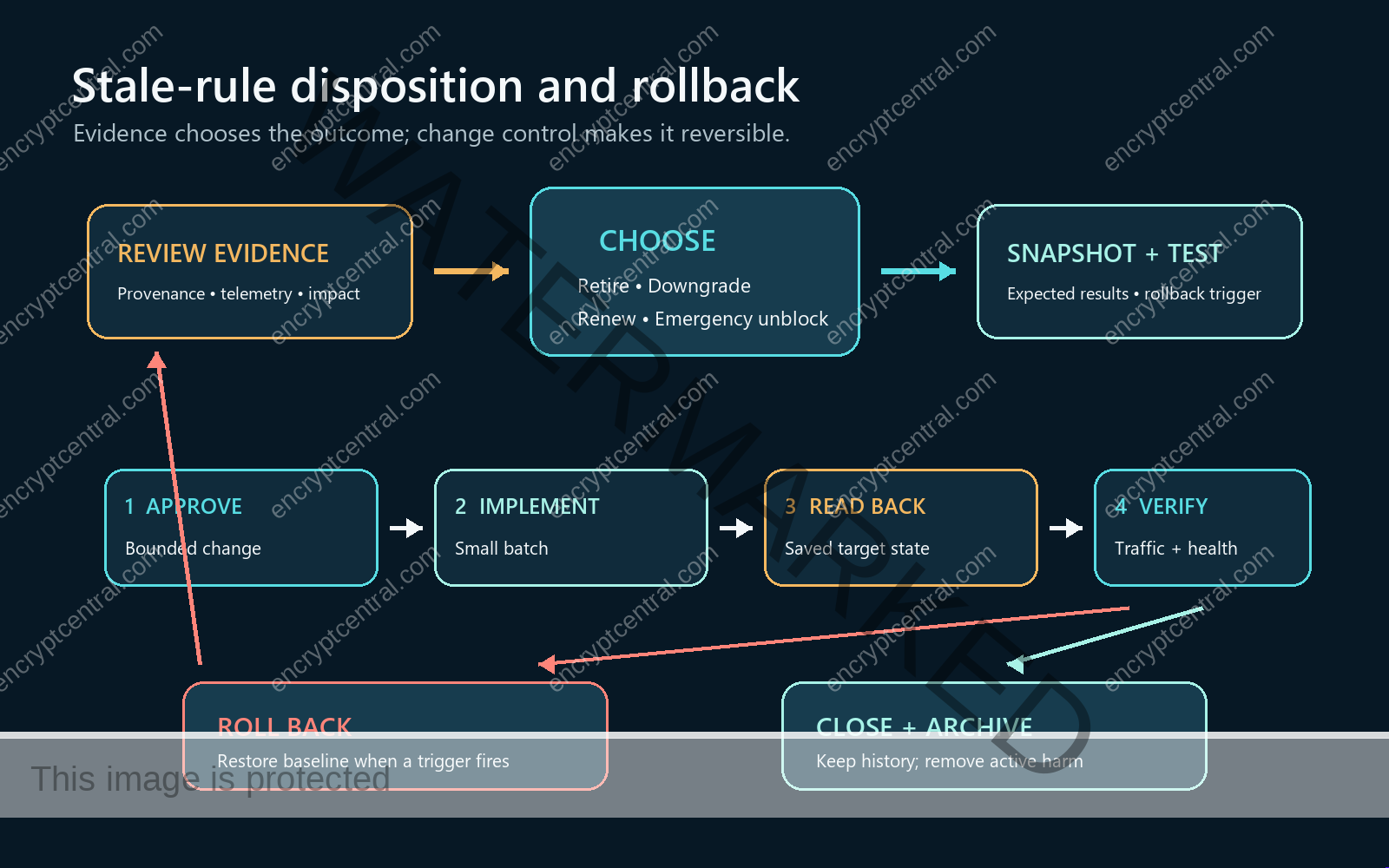
Use four controlled outcomes
Retire active prevention
Remove or disable the blocking action when current evidence no longer justifies prevention, the observable has been reassigned, the protected scope disappeared, or the false-positive cost exceeds the remaining value. Preserve the historical indicator, provenance, decision, and match history for retrospective hunting and audit needs.
Downgrade to alert or log
Use observation mode when uncertainty remains but immediate prevention is no longer proportionate. Define what telemetry will be collected, who will review it, how long the observation window lasts, and what result would restore the block or complete retirement. A silent disabled rule without an owner is not a controlled downgrade.
Renew with a new boundary
Renew when fresh, relevant evidence supports continued prevention. Record the evidence, owner, approved scope, and next review trigger. Do not extend the date merely because another feed re-published the same value or because the review queue was busy.
Emergency unblock
Use an expedited path when a rule is causing a confirmed outage, partner disruption, or material false positive. Preserve the decision trail and perform the same post-change verification after service is restored. Emergency handling shortens the path; it does not erase accountability.
Run the change through a reversible sequence
NIST SP 800-128 Update 1 describes configuration change control through proposal, recording, security-impact analysis, testing, approval, implementation, verification, and documentation, with previous approved baselines retained for rollback or restoration. NIST SP 800-41 Rev. 1 similarly supports change management, rule comments, testing, backups, and periodic review for firewall policies and rulesets.
Translate those principles into a small retirement batch:
- Export or snapshot the current configuration in a form the target control can restore.
- Record the exact rule IDs, list entries, dependent objects, owners, and intended changes.
- Define expected allowed traffic, expected blocked test traffic, logging results, health checks, and rollback triggers.
- Test the change in a non-production or limited scope when the platform and risk permit.
- Obtain the approval required by the organization’s change policy.
- Change a bounded set rather than deleting an entire feed-derived list at once.
- Verify both sides: intended traffic now succeeds and unrelated malicious or policy-denied traffic remains controlled.
- Monitor for delayed effects, restore the snapshot if a trigger fires, and close the change only after verification.
Do not rely on a screenshot as the only backup. Preserve a machine-restorable configuration where the product supports it, plus human-readable rule context. Confirm that the restoration method is usable before the change window.
Watch for propagation failures
A source-side update can leave several kinds of drift. The TIP may mark an indicator expired while the export job only sends additions. A firewall object may be shared by another policy. A SIEM rule may alert on an indicator even after the firewall block is removed. A managed service provider may hold a separate copy. A cached DNS or proxy list may update on a different schedule.
For each destination, verify the actual saved state after the change. Do not infer removal from a successful API response or a dashboard badge. If the team downgrades a block to monitoring, confirm that the event path reaches the intended queue. EncryptCentral’s security logging and alerting failures guide covers the broader event-to-responder pipeline.
Preserve history without preserving harm
Retiring enforcement should not erase the intelligence record. Keep the original indicator, source, assessment, deployment history, local matches, review evidence, disposition, approver, change record, and verification result according to the organization’s retention and access policies. This supports incident reconstruction, retrospective hunting, lessons learned, and proof that a harmful rule was removed deliberately.
Separate distribution restrictions from lifecycle decisions. TLP or contractual handling can limit who may receive intelligence, but it does not by itself determine whether a local block remains justified. EncryptCentral’s TLP 2.0 sharing checklist addresses those communication boundaries.
Common stale-rule review failures
- Expiration equals deletion: the team assumes a source field removed every downstream rule.
- Expiration equals innocence: the team removes prevention without checking current evidence or local scope.
- Latest ingestion equals latest activity: copied or recycled feed data resets the clock.
- Sighting equals maliciousness: observation, sinkhole traffic, scanning, and confirmed hostile use are collapsed into one signal.
- One-size TTL: volatile cloud IPs and stable file hashes receive the same lifecycle policy.
- No rule lineage: nobody can find every control that received the indicator.
- Delete without rollback: configuration is changed before a restorable baseline and test plan exist.
- Archive by erasure: enforcement ends and the evidence trail disappears with it.
A practical review checklist
- Identify the source indicator, observable type, provenance, and original purpose.
- Map every downstream rule, list, policy, and managed-service copy.
- Separate validity, confidence, revocation, decay, sightings, and enforcement state.
- Check current producer state, local matches, prevalence, ownership, and protected scope.
- Exclude recycled feed timestamps and unqualified sightings from automatic renewal.
- Choose retire, downgrade, renew, or emergency-unblock with a written rationale.
- Capture a restorable baseline and define expected results and rollback triggers.
- Approve and implement a bounded change.
- Read back each target control and verify traffic, logging, and service health.
- Preserve the historical record and set the next review trigger where needed.
Threat indicator expiration is a governance checkpoint between intelligence and enforcement. Teams that can trace the rule, interpret the evidence, make a bounded decision, and restore the prior state when needed can remove stale blocks without turning every cleanup into a gamble.
Related posts:
 What Are 10 Safety Rules For The Internet?
 Battle of Threat Intelligence Platforms: Cisco, ManageEngine, CrowdStrike, IBM, Security X-Force
 TLP 2.0 Threat Intelligence Sharing Checklist
 CrowdStrike Falcon® Intelligence: Automated Threat Intelligence Review
 Cisco Talos Intelligence Group – Comprehensive Threat Intelligence Review
 ZeroFox Threat Intelligence Services Review